
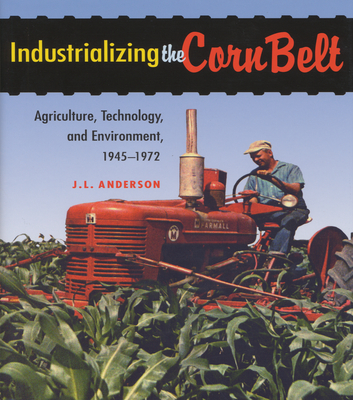
Industrializing the Corn Belt: Agriculture, Technology, and Environment, 1945-1972
| AUTHOR | Anderson, J. L. |
| PUBLISHER | Northern Illinois University Press (02/15/2016) |
| PRODUCT TYPE | Paperback (Paperback) |
From the late 1940s to the early 1970s, farmers in the Corn Belt transformed their region into a new, industrial powerhouse of large-scale production, mechanization, specialization, and efficiency. Many farm experts and implement manufacturers had urged farmers in this direction for decades, but it was the persistent labor shortage and cost-price squeeze following WWII that prompted farmers to pave the way to industrializing agriculture. Anderson examines the changes in Iowa, a representative state of the Corn Belt, in order to explore why farmers adopted particular technologies and how, over time, they integrated new tools and techniques.
In addition to the impressive field machinery, grain storage facilities, and automated feeding systems were the less visible, but no less potent, chemical technologies--antibiotics and growth hormones administered to livestock, as well as insecticide, herbicide, and fertilizer applied to crops. Much of this new technology created unintended consequences: pesticides encouraged the proliferation of resistant strains of plants and insects while also polluting the environment and threatening wildlife, and the use of feed additives triggered concern about the health effects to consumers.
In Industrializing the Corn Belt, J. L. Anderson explains that the cost of equipment and chemicals made unprecedented demands on farm capital, and in order to maximize production, farmers planted more acres with fewer but more profitable crops or specialized in raising large herds of a single livestock species. The industrialization of agriculture gave rural Americans a lifestyle resembling that of their urban and suburban counterparts. Yet the rural population continued to dwindle as farms required less human labor, and many small farmers, unable or unwilling to compete, chose to sell out.
Based on farm records, cooperative extension reports, USDA publications, oral interviews, trade literature, and agricultural periodicals, Industrializing the Corn Belt offers a fresh look at an important period of revolutionary change in agriculture through the eyes of those who grew the crops, raised the livestock, implemented new technology, and ultimately made the decisions that transformed the nature of the family farm and the Midwestern landscape.
From the late 1940s to the early 1970s, farmers in the Corn Belt transformed their region into a new, industrial powerhouse of large-scale production, mechanization, specialization, and efficiency. Many farm experts and implement manufacturers had urged farmers in this direction for decades, but it was the persistent labor shortage and cost-price squeeze following WWII that prompted farmers to pave the way to industrializing agriculture. Anderson examines the changes in Iowa, a representative state of the Corn Belt, in order to explore why farmers adopted particular technologies and how, over time, they integrated new tools and techniques.
In addition to the impressive field machinery, grain storage facilities, and automated feeding systems were the less visible, but no less potent, chemical technologies--antibiotics and growth hormones administered to livestock, as well as insecticide, herbicide, and fertilizer applied to crops. Much of this new technology created unintended consequences: pesticides encouraged the proliferation of resistant strains of plants and insects while also polluting the environment and threatening wildlife, and the use of feed additives triggered concern about the health effects to consumers.
In Industrializing the Corn Belt, J. L. Anderson explains that the cost of equipment and chemicals made unprecedented demands on farm capital, and in order to maximize production, farmers planted more acres with fewer but more profitable crops or specialized in raising large herds of a single livestock species. The industrialization of agriculture gave rural Americans a lifestyle resembling that of their urban and suburban counterparts. Yet the rural population continued to dwindle as farms required less human labor, and many small farmers, unable or unwilling to compete, chose to sell out.
Based on farm records, cooperative extension reports, USDA publications, oral interviews, trade literature, and agricultural periodicals, Industrializing the Corn Belt offers a fresh look at an important period of revolutionary change in agriculture through the eyes of those who grew the crops, raised the livestock, implemented new technology, and ultimately made the decisions that transformed the nature of the family farm and the Midwestern landscape.