
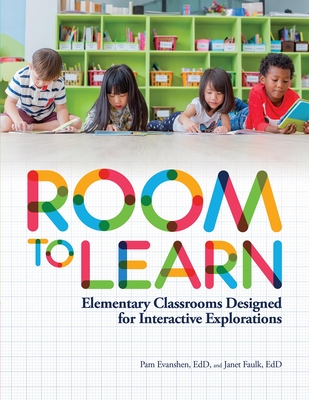
Room to Learn: Elementary Classrooms Designed for Interactive Explorations
| AUTHOR | Evenshen, Pamela; Evanshen, Pam; Faulk, Janet |
| PUBLISHER | Gryphon House (10/01/2019) |
| PRODUCT TYPE | Paperback (Paperback) |
Description
Environments are a complex interaction of physical elements, including sensory components, design and organization, aesthetics, nurturing attributes, and pedagogical resources. Research shows these elements can work together to improve early learning, self-efficacy and higher-order thinking skills. Pamela Evanshen, EdD and Janet Faulk, EdD, have developed an environmental rating scale--Assessing the Pillars of the Physical Environment for Academic Learning (APPEAL)--to help educational professionals evaluate and improve the design and use of elementary learning environments. Transform learning spaces from teacher-centered classrooms where creativity and collaboration are stifled to student-centered, developmentally appropriate learning communities where children thrive. The APPEAL rating scale is a valid and reliable assessment that quantifies six environmental domains:
- Meaningful Learning: occurs in a healthy, welcoming, and inviting classroom
- Social Learning: encourages positive learning interactions through room arrangement and seating choices
- Purposeful Learning: facilitates discover and active engagement through learning centers and stations, personal spaces for children, and teacher space
- Responsible Learning: encourages children to take ownership of their learning, be accountable for their effort, and work together to accomplish learning goals
- Continuous Learning: showcases children's understandings of core content knowledge
- Inquiry-Based Learning: project-based learning and collaborative problem solving supported by rich resources
Show More
Product Format
Product Details
ISBN-13:
9780876598115
ISBN-10:
0876598114
Binding:
Paperback or Softback (Trade Paperback (Us))
Content Language:
English
More Product Details
Page Count:
176
Carton Quantity:
20
Product Dimensions:
8.50 x 0.60 x 10.90 inches
Weight:
1.90 pound(s)
Feature Codes:
Bibliography,
Index,
Price on Product
Country of Origin:
US
Subject Information
BISAC Categories
Education | Classroom Management
Education | Schools - Levels - Elementary
Education | Schools - Levels - Early Childhood (Incl. Preschool & Kinder
Grade Level:
College Freshman
and up
Dewey Decimal:
371.102
Library of Congress Control Number:
2019010753
Descriptions, Reviews, Etc.
jacket back
Environments are a complex interaction of physical elements, including sensory components, design and organization, aesthetics, nurturing attributes, and pedagogical resources. Research shows these elements can work together to improve early learning, self-efficacy and higher-order thinking skills. Pamela Evanshen, EdD and Janet Faulk, EdD, have developed an environmental rating scale--Assessing the Pillars of the Physical Environment for Academic Learning (APPEAL)--to help educational professionals evaluate and improve the design and use of elementary learning environments. Transform learning spaces from teacher-centered classrooms where creativity and collaboration are stifled to student-centered, developmentally appropriate learning communities where children thrive. The APPEAL rating scale is a valid and reliable assessment that quantifies six environmental domains:
- Meaningful Learning: occurs in a healthy, welcoming, and inviting classroom
- Social Learning: encourages positive learning interactions through room arrangement and seating choices
- Purposeful Learning: facilitates discover and active engagement through learning centers and stations, personal spaces for children, and teacher space
- Responsible Learning: encourages children to take ownership of their learning, be accountable for their effort, and work together to accomplish learning goals
- Continuous Learning: showcases children's understandings of core content knowledge
- Inquiry-Based Learning: project-based learning and collaborative problem solving supported by rich resources
Show More
jacket front
Environments are a complex interaction of physical elements, including sensory components, design and organization, aesthetics, nurturing attributes, and pedagogical resources. Research shows these elements can work together to improve early learning, self-efficacy and higher-order thinking skills. Pamela Evanshen, EdD and Janet Faulk, EdD, have developed an environmental rating scale--Assessing the Pillars of the Physical Environment for Academic Learning (APPEAL)--to help educational professionals evaluate and improve the design and use of elementary learning environments. Transform learning spaces from teacher-centered classrooms where creativity and collaboration are stifled to student-centered, developmentally appropriate learning communities where children thrive. The APPEAL rating scale is a valid and reliable assessment that quantifies six environmental domains:
- Meaningful Learning: occurs in a healthy, welcoming, and inviting classroom
- Social Learning: encourages positive learning interactions through room arrangement and seating choices
- Purposeful Learning: facilitates discover and active engagement through learning centers and stations, personal spaces for children, and teacher space
- Responsible Learning: encourages children to take ownership of their learning, be accountable for their effort, and work together to accomplish learning goals
- Continuous Learning: showcases children's understandings of core content knowledge
- Inquiry-Based Learning: project-based learning and collaborative problem solving supported by rich resources
Show More
publisher marketing
Environments are a complex interaction of physical elements, including sensory components, design and organization, aesthetics, nurturing attributes, and pedagogical resources. Research shows these elements can work together to improve early learning, self-efficacy and higher-order thinking skills. Pamela Evanshen, EdD and Janet Faulk, EdD, have developed an environmental rating scale--Assessing the Pillars of the Physical Environment for Academic Learning (APPEAL)--to help educational professionals evaluate and improve the design and use of elementary learning environments. Transform learning spaces from teacher-centered classrooms where creativity and collaboration are stifled to student-centered, developmentally appropriate learning communities where children thrive. The APPEAL rating scale is a valid and reliable assessment that quantifies six environmental domains:
- Meaningful Learning: occurs in a healthy, welcoming, and inviting classroom
- Social Learning: encourages positive learning interactions through room arrangement and seating choices
- Purposeful Learning: facilitates discover and active engagement through learning centers and stations, personal spaces for children, and teacher space
- Responsible Learning: encourages children to take ownership of their learning, be accountable for their effort, and work together to accomplish learning goals
- Continuous Learning: showcases children's understandings of core content knowledge
- Inquiry-Based Learning: project-based learning and collaborative problem solving supported by rich resources
Show More
List Price $39.95
Your Price
$39.55