
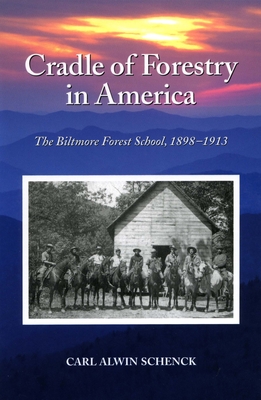
Cradle of Forestry in America: The Biltmore Forest School of 1893-1913
| AUTHOR | Anderson, Steven; Butler, Ovid; Schenck, Carl Alwin |
| PUBLISHER | Forest History Society (01/01/1955) |
| PRODUCT TYPE | Video (Other) |
Description
Dr. Carl Alwin Schenck, a forester born and educated in Germany, arrived in America in April 1895 to manage the 125,000-acre forest on George W. Vanderbilt's famed Biltmore Estate in North Carolina, celebrated today as the "Cradle of Forestry in America."
To train men to assist him in the woods, in 1898 Schenck started the Biltmore Forest School, America's first forestry school. As Schenck noted with pride, "My boys worked continuously in the woods, while those at other schools saw wood only on their desks." Many of the school's more than 300 graduates became influential leaders in both government and industrial forestry.
Cradle of Forestry in America is Schenck's own story of his beloved school. But it's also the story of the birth of forest conservation in America. Clashes with men like Gifford Pinchot--his predecessor, friend, and rival--helped shape the very movement inspired and spurred by Schenck's Biltmore work. Today Schenck's philosophy remains controversial: "That forestry is best which pays best."
To train men to assist him in the woods, in 1898 Schenck started the Biltmore Forest School, America's first forestry school. As Schenck noted with pride, "My boys worked continuously in the woods, while those at other schools saw wood only on their desks." Many of the school's more than 300 graduates became influential leaders in both government and industrial forestry.
Cradle of Forestry in America is Schenck's own story of his beloved school. But it's also the story of the birth of forest conservation in America. Clashes with men like Gifford Pinchot--his predecessor, friend, and rival--helped shape the very movement inspired and spurred by Schenck's Biltmore work. Today Schenck's philosophy remains controversial: "That forestry is best which pays best."
Show More
Product Format
Product Details
ISBN-13:
9780890300558
ISBN-10:
0890300550
Content Language:
English
More Product Details
Carton Quantity:
0
Product Dimensions:
5.46 x 0.59 x 8.59 inches
Weight:
0.73 pound(s)
Country of Origin:
US
Subject Information
BISAC Categories
Unassigned | Agriculture - Forestry
Unassigned | Environmental Conservation & Protection - General
Unassigned | History
Dewey Decimal:
634.909
Library of Congress Control Number:
98007308
Descriptions, Reviews, Etc.
publisher marketing
Dr. Carl Alwin Schenck, a forester born and educated in Germany, arrived in America in April 1895 to manage the 125,000-acre forest on George W. Vanderbilt's famed Biltmore Estate in North Carolina, celebrated today as the "Cradle of Forestry in America."
To train men to assist him in the woods, in 1898 Schenck started the Biltmore Forest School, America's first forestry school. As Schenck noted with pride, "My boys worked continuously in the woods, while those at other schools saw wood only on their desks." Many of the school's more than 300 graduates became influential leaders in both government and industrial forestry.
Cradle of Forestry in America is Schenck's own story of his beloved school. But it's also the story of the birth of forest conservation in America. Clashes with men like Gifford Pinchot--his predecessor, friend, and rival--helped shape the very movement inspired and spurred by Schenck's Biltmore work. Today Schenck's philosophy remains controversial: "That forestry is best which pays best."
To train men to assist him in the woods, in 1898 Schenck started the Biltmore Forest School, America's first forestry school. As Schenck noted with pride, "My boys worked continuously in the woods, while those at other schools saw wood only on their desks." Many of the school's more than 300 graduates became influential leaders in both government and industrial forestry.
Cradle of Forestry in America is Schenck's own story of his beloved school. But it's also the story of the birth of forest conservation in America. Clashes with men like Gifford Pinchot--his predecessor, friend, and rival--helped shape the very movement inspired and spurred by Schenck's Biltmore work. Today Schenck's philosophy remains controversial: "That forestry is best which pays best."
Show More
List Price $16.95
Your Price
$16.78