
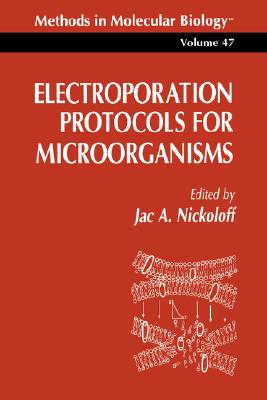
Electroporation Protocols for Microorganisms
| PUBLISHER | Humana (06/20/1995) |
| PRODUCT TYPE | Paperback (Paperback) |
Description
Electroporation is one of the most widespread techniques used in modem molecular genetics. It is most commonly used to introduce DNA into cells for investigations of gene structure and function, and in this regard, electroporation is both highly versatile, being effective with nearly all species and cell types, and highly efficient. For many cell types, electroporation is either the most efficient or the only means known to effect gene transfer. However, exposure of cells to brief, hi- intensity electric fields has found broad application in other aspects of biological research, and is now routinely used to introduce other types of biological and analytic molecules into cells, to induce cell-cell fusion, and to transfer DNA directly between different species. The first seven chapters of Electroporation Protocols for Micro organisms describe the underlying theory of electroporation, the com mercially available instrumentation, and a number of specialized electroporation applications, such as cDNA library construction and interspecies DNA electrotransfer. Each of the remaining chapters pre sents a well developed method for electrotransformation of a particular bacterial, fungal, or protist species. These chapters also serve to intro duce those new to the field the important research questions that are currently being addressed with particular organisms, highlighting both the major advantages and limitations of each species as a model organ ism, and explaining the roles that electroporation has played in the development of the molecular genetic systems currently in use."
Show More
Product Format
Product Details
ISBN-13:
9780896033108
ISBN-10:
0896033104
Binding:
Paperback or Softback (Trade Paperback (Us))
Content Language:
English
More Product Details
Page Count:
372
Carton Quantity:
20
Product Dimensions:
6.00 x 0.88 x 9.00 inches
Weight:
1.28 pound(s)
Feature Codes:
Bibliography,
Index,
Illustrated
Country of Origin:
US
Subject Information
BISAC Categories
Science | Life Sciences - Molecular Biology
Science | Life Sciences - Evolution
Science | General
Dewey Decimal:
576.139
Library of Congress Control Number:
95014992
Descriptions, Reviews, Etc.
publisher marketing
Electroporation is one of the most widespread techniques used in modem molecular genetics. It is most commonly used to introduce DNA into cells for investigations of gene structure and function, and in this regard, electroporation is both highly versatile, being effective with nearly all species and cell types, and highly efficient. For many cell types, electroporation is either the most efficient or the only means known to effect gene transfer. However, exposure of cells to brief, hi- intensity electric fields has found broad application in other aspects of biological research, and is now routinely used to introduce other types of biological and analytic molecules into cells, to induce cell-cell fusion, and to transfer DNA directly between different species. The first seven chapters of Electroporation Protocols for Micro organisms describe the underlying theory of electroporation, the com mercially available instrumentation, and a number of specialized electroporation applications, such as cDNA library construction and interspecies DNA electrotransfer. Each of the remaining chapters pre sents a well developed method for electrotransformation of a particular bacterial, fungal, or protist species. These chapters also serve to intro duce those new to the field the important research questions that are currently being addressed with particular organisms, highlighting both the major advantages and limitations of each species as a model organ ism, and explaining the roles that electroporation has played in the development of the molecular genetic systems currently in use."
Show More
List Price $109.99
Your Price
$108.89