
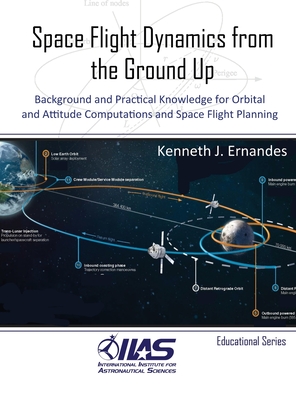
Space Flight Dynamics from the Ground Up: Background and Practical Knowledge for Orbital and Attitude Computations and Space Flight Planning
| AUTHOR | Ernandes, Kenneth J. |
| PUBLISHER | Integrated Spaceflight Services, LLC (07/15/2024) |
| PRODUCT TYPE | Hardcover (Hardcover) |
Space Flight Dynamics from the Ground Up is a text to support the International Institute of Astronautical Sciences (IIAS) space operations program and particularly the Orbital Mechanics and Mission Simulation course. The subjects are organized in three distinct strata to accommodate the widest range of interest: the description level, the equation or algorithm level, and the derivation level.
The description level provides a qualitative explanation. This serves as an introduction to the various subject areas that may be sufficient for certain readers. The equation or algorithm level provides practical computations to accommodate basic problem solving or software development. This allows the reader to focus on the "how to" without needing to be concerned as to the source of the equations or algorithms. The derivation level demonstrates that the equations and algorithms have a sound mathematical and scientific foundation, typically in the form of a rigorous development from the first principles. This level is reserved for those wishing to gain a deep understanding of the concepts and subject areas.
This book is intended for the student or professional interested in space flight dynamics for any spacecraft, but has an emphasis for human spaceflight. It covers a wide range of orbit and attitude topics. The orbital topics include characteristics of free flight, prediction, tracking, thrust event planning, and statistical estimation from observations. Trajectories may be limited to a single celestial body or integrated into lunar or interplanetary missions. The attitude topics include characterizing and predicting rotational motion in the presence of torques, and momentum transfer planning. An essential part is the use of various fidelity levels and how they may be employed for both simulation and actual mission operations.
Space Flight Dynamics from the Ground Up is a text to support the International Institute of Astronautical Sciences (IIAS) space operations program and particularly the Orbital Mechanics and Mission Simulation course. The subjects are organized in three distinct strata to accommodate the widest range of interest: the description level, the equation or algorithm level, and the derivation level.
The description level provides a qualitative explanation. This serves as an introduction to the various subject areas that may be sufficient for certain readers. The equation or algorithm level provides practical computations to accommodate basic problem solving or software development. This allows the reader to focus on the "how to" without needing to be concerned as to the source of the equations or algorithms. The derivation level demonstrates that the equations and algorithms have a sound mathematical and scientific foundation, typically in the form of a rigorous development from the first principles. This level is reserved for those wishing to gain a deep understanding of the concepts and subject areas.
This book is intended for the student or professional interested in space flight dynamics for any spacecraft, but has an emphasis for human spaceflight. It covers a wide range of orbit and attitude topics. The orbital topics include characteristics of free flight, prediction, tracking, thrust event planning, and statistical estimation from observations. Trajectories may be limited to a single celestial body or integrated into lunar or interplanetary missions. The attitude topics include characterizing and predicting rotational motion in the presence of torques, and momentum transfer planning. An essential part is the use of various fidelity levels and how they may be employed for both simulation and actual mission operations.