
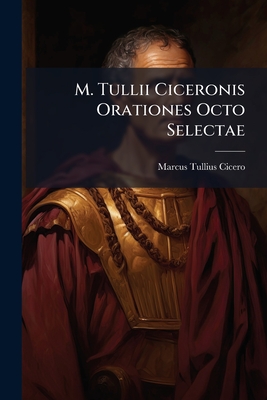
M. Tullii Ciceronis Orationes Octo Selectae
| AUTHOR | Cicero, Marcus Tullius |
| PUBLISHER | Hutson Street Press (05/22/2025) |
| PRODUCT TYPE | Paperback (Paperback) |
M. Tullii Ciceronis Orationes Octo Selectae presents a collection of eight carefully chosen orations by Marcus Tullius Cicero, offering students and enthusiasts a compelling entry point into the world of Roman rhetoric and law. This volume includes: "Pro A. Caecina," "Pro A. Cluentio," "De Lege Agraria Or. II," "Pro Cn. Plancio," "Pro M. Coelio," "Pro L. Corn. Balbo," "Pro C. Rabirio Postumo," and "Philippica I." These speeches showcase Cicero's mastery of Latin prose and his profound impact on the political and social landscape of ancient Rome.
These selections provide invaluable insights into the legal, political, and social issues that defined the late Roman Republic. The orations offer a window into Cicero's skillful use of rhetoric and argumentation, making this collection an essential resource for anyone studying Latin literature, Roman history, and the art of persuasive speaking.
This work has been selected by scholars as being culturally important, and is part of the knowledge base of civilization as we know it. This work was reproduced from the original artifact, and remains as true to the original work as possible. Therefore, you will see the original copyright references, library stamps (as most of these works have been housed in our most important libraries around the world), and other notations in the work.
This work is in the public domain in the United States of America, and possibly other nations. Within the United States, you may freely copy and distribute this work, as no entity (individual or corporate) has a copyright on the body of the work.
As a reproduction of a historical artifact, this work may contain missing or blurred pages, poor pictures, errant marks, etc. Scholars believe, and we concur, that this work is important enough to be preserved, reproduced, and made generally available to the public. We appreciate your support of the preservation process, and thank you for being an important part of keeping this knowledge alive and relevant.
M. Tullii Ciceronis Orationes Octo Selectae presents a collection of eight carefully chosen orations by Marcus Tullius Cicero, offering students and enthusiasts a compelling entry point into the world of Roman rhetoric and law. This volume includes: "Pro A. Caecina," "Pro A. Cluentio," "De Lege Agraria Or. II," "Pro Cn. Plancio," "Pro M. Coelio," "Pro L. Corn. Balbo," "Pro C. Rabirio Postumo," and "Philippica I." These speeches showcase Cicero's mastery of Latin prose and his profound impact on the political and social landscape of ancient Rome.
These selections provide invaluable insights into the legal, political, and social issues that defined the late Roman Republic. The orations offer a window into Cicero's skillful use of rhetoric and argumentation, making this collection an essential resource for anyone studying Latin literature, Roman history, and the art of persuasive speaking.
This work has been selected by scholars as being culturally important, and is part of the knowledge base of civilization as we know it. This work was reproduced from the original artifact, and remains as true to the original work as possible. Therefore, you will see the original copyright references, library stamps (as most of these works have been housed in our most important libraries around the world), and other notations in the work.
This work is in the public domain in the United States of America, and possibly other nations. Within the United States, you may freely copy and distribute this work, as no entity (individual or corporate) has a copyright on the body of the work.
As a reproduction of a historical artifact, this work may contain missing or blurred pages, poor pictures, errant marks, etc. Scholars believe, and we concur, that this work is important enough to be preserved, reproduced, and made generally available to the public. We appreciate your support of the preservation process, and thank you for being an important part of keeping this knowledge alive and relevant.