
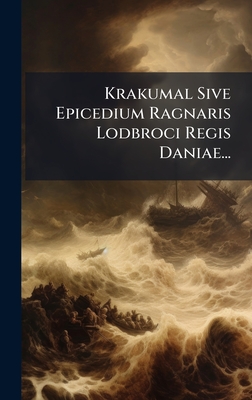
Krakumal Sive Epicedium Ragnaris Lodbroci Regis Daniae...
| AUTHOR | Anonymous |
| PUBLISHER | Hutson Street Press (05/22/2025) |
| PRODUCT TYPE | Hardcover (Hardcover) |
Krakumal Sive Epicedium Ragnaris Lodbroci Regis Daniae... is an anonymous Old Norse poem recounting the death of Ragnar Lodbrok. Also known as "Krákumál," the poem is presented as Ragnar's death song as he lies dying in a pit of snakes inflicted upon him by King Ã?lla of Northumbria. It reflects on his life and martial exploits with stoicism.
The poem consists of sixteen stanzas, each ending with the refrain: 'Grimly we fought with swords.' Each stanza recounts battles and raids attributed to Ragnar. The work is a significant example of skaldic verse and provides insight into the Viking ethos and the worldview of a warrior facing death. While its historical accuracy is debated, it remains a vital cultural and literary artifact, offering a glimpse into the legendary sagas surrounding one of the most famous figures of the Viking Age. "Krákumál" remains important for its poetic merit and historical context.
This work has been selected by scholars as being culturally important, and is part of the knowledge base of civilization as we know it. This work was reproduced from the original artifact, and remains as true to the original work as possible. Therefore, you will see the original copyright references, library stamps (as most of these works have been housed in our most important libraries around the world), and other notations in the work.
This work is in the public domain in the United States of America, and possibly other nations. Within the United States, you may freely copy and distribute this work, as no entity (individual or corporate) has a copyright on the body of the work.
As a reproduction of a historical artifact, this work may contain missing or blurred pages, poor pictures, errant marks, etc. Scholars believe, and we concur, that this work is important enough to be preserved, reproduced, and made generally available to the public. We appreciate your support of the preservation process, and thank you for being an important part of keeping this knowledge alive and relevant.
Krakumal Sive Epicedium Ragnaris Lodbroci Regis Daniae... is an anonymous Old Norse poem recounting the death of Ragnar Lodbrok. Also known as "Krákumál," the poem is presented as Ragnar's death song as he lies dying in a pit of snakes inflicted upon him by King Ã?lla of Northumbria. It reflects on his life and martial exploits with stoicism.
The poem consists of sixteen stanzas, each ending with the refrain: 'Grimly we fought with swords.' Each stanza recounts battles and raids attributed to Ragnar. The work is a significant example of skaldic verse and provides insight into the Viking ethos and the worldview of a warrior facing death. While its historical accuracy is debated, it remains a vital cultural and literary artifact, offering a glimpse into the legendary sagas surrounding one of the most famous figures of the Viking Age. "Krákumál" remains important for its poetic merit and historical context.
This work has been selected by scholars as being culturally important, and is part of the knowledge base of civilization as we know it. This work was reproduced from the original artifact, and remains as true to the original work as possible. Therefore, you will see the original copyright references, library stamps (as most of these works have been housed in our most important libraries around the world), and other notations in the work.
This work is in the public domain in the United States of America, and possibly other nations. Within the United States, you may freely copy and distribute this work, as no entity (individual or corporate) has a copyright on the body of the work.
As a reproduction of a historical artifact, this work may contain missing or blurred pages, poor pictures, errant marks, etc. Scholars believe, and we concur, that this work is important enough to be preserved, reproduced, and made generally available to the public. We appreciate your support of the preservation process, and thank you for being an important part of keeping this knowledge alive and relevant.