
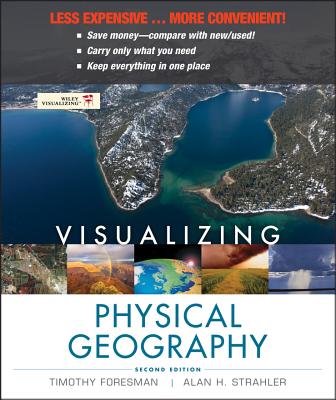
Visualizing Physical Geography
| AUTHOR | Strahler, Alan H.; Foresman, Timothy; Strahler, Alan H. |
| PUBLISHER | Wiley (01/11/2012) |
| PRODUCT TYPE | Paperback (Loose Leaf) |
This text is an unbound, binder-ready edition.
Visualizing Physical Geography employs uniquely designed visual pedagogy to help students acquire the skills they need to become better learners. The 2nd edition has refined and expanded the visuals using insights from research on student outcomes. The Visualizing approach uses a variety of research-based visuals to engage students so they become active participants in the learning process. Visualizing Physical Geography immerses students in course material through visuals (both in print and rich multimedia resources) while organizing complex processes and related course information into easily digestible segments. Visualizing Physical Geography is a comprehensive, modern book for today's physical geography course. With current examples, thorough coverage of geographers' tools and technology, and a visual design that is accessible without sacrificing content, it is a title that will appeal to a broad range of instructors. The narrative and concepts are tightly linked to visual elements, including practical examples that highlight the relevance of the concepts. Maps are integrated throughout to help reveal patterns or trends. Divergent views and critical thinking are emphasized. Photographs and other visuals are also included to reinforce the concepts.
LESS EXPENSIVE ... MORE CONVENIENT!
- Save money--compare with new/used!
- Carry only what you need
- Keep everything in one place
"Students using Wiley Visualizing show much greater increases in knowledge and skills, and have higher retention rates through the course, than their counterparts that used competing textbooks."
--SEG Research, an independent research firm
IMPROVING STUDENT LEARNING WITH GRAPHICALLY ENHANCED EDUCATIONAL PROGRAMS:
SEG Research recently conducted a national, multi-site study of students enrolled in introductory-level college courses. The study evaluated the effectiveness of Wiley Visualizing, an educational program designed to better engage students, increase retention, and improve student learning by use of a pedagogy in which meaningful visuals and multimedia are integrated with the text.
The findings, rare for this kind of education research, indicate that students using Wiley Visualizing, including both print and online resources, made significantly greater gains in content area knowledge and skills and had higher retention over the course of the semester when compared to students in classes using competing textbooks and accompanying multimedia (SEG Research, 2010)*.
Wiley Visualizing supports faculty and promotes student engagement by facilitating comprehension leading to increased retention.
LEARNING THROUGH VISUALIZING
This text is an unbound, binder-ready edition.
Visualizing Physical Geography employs uniquely designed visual pedagogy to help students acquire the skills they need to become better learners. The 2nd edition has refined and expanded the visuals using insights from research on student outcomes. The Visualizing approach uses a variety of research-based visuals to engage students so they become active participants in the learning process. Visualizing Physical Geography immerses students in course material through visuals (both in print and rich multimedia resources) while organizing complex processes and related course information into easily digestible segments. Visualizing Physical Geography is a comprehensive, modern book for today's physical geography course. With current examples, thorough coverage of geographers' tools and technology, and a visual design that is accessible without sacrificing content, it is a title that will appeal to a broad range of instructors. The narrative and concepts are tightly linked to visual elements, including practical examples that highlight the relevance of the concepts. Maps are integrated throughout to help reveal patterns or trends. Divergent views and critical thinking are emphasized. Photographs and other visuals are also included to reinforce the concepts.