
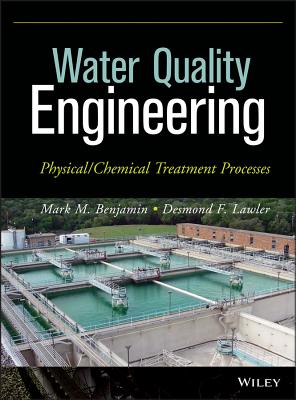
Water Quality Engineering: Physical / Chemical Treatment Processes
| AUTHOR | Lawler, Desmond F.; Benjamin, Mark M.; Benjamin et al. |
| PUBLISHER | Wiley (07/01/2013) |
| PRODUCT TYPE | Hardcover (Hardcover) |
Explains the fundamental theory and mathematics of water and wastewater treatment processes
By carefully explaining both the underlying theory and the underlying mathematics, this text enables readers to fully grasp the fundamentals of physical and chemical treatment processes for water and wastewater. Throughout the book, the authors use detailed examples to illustrate real-world challenges and their solutions, including step-by-step mathematical calculations. Each chapter ends with a set of problems that enable readers to put their knowledge into practice by developing and analyzing complex processes for the removal of soluble and particulate materials in order to ensure the safety of our water supplies.
Designed to give readers a deep understanding of how water treatment processes actually work, Water Quality Engineering explores:
- Application of mass balances in continuous flow systems, enabling readers to understand and predict changes in water quality
- Processes for removing soluble contaminants from water, including treatment of municipal and industrial wastes
- Processes for removing particulate materials from water
- Membrane processes to remove both soluble and particulate materials
Following the discussion of mass balances in continuous flow systems in the first part of the book, the authors explain and analyze water treatment processes in subsequent chapters by setting forth the relevant mass balance for the process, reactor geometry, and flow pattern under consideration.
With its many examples and problem sets, Water Quality Engineering is recommended as a textbook for graduate courses in physical and chemical treatment processes for water and wastewater. By drawing together the most recent research findings and industry practices, this text is also recommended for professional environmental engineers in search of a contemporary perspective on water and wastewater treatment processes.
Explains the fundamental theory and mathematics of water and wastewater treatment processes
By carefully explaining both the underlying theory and the underlying mathematics, this text enables readers to fully grasp the fundamentals of physical and chemical treatment processes for water and wastewater. Throughout the book, the authors use detailed examples to illustrate real-world challenges and their solutions, including step-by-step mathematical calculations. Each chapter ends with a set of problems that enable readers to put their knowledge into practice by developing and analyzing complex processes for the removal of soluble and particulate materials in order to ensure the safety of our water supplies.
Designed to give readers a deep understanding of how water treatment processes actually work, Water Quality Engineering explores:
- Application of mass balances in continuous flow systems, enabling readers to understand and predict changes in water quality
- Processes for removing soluble contaminants from water, including treatment of municipal and industrial wastes
- Processes for removing particulate materials from water
- Membrane processes to remove both soluble and particulate materials
Following the discussion of mass balances in continuous flow systems in the first part of the book, the authors explain and analyze water treatment processes in subsequent chapters by setting forth the relevant mass balance for the process, reactor geometry, and flow pattern under consideration.
With its many examples and problem sets, Water Quality Engineering is recommended as a textbook for graduate courses in physical and chemical treatment processes for water and wastewater. By drawing together the most recent research findings and industry practices, this text is also recommended for professional environmental engineers in search of a contemporary perspective on water and wastewater treatment processes.
Explains the fundamental theory and mathematics of water and wastewater treatment processes
By carefully explaining both the underlying theory and the underlying mathematics, this text enables readers to fully grasp the fundamentals of physical and chemical treatment processes for water and wastewater. Throughout the book, the authors use detailed examples to illustrate real-world challenges and their solutions, including step-by-step mathematical calculations. Each chapter ends with a set of problems that enable readers to put their knowledge into practice by developing and analyzing complex processes for the removal of soluble and particulate materials in order to ensure the safety of our water supplies.
Designed to give readers a deep understanding of how water treatment processes actually work, Water Quality Engineering explores:
- Application of mass balances in continuous flow systems, enabling readers to understand and predict changes in water quality
- Processes for removing soluble contaminants from water, including treatment of municipal and industrial wastes
- Processes for removing particulate materials from water
- Membrane processes to remove both soluble and particulate materials
Following the discussion of mass balances in continuous flow systems in the first part of the book, the authors explain and analyze water treatment processes in subsequent chapters by setting forth the relevant mass balance for the process, reactor geometry, and flow pattern under consideration.
With its many examples and problem sets, Water Quality Engineering is recommended as a textbook for graduate courses in physical and chemical treatment processes for water and wastewater. By drawing together the most recent research findings and industry practices, this text is also recommended for professional environmental engineers in search of a contemporary perspective on water and wastewater treatment processes.