
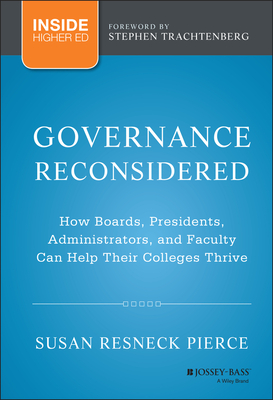
Governance Reconsidered
| AUTHOR | Pierce, Susan R.; Trachtenberg, Stephen |
| PUBLISHER | Jossey-Bass (05/05/2014) |
| PRODUCT TYPE | Hardcover (Hardcover) |
As pressures mount in the academic world, more and more presidents and trustees are ignoring the traditional processes of shared governance by making decisions about academic matters that previously had been considered the primary responsibility of the faculty. In Governance Reconsidered, Susan Resneck Pierce examines the reasons for this trend, and how it has impacted American colleges and universities.
Throughout her decades-long career as a faculty member, dean, academic vice president, president, and consultant, Susan Pierce has believed that colleges and universities are most successful when all constituencies (including trustees, the administration, faculty and staff members, students, and as appropriate alumni and the larger community) work collaboratively. But the landscape of higher education has changed in recent years, fraying the conventional notions and practices of shared governance. Confronted with unprecedented financial challenges, many boards now charge their presidents with responding rapidly to these challenges without extended and sometimes any consultation with the faculty.
To help institutions resolve this tension between the need for timely action and deference to the faculty's role in academic matters, Governance Reconsidered addresses these key topics:
- How the notions of shared governance have evolved over the last century
- The nature of the pressures facing higher education
- Clarity about the roles and responsibilities of trustees, the president, and the faculty
- How trustees, presidents, and the faculty can work together in new ways to respond quickly to external challenges and at the same time preserve the integrity of the academic programs
- How thriving universities govern collaboratively
Governance Reconsidered also focuses on the impact on shared governance of the growing number of contingent faculty, online education, and increasing questions about the value of higher education. These matters have a profound effect on how institutions are run and on the actions of those who run them.
College presidents, trustees, faculty, senior administrators, and student representatives need to think in new ways about higher education governance, as well as how to apply those principles to build a prosperous institution. Readers of this book will learn from both cautionary tales and success stories from the world of higher education. These case studies demonstrate how Susan Pierce's inspirational view of shared governance can work in practice. Governance Reconsidered explains how to meet the challenges of today's higher education environment by enacting transformative change while simultaneously engaging faculties, boards, and communities.
As pressures mount in the academic world, more and more presidents and trustees are ignoring the traditional processes of shared governance by making decisions about academic matters that previously had been considered the primary responsibility of the faculty. In Governance Reconsidered, Susan Resneck Pierce examines the reasons for this trend, and how it has impacted American colleges and universities.
Throughout her decades-long career as a faculty member, dean, academic vice president, president, and consultant, Susan Pierce has believed that colleges and universities are most successful when all constituencies (including trustees, the administration, faculty and staff members, students, and as appropriate alumni and the larger community) work collaboratively. But the landscape of higher education has changed in recent years, fraying the conventional notions and practices of shared governance. Confronted with unprecedented financial challenges, many boards now charge their presidents with responding rapidly to these challenges without extended and sometimes any consultation with the faculty.
To help institutions resolve this tension between the need for timely action and deference to the faculty's role in academic matters, Governance Reconsidered addresses these key topics:
- How the notions of shared governance have evolved over the last century
- The nature of the pressures facing higher education
- Clarity about the roles and responsibilities of trustees, the president, and the faculty
- How trustees, presidents, and the faculty can work together in new ways to respond quickly to external challenges and at the same time preserve the integrity of the academic programs
- How thriving universities govern collaboratively
Governance Reconsidered also focuses on the impact on shared governance of the growing number of contingent faculty, online education, and increasing questions about the value of higher education. These matters have a profound effect on how institutions are run and on the actions of those who run them.
College presidents, trustees, faculty, senior administrators, and student representatives need to think in new ways about higher education governance, as well as how to apply those principles to build a prosperous institution. Readers of this book will learn from both cautionary tales and success stories from the world of higher education. These case studies demonstrate how Susan Pierce's inspirational view of shared governance can work in practice. Governance Reconsidered explains how to meet the challenges of today's higher education environment by enacting transformative change while simultaneously engaging faculties, boards, and communities.
As pressures mount in the academic world, more and more presidents and trustees are ignoring the traditional processes of shared governance by making decisions about academic matters that previously had been considered the primary responsibility of the faculty. In Governance Reconsidered, Susan Resneck Pierce examines the reasons for this trend, and how it has impacted American colleges and universities.
Throughout her decades-long career as a faculty member, dean, academic vice president, president, and consultant, Susan Pierce has believed that colleges and universities are most successful when all constituencies (including trustees, the administration, faculty and staff members, students, and as appropriate alumni and the larger community) work collaboratively. But the landscape of higher education has changed in recent years, fraying the conventional notions and practices of shared governance. Confronted with unprecedented financial challenges, many boards now charge their presidents with responding rapidly to these challenges without extended and sometimes any consultation with the faculty.
To help institutions resolve this tension between the need for timely action and deference to the faculty's role in academic matters, Governance Reconsidered addresses these key topics:
- How the notions of shared governance have evolved over the last century
- The nature of the pressures facing higher education
- Clarity about the roles and responsibilities of trustees, the president, and the faculty
- How trustees, presidents, and the faculty can work together in new ways to respond quickly to external challenges and at the same time preserve the integrity of the academic programs
- How thriving universities govern collaboratively
Governance Reconsidered also focuses on the impact on shared governance of the growing number of contingent faculty, online education, and increasing questions about the value of higher education. These matters have a profound effect on how institutions are run and on the actions of those who run them.
College presidents, trustees, faculty, senior administrators, and student representatives need to think in new ways about higher education governance, as well as how to apply those principles to build a prosperous institution. Readers of this book will learn from both cautionary tales and success stories from the world of higher education. These case studies demonstrate how Susan Pierce's inspirational view of shared governance can work in practice. Governance Reconsidered explains how to meet the challenges of today's higher education environment by enacting transformative change while simultaneously engaging faculties, boards, and communities.