
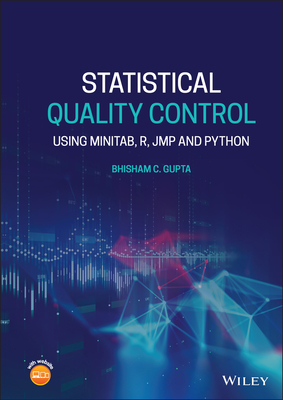
Statistical Quality Control: Using Minitab, R, Jmp and Python
| AUTHOR | Gupta, Bhisham C. |
| PUBLISHER | Wiley (04/27/2021) |
| PRODUCT TYPE | Hardcover (Hardcover) |
Provides a basic understanding of statistical quality control (SQC) and demonstrates how to apply the techniques of SQC to improve the quality of products in various sectors
This book introduces Statistical Quality Control and the elements of Six Sigma Methodology, illustrating the widespread applications that both have for a multitude of areas, including manufacturing, finance, transportation, and more. It places emphasis on both the theory and application of various SQC techniques and offers a large number of examples using data encountered in real life situations to support each theoretical concept.
Statistical Quality Control: Using MINITAB, R, JMP and Python begins with a brief discussion of the different types of data encountered in various fields of statistical applications and introduces graphical and numerical tools needed to conduct preliminary analysis of the data. It then discusses the basic concept of statistical quality control (SQC) and Six Sigma Methodology and examines the different types of sampling methods encountered when sampling schemes are used to study certain populations. The book also covers Phase 1 Control Charts for variables and attributes; Phase II Control Charts to detect small shifts; the various types of Process Capability Indices (CPI); certain aspects of Measurement System Analysis (MSA); various aspects of PRE-control; and more. This helpful guide also:
- Focuses on the learning and understanding of statistical quality control for second and third year undergraduates and practitioners in the field Discusses aspects of Six Sigma Methodology Teaches readers to use MINITAB, R, JMP and Python to create and analyze charts Requires no previous knowledge of statistical theory Is supplemented by an instructor-only book companion site featuring data sets and a solutions manual to all problems, as well as a student book companion site that includes data sets and a solutions manual to all odd-numbered problems
Statistical Quality Control Using MINITAB, R, JMP and Python is an excellent book for students studying engineering, statistics, management studies, and other related fields and who are interested in learning various techniques of statistical quality control. It also serves as a desk reference for practitioners who work to improve quality in various sectors, such as manufacturing, service, transportation, medical, oil, and financial institutions. It's also useful for those who use Six Sigma techniques to improve the quality of products in such areas.
Provides a basic understanding of statistical quality control (SQC) and demonstrates how to apply the techniques of SQC to improve the quality of products in various sectors
This book introduces Statistical Quality Control and the elements of Six Sigma Methodology, illustrating the widespread applications that both have for a multitude of areas, including manufacturing, finance, transportation, and more. It places emphasis on both the theory and application of various SQC techniques and offers a large number of examples using data encountered in real life situations to support each theoretical concept.
Statistical Quality Control: Using MINITAB, R, JMP and Python begins with a brief discussion of the different types of data encountered in various fields of statistical applications and introduces graphical and numerical tools needed to conduct preliminary analysis of the data. It then discusses the basic concept of statistical quality control (SQC) and Six Sigma Methodology and examines the different types of sampling methods encountered when sampling schemes are used to study certain populations. The book also covers Phase 1 Control Charts for variables and attributes; Phase II Control Charts to detect small shifts; the various types of Process Capability Indices (CPI); certain aspects of Measurement System Analysis (MSA); various aspects of PRE-control; and more. This helpful guide also
- Focuses on the learning and understanding of statistical quality control for second and third year undergraduates and practitioners in the field
- Discusses aspects of Six Sigma Methodology
- Teaches readers to use MINITAB, R, JMP and Python to create and analyze charts
- Requires no previous knowledge of statistical theory
- Is supplemented by an instructor-only book companion site featuring data sets and a solutions manual to all problems, as well as a student book companion site that includes data sets and a solutions manual to all odd-numbered problems
Statistical Quality Control: Using MINITAB, R, JMP and Python is an excellent book for students studying engineering, statistics, management studies, and other related fields and who are interested in learning various techniques of statistical quality control. It also serves as a desk reference for practitioners who work to improve quality in various sectors, such as manufacturing, service, transportation, medical, oil, and financial institutions. It's also useful for those who use Six Sigma techniques to improve the quality of products in such areas.
Provides a basic understanding of statistical quality control (SQC) and demonstrates how to apply the techniques of SQC to improve the quality of products in various sectors
This book introduces Statistical Quality Control and the elements of Six Sigma Methodology, illustrating the widespread applications that both have for a multitude of areas, including manufacturing, finance, transportation, and more. It places emphasis on both the theory and application of various SQC techniques and offers a large number of examples using data encountered in real life situations to support each theoretical concept.
Statistical Quality Control: Using MINITAB, R, JMP and Python begins with a brief discussion of the different types of data encountered in various fields of statistical applications and introduces graphical and numerical tools needed to conduct preliminary analysis of the data. It then discusses the basic concept of statistical quality control (SQC) and Six Sigma Methodology and examines the different types of sampling methods encountered when sampling schemes are used to study certain populations. The book also covers Phase 1 Control Charts for variables and attributes; Phase II Control Charts to detect small shifts; the various types of Process Capability Indices (CPI); certain aspects of Measurement System Analysis (MSA); various aspects of PRE-control; and more. This helpful guide also:
- Focuses on the learning and understanding of statistical quality control for second and third year undergraduates and practitioners in the field Discusses aspects of Six Sigma Methodology Teaches readers to use MINITAB, R, JMP and Python to create and analyze charts Requires no previous knowledge of statistical theory Is supplemented by an instructor-only book companion site featuring data sets and a solutions manual to all problems, as well as a student book companion site that includes data sets and a solutions manual to all odd-numbered problems
Statistical Quality Control Using MINITAB, R, JMP and Python is an excellent book for students studying engineering, statistics, management studies, and other related fields and who are interested in learning various techniques of statistical quality control. It also serves as a desk reference for practitioners who work to improve quality in various sectors, such as manufacturing, service, transportation, medical, oil, and financial institutions. It's also useful for those who use Six Sigma techniques to improve the quality of products in such areas.