
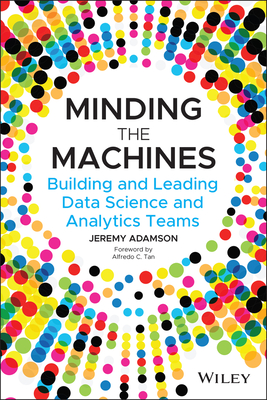
Minding the Machines: Building and Leading Data Science and Analytics Teams
| AUTHOR | Adamson, Jeremy |
| PUBLISHER | Wiley (07/27/2021) |
| PRODUCT TYPE | Paperback (Paperback) |
Learn and provide clear insights into how to structure and lead a successful analytics team. This is a deceptively challenging goal since there are no templates to work from. Establishing a project management office, information services, or human resources department is an understood process and does not vary greatly between organizations. Establishing an analytics team, by contrast, requires a significant up-front investment in understanding and contextualizing the initiative. Many organizations have attempted to use operating models and templates from other functions, in particular IT and operations research. This fundamental misunderstanding of where analytics fits within an organization has led to visible failures and has set back the analytical maturity of many organizations. Business leaders need to hire or develop data-centric talent who are able to step back from analysis and project management to view their work through a lens of value-creation.
Understand how organizations and practitioners need to structure, build, and lead a successful analytics team - to bridge the gap between business leaders and the analytical function. The analytics job market is very frothy, and the talent pool has swelled in recent years with engineers, actuaries, and scientists up-skilling and re-branding themselves as data scientists. This influx of highly technical specialists with limited leadership experience has had negative consequences for the practice as a whole.
Minding the Machines is organized in three key pillars: Strategy, Process, and People.
- Strategy - How to assess organizational readiness, identify gaps, establish an attainable roadmap, and properly articulate a value proposition and case for change.
- Process - How to select and manage projects across their lifecycle including design thinking, risk assessment, governance, and operationalization.
- People - How to structure and engage a team, establish productive and parsimonious conventions, and to lead a distinct practice with unique requirements.
Analytical practitioners want to read this book because career progression opportunities for analytical professionals are very limited. Despite reaching senior technical roles they often report to a business focused manager who understands little about the analytical function. Practitioners seek leadership opportunities, but do not have the tools to move into leadership roles or to be successful in them.
Business leaders with foundational analytical abilities want to read this book because what they may have learned from other business units is at best not applicable to analytics teams, and at worst counterproductive. There needs to be a resource specific to this unique practice.
Students want to read this book because though they are developing strong technical abilities and learning the newest techniques, they are not being instructed in business leadership in an analytics context. This gap in education is amplifying the problem as the profession moves away from long-horizon highly technical solutions and towards a focus on immediate value.
Make data science part of the lifeblood of your business, and avoid costly missteps
By now, almost every organization has stepped into the world of big data analytics--and some of us have already tried again and again to get it right. We know that data science has the potential to unlock tremendous value, so why is it so hard to get it right? In Minding the Machines, analytics strategy expert Jeremy Adamson explains that the problem is often one of too many cooks in the kitchen, and too few recipes for success. This book shows you how to blend data science with business acumen.
Inside, you'll find a roadmap for internalizing the three pillars of analytics: strategy, process, and people. Create an analytics operation that can truly transform outcomes.
- Install the right leaders and position your analytics unit within your organization
- Integrate analytics insights into the business in a constructive and meaningful way
- Identify and fully commit to projects that will add value over the long term
- Hire the right people and get them working for the organization as a whole
Anyone who aspires to be part of a world-class analytics team will benefit from the tasks, methods, and frameworks clearly presented in this valuable book.
"For leaders craving a playbook that puts together all the key elements required for building a high performing Advanced Analytics & AI function in a comprehensive but down to earth manner, this book is most definitely a must read."
-- Celia Wanderley, Chief Customer Officer and Head of Services at AltaML
"... with detailed explanations and checklists throughout, anyone looking to grow an analytics and data science organization can find support within the book."
-- Bill Franks, author of The Analytics Revolution, and Director, Center for Statistics and Analytical Research, Kennesaw State University
" ... a valuable resource for all parties as they advance the role of analytics, and being digital, in their organization... "
-- Lee Ackerman, Director of Digital Strategy, SAIT's School for Advanced Digital Technology
Make data science part of the lifeblood of your business, and avoid costly missteps
By now, almost every organization has stepped into the world of big data analytics--and some of us have already tried again and again to get it right. We know that data science has the potential to unlock tremendous value, so why is it so hard to get it right? In Minding the Machines, analytics strategy expert Jeremy Adamson explains that the problem is often one of too many cooks in the kitchen, and too few recipes for success. This book shows you how to blend data science with business acumen.
Inside, you'll find a roadmap for internalizing the three pillars of analytics: strategy, process, and people. Create an analytics operation that can truly transform outcomes.
- Install the right leaders and position your analytics unit within your organization
- Integrate analytics insights into the business in a constructive and meaningful way
- Identify and fully commit to projects that will add value over the long term
- Hire the right people and get them working for the organization as a whole
Anyone who aspires to be part of a world-class analytics team will benefit from the tasks, methods, and frameworks clearly presented in this valuable book.
"For leaders craving a playbook that puts together all the key elements required for building a high performing Advanced Analytics & AI function in a comprehensive but down to earth manner, this book is most definitely a must read."
-- Celia Wanderley, Chief Customer Officer and Head of Services at AltaML
"... with detailed explanations and checklists throughout, anyone looking to grow an analytics and data science organization can find support within the book."
-- Bill Franks, author of The Analytics Revolution, and Director, Center for Statistics and Analytical Research, Kennesaw State University
" ... a valuable resource for all parties as they advance the role of analytics, and being digital, in their organization... "
-- Lee Ackerman, Director of Digital Strategy, SAIT's School for Advanced Digital Technology
Learn and provide clear insights into how to structure and lead a successful analytics team. This is a deceptively challenging goal since there are no templates to work from. Establishing a project management office, information services, or human resources department is an understood process and does not vary greatly between organizations. Establishing an analytics team, by contrast, requires a significant up-front investment in understanding and contextualizing the initiative. Many organizations have attempted to use operating models and templates from other functions, in particular IT and operations research. This fundamental misunderstanding of where analytics fits within an organization has led to visible failures and has set back the analytical maturity of many organizations. Business leaders need to hire or develop data-centric talent who are able to step back from analysis and project management to view their work through a lens of value-creation.
Understand how organizations and practitioners need to structure, build, and lead a successful analytics team - to bridge the gap between business leaders and the analytical function. The analytics job market is very frothy, and the talent pool has swelled in recent years with engineers, actuaries, and scientists up-skilling and re-branding themselves as data scientists. This influx of highly technical specialists with limited leadership experience has had negative consequences for the practice as a whole.
Minding the Machines is organized in three key pillars: Strategy, Process, and People.
- Strategy - How to assess organizational readiness, identify gaps, establish an attainable roadmap, and properly articulate a value proposition and case for change.
- Process - How to select and manage projects across their lifecycle including design thinking, risk assessment, governance, and operationalization.
- People - How to structure and engage a team, establish productive and parsimonious conventions, and to lead a distinct practice with unique requirements.
Analytical practitioners want to read this book because career progression opportunities for analytical professionals are very limited. Despite reaching senior technical roles they often report to a business focused manager who understands little about the analytical function. Practitioners seek leadership opportunities, but do not have the tools to move into leadership roles or to be successful in them.
Business leaders with foundational analytical abilities want to read this book because what they may have learned from other business units is at best not applicable to analytics teams, and at worst counterproductive. There needs to be a resource specific to this unique practice.
Students want to read this book because though they are developing strong technical abilities and learning the newest techniques, they are not being instructed in business leadership in an analytics context. This gap in education is amplifying the problem as the profession moves away from long-horizon highly technical solutions and towards a focus on immediate value.