
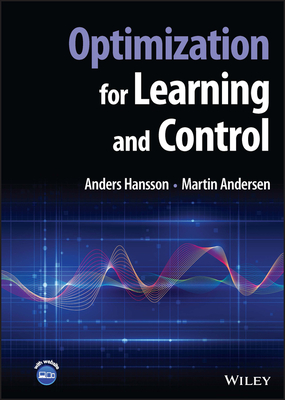
Optimization for Learning and Control
| AUTHOR | Hansson, Anders; Andersen, Martin |
| PUBLISHER | Wiley (06/07/2023) |
| PRODUCT TYPE | Hardcover (Hardcover) |
Comprehensive resource providing a masters' level introduction to optimization theory and algorithms for learning and control
Optimization for Learning and Control describes how optimization is used in these domains, giving a thorough introduction to both unsupervised learning, supervised learning, and reinforcement learning, with an emphasis on optimization methods for large-scale learning and control problems.
Several applications areas are also discussed, including signal processing, system identification, optimal control, and machine learning.
Today, most of the material on the optimization aspects of deep learning that is accessible for students at a Masters' level is focused on surface-level computer programming; deeper knowledge about the optimization methods and the trade-offs that are behind these methods is not provided. The objective of this book is to make this scattered knowledge, currently mainly available in publications in academic journals, accessible for Masters' students in a coherent way. The focus is on basic algorithmic principles and trade-offs.
Optimization for Learning and Control covers sample topics such as:
- Optimization theory and optimization methods, covering classes of optimization problems like least squares problems, quadratic problems, conic optimization problems and rank optimization.
- First-order methods, second-order methods, variable metric methods, and methods for nonlinear least squares problems.
- Stochastic optimization methods, augmented Lagrangian methods, interior-point methods, and conic optimization methods.
- Dynamic programming for solving optimal control problems and its generalization to reinforcement learning.
- How optimization theory is used to develop theory and tools of statistics and learning, e.g., the maximum likelihood method, expectation maximization, k-means clustering, and support vector machines.
- How calculus of variations is used in optimal control and for deriving the family of exponential distributions.
Optimization for Learning and Control is an ideal resource on the subject for scientists and engineers learning about which optimization methods are useful for learning and control problems; the text will also appeal to industry professionals using machine learning for different practical applications.
Comprehensive resource providing a masters' level introduction to optimization theory and algorithms for learning and control
Optimization for Learning and Control describes how optimization is used in these domains, giving a thorough introduction to both unsupervised learning, supervised learning, and reinforcement learning, with an emphasis on optimization methods for large-scale learning and control problems.
Several applications areas are also discussed, including signal processing, system identification, optimal control, and machine learning.
Today, most of the material on the optimization aspects of deep learning that is accessible for students at a Masters' level is focused on surface-level computer programming; deeper knowledge about the optimization methods and the trade-offs that are behind these methods is not provided. The objective of this book is to make this scattered knowledge, currently mainly available in publications in academic journals, accessible for Masters' students in a coherent way. The focus is on basic algorithmic principles and trade-offs.
Optimization for Learning and Control covers sample topics such as:
- Optimization theory and optimization methods, covering classes of optimization problems like least squares problems, quadratic problems, conic optimization problems and rank optimization.
- First-order methods, second-order methods, variable metric methods, and methods for nonlinear least squares problems.
- Stochastic optimization methods, augmented Lagrangian methods, interior-point methods, and conic optimization methods.
- Dynamic programming for solving optimal control problems and its generalization to reinforcement learning.
- How optimization theory is used to develop theory and tools of statistics and learning, e.g., the maximum likelihood method, expectation maximization, k-means clustering, and support vector machines.
- How calculus of variations is used in optimal control and for deriving the family of exponential distributions.
Optimization for Learning and Control is an ideal resource on the subject for scientists and engineers learning about which optimization methods are useful for learning and control problems; the text will also appeal to industry professionals using machine learning for different practical applications.
Comprehensive resource providing a masters' level introduction to optimization theory and algorithms for learning and control
Optimization for Learning and Control describes how optimization is used in these domains, giving a thorough introduction to both unsupervised learning, supervised learning, and reinforcement learning, with an emphasis on optimization methods for large-scale learning and control problems.
Several applications areas are also discussed, including signal processing, system identification, optimal control, and machine learning.
Today, most of the material on the optimization aspects of deep learning that is accessible for students at a Masters' level is focused on surface-level computer programming; deeper knowledge about the optimization methods and the trade-offs that are behind these methods is not provided. The objective of this book is to make this scattered knowledge, currently mainly available in publications in academic journals, accessible for Masters' students in a coherent way. The focus is on basic algorithmic principles and trade-offs.
Optimization for Learning and Control covers sample topics such as:
- Optimization theory and optimization methods, covering classes of optimization problems like least squares problems, quadratic problems, conic optimization problems and rank optimization.
- First-order methods, second-order methods, variable metric methods, and methods for nonlinear least squares problems.
- Stochastic optimization methods, augmented Lagrangian methods, interior-point methods, and conic optimization methods.
- Dynamic programming for solving optimal control problems and its generalization to reinforcement learning.
- How optimization theory is used to develop theory and tools of statistics and learning, e.g., the maximum likelihood method, expectation maximization, k-means clustering, and support vector machines.
- How calculus of variations is used in optimal control and for deriving the family of exponential distributions.
Optimization for Learning and Control is an ideal resource on the subject for scientists and engineers learning about which optimization methods are useful for learning and control problems; the text will also appeal to industry professionals using machine learning for different practical applications.