
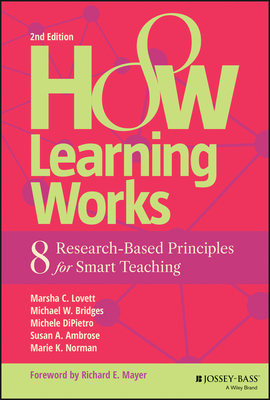
How Learning Works: Eight Research-Based Principles for Smart Teaching
| AUTHOR | Bridges, Michael W.; Lovett, Marsha C.; Dipietro, Michele |
| PUBLISHER | Jossey-Bass (03/14/2023) |
| PRODUCT TYPE | Hardcover (Hardcover) |
As educators in the ever-evolving landscape of higher education, we are continuously challenged to keep our courses effective, engaging, relevant, and inclusive. The updated and expanded second edition of How Learning Works can help! It incorporates the latest research, provides a wider range of strategies, and adds a new principle to your toolkit.
Readers will find eight essential learning principles that distill the overwhelming research literature into:
- Real-world teaching and learning scenarios
- Examples that reflect a diverse set of teaching environments and learner populations
- 150 practical strategies you can apply to your teaching context
With these practical, broadly applicable insights, you can:
- Understand why your successful teaching approaches work
- Solve common teaching and learning problems
- Adapt your teaching to new modalities (e.g., online, hybrid) and challenges
- Ground your innovations in evidence-based practice
Based on research from cognitive psychology, developmental psychology, education, anthropology, and more--this book makes learning work...for you and your students.
Praise for How Learning Works, 2nd Edition
"Since the publication of the original How Learning Works, I have returned again and again to its thorough and readable summaries of the most important research on student learning. This Second Edition has become an even more essential resource for faculty, as the authors have infused the book's recommendations with greater awareness of the social, emotional, and cultural factors that impact student identity and development."
--James Lang, Author of Small Teaching
"How Learning Works is a poignant and provocative book that engages meaningfully and intentionally with the intellectual and affective dimensions of teaching and learning that shape our complex and diverse higher education classrooms. Presenting a well-researched, relevant and socially conscious range of cognitive and social principles and practices, the authors explore what it means to engage intentionally with students as whole beings, in a socially just, inclusive and pedagogically responsible way."
--Kasturi Behari-Leak, Dean of the Centre for Higher Education Development, University of Cape Town
"The Second Edition of How Learning Works is superb. I particularly admire its breadth of coverage, which includes socio-emotional and cognitive components of learning. I highly recommend it for anyone at any level in education."
--Henry L. Roediger, III, James S. McDonnell Professor of Psychology, Washington University in St. Louis; Co-author of Make It Stick: The Science of Successful Learning
"How Learning Works is the essential book on teaching and learning in higher education. The new edition is even better than the original. Drawing deeply on recent research to outline eight principles of How Learning Works, the authors provide practical guidance to put those principles into action. This book is smart, useful, and inspiring!"
--Peter Felten, Executive Director, Center for Engaged Learning, Elon University
In the newly revised Second Edition of How Learning Works, a team of distinguished educators and researchers delivers an insightful and practical roadmap to creating a curriculum that meets the needs of modern students in modern classrooms. Readers will learn to design and implement effective, engaging, relevant, and inclusive courses that incorporate the latest learning research.
In this book, you'll discover why new teaching approaches are so successful and how to solve common teaching and learning problems. You'll also learn to adapt your teaching to new modalities--including online and hybrid environments--that bring with them novel challenges and untapped potential.
How Learning Works grounds its instruction and advice in evidence and research from cognitive psychology, developmental psychology, education, anthropology, and other disciplines, creating a firm foundation of evidence-based practice on which you can build your curricula. It includes 150 practical strategies you can apply immediately, in any teaching context, as well as examples that reflect a diverse and varied set of teaching environments and learner populations.
From understanding and emphasizing the importance of the prior knowledge students bring to your classroom to the different ways that students organize knowledge and apply what they know, this book expands upon the key principles identified by the authors in their thirty years' experience working one-on-one with faculty and studying the research literature.
A can't-miss resource for higher education faculty, faculty developers, and administrators, the latest edition of How Learning Works will also earn a place in the libraries of graduate students in education and those with professorial aspirations, as well as online and hybrid course designers and instructors.
As educators in the ever-evolving landscape of higher education, we are continuously challenged to keep our courses effective, engaging, relevant, and inclusive. The updated and expanded second edition of How Learning Works can help! It incorporates the latest research, provides a wider range of strategies, and adds a new principle to your toolkit.
Readers will find eight essential learning principles that distill the overwhelming research literature into:
- Real-world teaching and learning scenarios
- Examples that reflect a diverse set of teaching environments and learner populations
- 150 practical strategies you can apply to your teaching context
With these practical, broadly applicable insights, you can:
- Understand why your successful teaching approaches work
- Solve common teaching and learning problems
- Adapt your teaching to new modalities (e.g., online, hybrid) and challenges
- Ground your innovations in evidence-based practice
Based on research from cognitive psychology, developmental psychology, education, anthropology, and more--this book makes learning work...for you and your students.