
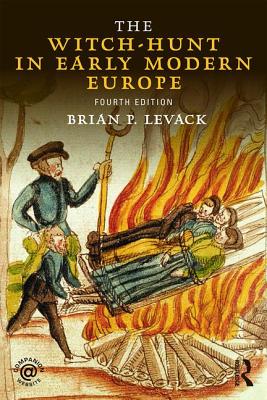
The Witch-Hunt in Early Modern Europe
| AUTHOR | Levack, Brian P. |
| PUBLISHER | Routledge (10/05/2015) |
| PRODUCT TYPE | Paperback (Paperback) |
The Witch-Hunt in Early Modern Europe, now in its fourth edition, introduces students to the phenomenon that saw thousands of people accused, prosecuted and executed for the crime of witchcraft between 1450 and 1750. The witch-hunt was not a single event; it comprised thousands of individual prosecutions, each shaped by the religious and social dimensions of the particular area, as well as political and legal factors. Brian Levack considers the many theories, as well as contributing to the scholarly debate.
This new edition is fully updated to include the latest research in the field, in particular providing expanded coverage on children, male witches, the relationship between shamanism and witchcraft and demonic possession. It also explores the geographical distribution of prosecutions, making comparisons between different countries and discusses the recent work on regions, cities and kingdoms.
The Witch-Hunt in Early Modern Europe is now fully intergrated with Brian Levack's The Witchcraft Sourcebook 2ed, both within the text and on a new companion website which draws the two books together, creating an invaluable resource for students of witchcraft and witch trials in the early modern period.
The Witch-Hunt in Early Modern Europe, now in its fourth edition, introduces students to the phenomenon that saw thousands of people accused, prosecuted and executed for the crime of witchcraft between 1450 and 1750. The witch-hunt was not a single event; it comprised thousands of individual prosecutions, each shaped by the religious and social dimensions of the particular area, as well as political and legal factors. Brian Levack considers the many theories, as well as contributing to the scholarly debate.
This new edition is fully updated to include the latest research in the field, in particular providing expanded coverage on children, male witches, the relationship between shamanism and witchcraft and demonic possession. It also explores the geographical distribution of prosecutions, making comparisons between different countries and discusses the recent work on regions, cities and kingdoms.
The Witch-Hunt in Early Modern Europe is now fully intergrated with Brian Levack's The Witchcraft Sourcebook 2ed, both within the text and on a new companion website which draws the two books together, creating an invaluable resource for students of witchcraft and witch trials in the early modern period.
His study of the development of beliefs about witchcraft in Europe over the course of many centuries gave him the idea of writing a textbook on Western civilization that would illustrate a broader set of encounters between different cultures, societies, and ideologies. While writing the book, Levack and his two sons built a house on property that he and his wife, Nancy, own in the Texas hill country. He found that the two projectspresented similar challenges: it was easy to draw up the design, but far more difficult to execute it. When not teaching, writing, or doing carpentry work, Levack runs along the jogging trails of Austin, and he has recently discovered the pleasures of scuba diving.