
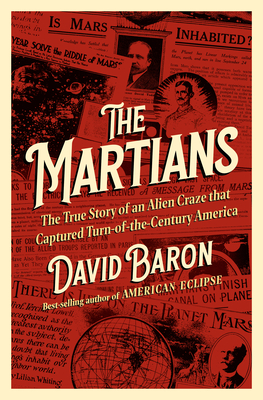
The Martians: The True Story of an Alien Craze That Captured Turn-Of-The-Century America
| AUTHOR | Baron, David |
| PUBLISHER | Liveright Publishing Corporation (08/26/2025) |
| PRODUCT TYPE | Hardcover (Hardcover) |
Description
"There is Life on the Planet Mars" --New York Times, December 9, 1906
This New York Times headline was no joke.
In the early 1900s, many Americans actually believed we had discovered intelligent life on Mars, as best-selling science writer David Baron chronicles in The Martians, his truly bizarre tale of a nation swept up in Mars mania.
At the center of Baron's historical drama is Percival Lowell, the Boston Brahmin and Harvard scion, who observed "canals" etched into the surface of Mars. Lowell devised a grand theory that the red planet was home to a utopian society that had built gargantuan ditches to funnel precious meltwater from the polar icecaps to desert farms and oasis cities. The public fell in love with the ambitious amateur astronomer who shared his findings in speeches and wildly popular books.
While at first people treated the Martians whimsically--Martians headlining Broadway shows, biologists speculating whether they were winged or gilled--the discussion quickly became serious. Inventor Nikola Tesla announced he had received radio signals from Mars; Alexander Graham Bell agreed there was "no escape from the conviction" that intelligent beings inhabited the planet. Martian excitement reached its zenith when Lowell financed an expedition to photograph Mars from Chile's Atacama Desert, resulting in what newspapers hailed as proof of the Martian canals' existence.
Triumph quickly yielded to tragedy. Those wild claims and highly speculative photographs emboldened Lowell's critics, whose withering attacks gathered steam and eventually wrecked the man and his theory--but not the fervor he had started. Although Lowell would die discredited and delusional in 1916, the Mars frenzy spurred a nascent literary genre called science fiction, and the world's sense of its place in the universe would never be the same.
Today, the red planet maintains its grip on the public's imagination. Many see Mars as civilization's destiny--the first step toward our becoming an interplanetary species--but, as David Baron demonstrates, this tendency to project our hopes onto the world next door is hardly new. The Martians is a scintillating and necessary reminder that while we look to Mars for answers, what we often find are mirrors of ourselves.
This New York Times headline was no joke.
In the early 1900s, many Americans actually believed we had discovered intelligent life on Mars, as best-selling science writer David Baron chronicles in The Martians, his truly bizarre tale of a nation swept up in Mars mania.
At the center of Baron's historical drama is Percival Lowell, the Boston Brahmin and Harvard scion, who observed "canals" etched into the surface of Mars. Lowell devised a grand theory that the red planet was home to a utopian society that had built gargantuan ditches to funnel precious meltwater from the polar icecaps to desert farms and oasis cities. The public fell in love with the ambitious amateur astronomer who shared his findings in speeches and wildly popular books.
While at first people treated the Martians whimsically--Martians headlining Broadway shows, biologists speculating whether they were winged or gilled--the discussion quickly became serious. Inventor Nikola Tesla announced he had received radio signals from Mars; Alexander Graham Bell agreed there was "no escape from the conviction" that intelligent beings inhabited the planet. Martian excitement reached its zenith when Lowell financed an expedition to photograph Mars from Chile's Atacama Desert, resulting in what newspapers hailed as proof of the Martian canals' existence.
Triumph quickly yielded to tragedy. Those wild claims and highly speculative photographs emboldened Lowell's critics, whose withering attacks gathered steam and eventually wrecked the man and his theory--but not the fervor he had started. Although Lowell would die discredited and delusional in 1916, the Mars frenzy spurred a nascent literary genre called science fiction, and the world's sense of its place in the universe would never be the same.
Today, the red planet maintains its grip on the public's imagination. Many see Mars as civilization's destiny--the first step toward our becoming an interplanetary species--but, as David Baron demonstrates, this tendency to project our hopes onto the world next door is hardly new. The Martians is a scintillating and necessary reminder that while we look to Mars for answers, what we often find are mirrors of ourselves.
Show More
Product Format
Product Details
ISBN-13:
9781324090663
ISBN-10:
1324090669
Binding:
Hardback or Cased Book (Sewn)
Content Language:
English
More Product Details
Page Count:
336
Carton Quantity:
20
Product Dimensions:
6.31 x 1.00 x 9.21 inches
Weight:
1.28 pound(s)
Feature Codes:
Bibliography,
Index,
Price on Product,
Illustrated
Country of Origin:
US
Subject Information
BISAC Categories
Science | Space Science - Space Exploration
Science | United States - 20th Century
Science | Anthropology - Cultural & Social
Dewey Decimal:
576.839
Descriptions, Reviews, Etc.
publisher marketing
"There is Life on the Planet Mars" --New York Times, December 9, 1906
This New York Times headline was no joke.
In the early 1900s, many Americans actually believed we had discovered intelligent life on Mars, as best-selling science writer David Baron chronicles in The Martians, his truly bizarre tale of a nation swept up in Mars mania.
At the center of Baron's historical drama is Percival Lowell, the Boston Brahmin and Harvard scion, who observed "canals" etched into the surface of Mars. Lowell devised a grand theory that the red planet was home to a utopian society that had built gargantuan ditches to funnel precious meltwater from the polar icecaps to desert farms and oasis cities. The public fell in love with the ambitious amateur astronomer who shared his findings in speeches and wildly popular books.
While at first people treated the Martians whimsically--Martians headlining Broadway shows, biologists speculating whether they were winged or gilled--the discussion quickly became serious. Inventor Nikola Tesla announced he had received radio signals from Mars; Alexander Graham Bell agreed there was "no escape from the conviction" that intelligent beings inhabited the planet. Martian excitement reached its zenith when Lowell financed an expedition to photograph Mars from Chile's Atacama Desert, resulting in what newspapers hailed as proof of the Martian canals' existence.
Triumph quickly yielded to tragedy. Those wild claims and highly speculative photographs emboldened Lowell's critics, whose withering attacks gathered steam and eventually wrecked the man and his theory--but not the fervor he had started. Although Lowell would die discredited and delusional in 1916, the Mars frenzy spurred a nascent literary genre called science fiction, and the world's sense of its place in the universe would never be the same.
Today, the red planet maintains its grip on the public's imagination. Many see Mars as civilization's destiny--the first step toward our becoming an interplanetary species--but, as David Baron demonstrates, this tendency to project our hopes onto the world next door is hardly new. The Martians is a scintillating and necessary reminder that while we look to Mars for answers, what we often find are mirrors of ourselves.
This New York Times headline was no joke.
In the early 1900s, many Americans actually believed we had discovered intelligent life on Mars, as best-selling science writer David Baron chronicles in The Martians, his truly bizarre tale of a nation swept up in Mars mania.
At the center of Baron's historical drama is Percival Lowell, the Boston Brahmin and Harvard scion, who observed "canals" etched into the surface of Mars. Lowell devised a grand theory that the red planet was home to a utopian society that had built gargantuan ditches to funnel precious meltwater from the polar icecaps to desert farms and oasis cities. The public fell in love with the ambitious amateur astronomer who shared his findings in speeches and wildly popular books.
While at first people treated the Martians whimsically--Martians headlining Broadway shows, biologists speculating whether they were winged or gilled--the discussion quickly became serious. Inventor Nikola Tesla announced he had received radio signals from Mars; Alexander Graham Bell agreed there was "no escape from the conviction" that intelligent beings inhabited the planet. Martian excitement reached its zenith when Lowell financed an expedition to photograph Mars from Chile's Atacama Desert, resulting in what newspapers hailed as proof of the Martian canals' existence.
Triumph quickly yielded to tragedy. Those wild claims and highly speculative photographs emboldened Lowell's critics, whose withering attacks gathered steam and eventually wrecked the man and his theory--but not the fervor he had started. Although Lowell would die discredited and delusional in 1916, the Mars frenzy spurred a nascent literary genre called science fiction, and the world's sense of its place in the universe would never be the same.
Today, the red planet maintains its grip on the public's imagination. Many see Mars as civilization's destiny--the first step toward our becoming an interplanetary species--but, as David Baron demonstrates, this tendency to project our hopes onto the world next door is hardly new. The Martians is a scintillating and necessary reminder that while we look to Mars for answers, what we often find are mirrors of ourselves.
Show More
Author:
Baron, David
David Baron, an award-winning journalist, reports on science for National Public Radio. He lives in Boston and Boulder.
Show More
List Price $29.99
Your Price
$29.69