
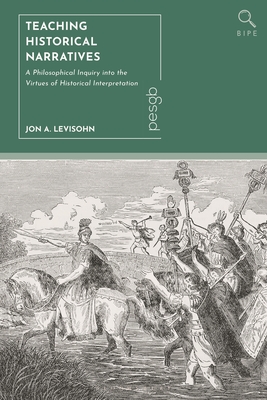
Teaching Historical Narratives: A Philosophical Inquiry into the Virtues of Historical Interpretation
| AUTHOR | Levisohn, Jon A.; Standish, Paul |
| PUBLISHER | Bloomsbury Academic (12/26/2024) |
| PRODUCT TYPE | Hardcover (Hardcover) |
Description
With this book Jon Levisohn argues that current history education is set up in a way that sees students of history at one end of a continuum with the academic experts in the field of history at the other, and where the goal of history education is to help students to think like historians.
Building on a critical engagement with Carl Hempel, Hayden White, and David Carr, as well as contemporary work in virtue epistemology, Levisohn proposes a new theory of historiography which serves as a set of guidelines for the teaching and learning of history. According to the theory, the work of historiography is best characterized as a negotiation among narratives, weaving together received narratives with new information and ideas in order to construct a new narrative. This negotiation happens with a particular orientation towards negative evidence or 'flexible disconfirmationism', and is assessed according to the openness, sensitivity, responsibility, creativity, boldness and humility, i.e. the virtues of historical interpretation. The book rethinks the work of history education, offering new ways of thinking about the goals of the teaching of history, namely, in terms of the cultivation of the interpretive virtues.
Building on a critical engagement with Carl Hempel, Hayden White, and David Carr, as well as contemporary work in virtue epistemology, Levisohn proposes a new theory of historiography which serves as a set of guidelines for the teaching and learning of history. According to the theory, the work of historiography is best characterized as a negotiation among narratives, weaving together received narratives with new information and ideas in order to construct a new narrative. This negotiation happens with a particular orientation towards negative evidence or 'flexible disconfirmationism', and is assessed according to the openness, sensitivity, responsibility, creativity, boldness and humility, i.e. the virtues of historical interpretation. The book rethinks the work of history education, offering new ways of thinking about the goals of the teaching of history, namely, in terms of the cultivation of the interpretive virtues.
Show More
Product Format
Product Details
ISBN-13:
9781350433397
ISBN-10:
135043339X
Binding:
Hardback or Cased Book (Sewn)
Content Language:
English
More Product Details
Page Count:
240
Carton Quantity:
30
Product Dimensions:
6.14 x 0.56 x 9.21 inches
Weight:
1.13 pound(s)
Feature Codes:
Dust Cover
Country of Origin:
US
Subject Information
BISAC Categories
Education | Teaching - Subjects - General
Education | Philosophy, Theory & Social Aspects
Descriptions, Reviews, Etc.
publisher marketing
With this book Jon Levisohn argues that current history education is set up in a way that sees students of history at one end of a continuum with the academic experts in the field of history at the other, and where the goal of history education is to help students to think like historians.
Building on a critical engagement with Carl Hempel, Hayden White, and David Carr, as well as contemporary work in virtue epistemology, Levisohn proposes a new theory of historiography which serves as a set of guidelines for the teaching and learning of history. According to the theory, the work of historiography is best characterized as a negotiation among narratives, weaving together received narratives with new information and ideas in order to construct a new narrative. This negotiation happens with a particular orientation towards negative evidence or 'flexible disconfirmationism', and is assessed according to the openness, sensitivity, responsibility, creativity, boldness and humility, i.e. the virtues of historical interpretation. The book rethinks the work of history education, offering new ways of thinking about the goals of the teaching of history, namely, in terms of the cultivation of the interpretive virtues.
Building on a critical engagement with Carl Hempel, Hayden White, and David Carr, as well as contemporary work in virtue epistemology, Levisohn proposes a new theory of historiography which serves as a set of guidelines for the teaching and learning of history. According to the theory, the work of historiography is best characterized as a negotiation among narratives, weaving together received narratives with new information and ideas in order to construct a new narrative. This negotiation happens with a particular orientation towards negative evidence or 'flexible disconfirmationism', and is assessed according to the openness, sensitivity, responsibility, creativity, boldness and humility, i.e. the virtues of historical interpretation. The book rethinks the work of history education, offering new ways of thinking about the goals of the teaching of history, namely, in terms of the cultivation of the interpretive virtues.
Show More
Your Price
$118.80