
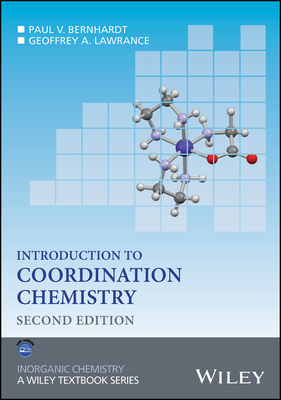
Introduction to Coordination Chemistry
| AUTHOR | Bernhardt, Paul V.; Lawrance, Geoffrey A. |
| PUBLISHER | Wiley (02/10/2025) |
| PRODUCT TYPE | Paperback (Paperback) |
An accessible introduction to one of the primary fields of study in Inorganic Chemistry, revised to incorporate contemporary topics and applications
Written in a highly readable, descriptive, and accessible style, Introduction to Coordination Chemistry examines and explains the interaction between metals and molecules that bind as ligands and the consequences of this assembly process. The book describes the chemical and physical properties and behavior of these complex assemblies and their applications The contents of this book tell a story, taking the reader from fundamentals, including metal ions, ligands, metal-ligand bonding, and structure, to key concepts, such as stability, synthesis and mechanisms, properties, and characterization. Subsequent chapters address applications involving metals in biology, medicine, and industrial chemistry.
Written by two highly qualified academics, this newly revised Second Edition of Introduction to Coordination Chemistry has been thoroughly updated to include full-color images throughout, as well as now including:
- Information on instrument-based experimental methods to reflect the increasing use of sophisticated, commercially available instruments in laboratory teaching
- An expansion of the chapter Metals in Biology showing key developments in the vast field of metalloproteins and metalloenzymes
- An updated description of polymetallic compounds and new discussions of metal-containing nanomolecules pertinent to advancements in nanotechnology
- An expanded discussion of organometallic compounds and catalysts and updating of Concept Keys to summarize key topics and further reading at the end of each chapter
Introduction to Coordination Chemistry is an ideal textbook resource for undergraduate inorganic chemistry students in their second or third year or at the intermediate level who have completed a general introductory chemistry course and are moving to a first specialist course in coordination chemistry.
INTRODUCTION TO COORDINATION CHEMISTRY
An accessible introduction to one of the primary fields of study in Inorganic Chemistry, revised to incorporate contemporary topics and applications
Written in a highly readable, descriptive, and accessible style, Introduction to Coordination Chemistry examines and explains the interaction between metals and molecules that bind as ligands and the consequences of this assembly process. The book describes the chemical and physical properties and behavior of these complex assemblies and their applications. The contents of this book tell a story, taking the reader from fundamentals, including metal ions, ligands, metal-ligand bonding, and structure, to key concepts, such as stability, synthesis and mechanisms, properties, and characterization. Subsequent chapters address applications involving metals in biology, medicine, and industrial chemistry.
Written by two highly qualified academics, this newly revised Second Edition of Introduction to Coordination Chemistry has been thoroughly updated to include full-color images throughout, as well as now including:
- Information on instrument-based experimental methods to reflect the increasing use of sophisticated, commercially available instruments in laboratory teaching
- An expansion of the chapter Metals in Biology showing key developments in the vast field of metalloproteins and metalloenzymes
- An updated description of polymetallic compounds and new discussions of metal-containing nanomolecules pertinent to advancements in nanotechnology
- An expanded discussion of organometallic compounds and catalysts and updating of Concept Keys to summarize key topics and further reading at the end of each chapter
Introduction to Coordination Chemistry is an ideal textbook resource for undergraduate inorganic chemistry students in their second or third year or at the intermediate level who have completed a general introductory chemistry course and are moving to a first specialist course in coordination chemistry.
INORGANIC CHEMISTRY ADVANCED TEXTBOOK
This series reflects the pivotal role of modern inorganic and physical chemistry in a whole range of emerging areas, such as materials chemistry, green chemistry and bioinorganic chemistry, as well as providing a solid grounding in established areas such as solid state chemistry, coordination chemistry, main group chemistry and physical inorganic chemistry.
An accessible introduction to one of the primary fields of study in Inorganic Chemistry, revised to incorporate contemporary topics and applications
Written in a highly readable, descriptive, and accessible style, Introduction to Coordination Chemistry examines and explains the interaction between metals and molecules that bind as ligands and the consequences of this assembly process. The book describes the chemical and physical properties and behavior of these complex assemblies and their applications The contents of this book tell a story, taking the reader from fundamentals, including metal ions, ligands, metal-ligand bonding, and structure, to key concepts, such as stability, synthesis and mechanisms, properties, and characterization. Subsequent chapters address applications involving metals in biology, medicine, and industrial chemistry.
Written by two highly qualified academics, this newly revised Second Edition of Introduction to Coordination Chemistry has been thoroughly updated to include full-color images throughout, as well as now including:
- Information on instrument-based experimental methods to reflect the increasing use of sophisticated, commercially available instruments in laboratory teaching
- An expansion of the chapter Metals in Biology showing key developments in the vast field of metalloproteins and metalloenzymes
- An updated description of polymetallic compounds and new discussions of metal-containing nanomolecules pertinent to advancements in nanotechnology
- An expanded discussion of organometallic compounds and catalysts and updating of Concept Keys to summarize key topics and further reading at the end of each chapter
Introduction to Coordination Chemistry is an ideal textbook resource for undergraduate inorganic chemistry students in their second or third year or at the intermediate level who have completed a general introductory chemistry course and are moving to a first specialist course in coordination chemistry.