
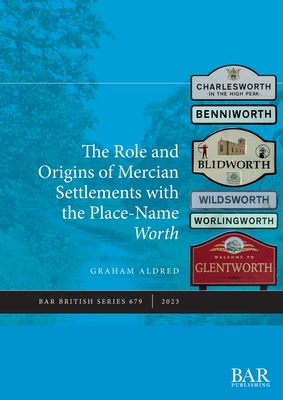
The Role and Origins of Mercian Settlements with the Place-Name Worth
| AUTHOR | Aldred, Graham |
| PUBLISHER | British Archaeological Reports (Oxford) Ltd (10/31/2023) |
| PRODUCT TYPE | Paperback (Paperback) |
It is commonly recognised that in the Anglo-Saxon world, the naming of geographical features and settlement names was far from arbitrary. Settlement names were specifically descriptive, communicating more than simply the name of a landscape aspect. Previous examinations of settlements containing the Old English term worth, along with its cognates worthy and wardine, have been limited to small regions or county-level analyses. Uniquely, this monograph examines the characteristics of these places in the wider context of the kingdom of Mercia (6th century AD-9th century AD). Worths are found clustered near boundaries and at the junctions of major lines of communication, as well as shared by similar topographic features. Mercia controlled territory spanning from Offa's Dyke in the west to the North Sea, and the Thames Valley in the south to the rivers Humber and Dee in the north. This expanse allows for the study of a broad geographical and political context. Offa's Dyke, the most prominent feature of Mercian power, confirms the assertion of local control in defence of the kingdom's land wealth. The remarkable placement of worths throughout the landscape hints at a level of control previously unrecorded in Anglo-Saxon England.
It is commonly recognised that in the Anglo-Saxon world, the naming of geographical features and settlement names was far from arbitrary. Settlement names were specifically descriptive, communicating more than simply the name of a landscape aspect. Previous examinations of settlements containing the Old English term worth, along with its cognates worthy and wardine, have been limited to small regions or county-level analyses. Uniquely, this monograph examines the characteristics of these places in the wider context of the kingdom of Mercia (6th century AD-9th century AD). Worths are found clustered near boundaries and at the junctions of major lines of communication, as well as shared by similar topographic features. Mercia controlled territory spanning from Offa's Dyke in the west to the North Sea, and the Thames Valley in the south to the rivers Humber and Dee in the north. This expanse allows for the study of a broad geographical and political context. Offa's Dyke, the most prominent feature of Mercian power, confirms the assertion of local control in defence of the kingdom's land wealth. The remarkable placement of worths throughout the landscape hints at a level of control previously unrecorded in Anglo-Saxon England.