
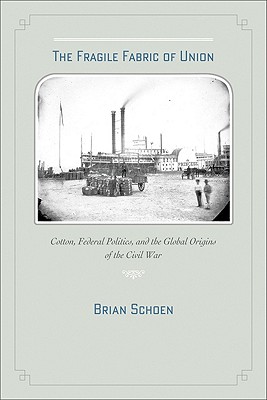
The Fragile Fabric of Union: Cotton, Federal Politics, and the Global Origins of the Civil War
| AUTHOR | Schoen, Brian D. |
| PUBLISHER | Johns Hopkins University Press (10/06/2011) |
| PRODUCT TYPE | Paperback (Paperback) |
Winner, 2010 Bennett H. Wall Award, Southern Historical Association
In this fresh study Brian Schoen views the Deep South and its cotton industry from a global perspective, revisiting old assumptions and providing new insights into the region, the political history of the United States, and the causes of the Civil War.
Schoen takes a unique and broad approach. Rather than seeing the Deep South and its planters as isolated from larger intellectual, economic, and political developments, he places the region firmly within them. In doing so, he demonstrates that the region's prominence within the modern world--and not its opposition to it--indelibly shaped Southern history.
The place of "King Cotton" in the sectional thinking and budding nationalism of the Lower South seems obvious enough, but Schoen reexamines the ever-shifting landscape of international trade from the 1780s through the eve of the Civil War. He argues that the Southern cotton trade was essential to the European economy, seemingly worth any price for Europeans to protect and maintain, and something to defend aggressively in the halls of Congress. This powerful association gave the Deep South the confidence to ultimately secede from the Union.
By integrating the history of the region with global events, Schoen reveals how white farmers, planters, and merchants created a "Cotton South," preserved its profitability for many years, and ensured its dominance in the international raw cotton markets. The story he tells reveals the opportunities and costs of cotton production for the Lower South and the United States.
Winner, Bennett H. Wall Award, Southern Historical Association
In this fresh study, Brian Schoen views the Deep South and its cotton industry from a global perspective, revisiting old assumptions and providing new insights into the region, the political history of the United States, and the causes of the Civil War.
"Impressive . . . Adds an intriguing new dimension to ongoing debates about the nature of southern economic development, what motivated southern states to secede, why they seceded when they did, and ultimately what caused the Civil War."--American Historical Review
"An important contribution to the reinterpretation of plantation slavery and the origins of the U.S. Civil War . . . A lucidly written, richly researched, and convincing analysis of the global forces that shaped the politics of the southern slaveholders."--Journal of American History
"Schoen has written an immensely important history of southern political economy, one that is destined to be prominent in future studies of the Old South."--Civil War Book Review
"In this provocative book, he forces historians who have not done so already to discount 'Lost Cause' lore and pay greater attention to southerners who thought they could use their monopoly in raw cotton as leverage to advance the interests of their region in the larger world."--Journal of Interdisciplinary History
"This book will be a welcome addition to the bookshelf of any scholar of the antebellum era."--Technology and Culture
Winner, Bennett H. Wall Award, Southern Historical Association
In this fresh study, Brian Schoen views the Deep South and its cotton industry from a global perspective, revisiting old assumptions and providing new insights into the region, the political history of the United States, and the causes of the Civil War.
Impressive . . . Adds an intriguing new dimension to ongoing debates about the nature of southern economic development, what motivated southern states to secede, why they seceded when they did, and ultimately what caused the Civil War.--American Historical Review
An important contribution to the reinterpretation of plantation slavery and the origins of the U.S. Civil War . . . A lucidly written, richly researched, and convincing analysis of the global forces that shaped the politics of the southern slaveholders.--Journal of American History
Schoen has written an immensely important history of southern political economy, one that is destined to be prominent in future studies of the Old South.--Civil War Book Review
In this provocative book, he forces historians who have not done so already to discount 'Lost Cause' lore and pay greater attention to southerners who thought they could use their monopoly in raw cotton as leverage to advance the interests of their region in the larger world.--Journal of Interdisciplinary History
This book will be a welcome addition to the bookshelf of any scholar of the antebellum era.--Technology and Culture
--Charles Postel, Bancroft prize-winning author of The Populist Vision "Enterprise and Society"Winner, 2010 Bennett H. Wall Award, Southern Historical Association
In this fresh study Brian Schoen views the Deep South and its cotton industry from a global perspective, revisiting old assumptions and providing new insights into the region, the political history of the United States, and the causes of the Civil War.
Schoen takes a unique and broad approach. Rather than seeing the Deep South and its planters as isolated from larger intellectual, economic, and political developments, he places the region firmly within them. In doing so, he demonstrates that the region's prominence within the modern world--and not its opposition to it--indelibly shaped Southern history.
The place of "King Cotton" in the sectional thinking and budding nationalism of the Lower South seems obvious enough, but Schoen reexamines the ever-shifting landscape of international trade from the 1780s through the eve of the Civil War. He argues that the Southern cotton trade was essential to the European economy, seemingly worth any price for Europeans to protect and maintain, and something to defend aggressively in the halls of Congress. This powerful association gave the Deep South the confidence to ultimately secede from the Union.
By integrating the history of the region with global events, Schoen reveals how white farmers, planters, and merchants created a "Cotton South," preserved its profitability for many years, and ensured its dominance in the international raw cotton markets. The story he tells reveals the opportunities and costs of cotton production for the Lower South and the United States.