
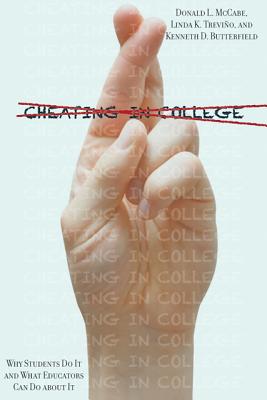
Cheating in College: Why Students Do It and What Educators Can Do about It
| AUTHOR | Trevio, Linda K.; Butterfield, Kenneth D.; McCabe, Donald L. et al. |
| PUBLISHER | Johns Hopkins University Press (11/01/2012) |
| PRODUCT TYPE | Hardcover (Hardcover) |
With academic dishonesty on the rise, this book explains why students cheat, how to foster integrity, and why it matters.
Today's students are tomorrow's leaders, and the college years are a critical period for their development of ethical standards. Cheating in College explores how and why students cheat and what policies, practices, and participation may be useful in promoting academic integrity and reducing cheating.
The authors investigate trends over time, including internet-based cheating. They consider personal and situational explanations, such as the culture of groups in which dishonesty is more common (such as business majors) and social settings that support cheating (such as fraternities and sororities). They also focus on how faculty and administrators are increasing their efforts to promote academic honesty among students. Orientation and training sessions, information on college and university websites, student handbooks that describe codes of conduct, honor codes, and course syllabi all define cheating and establish the consequences.
Based on the authors' multiyear, multisite surveys, Cheating in College quantifies and analyzes student cheating to demonstrate why academic integrity is important and to describe the cultural efforts that are effective in restoring it.
Today's students are tomorrow's leaders, and the college years are a critical period for their development of ethical standards. Cheating in College explores how and why students cheat and what policies, practices, and participation may be useful in promoting academic integrity and reducing cheating.
The authors investigate trends over time, including internet-based cheating. They consider personal and situational explanations, such as the culture of groups in which dishonesty is more common (such as business majors) and social settings that support cheating (such as fraternities and sororities). They also focus on how faculty and administrators are increasing their efforts to promote academic honesty among students. Orientation and training sessions, information on college and university websites, student handbooks that describe codes of conduct, honor codes, and course syllabi all define cheating and establish the consequences.
Based on the authors' multiyear, multisite surveys, Cheating in College quantifies and analyzes student cheating to demonstrate why academic integrity is important and to describe the cultural efforts that are effective in restoring it.
"The book was written to bring together two decades of research by the authors as well as by others . . . There is no book covering this topic like Cheating in College. The authors' reliance on large-scale quantitative and generalizable studies sets this work apart as a classic. This is an excellent book that should be required reading for academic affairs and student affairs leaders."--Journal of College & Character
"Cheating in College is a valuable read that allows educators of all disciplines to gain much-needed insight into the numerous complex issues related to student cheating. It also offers readers concrete and easy to follow tips on how to work to reduce the prevalence of cheating in their classrooms and campuses."--Academy of Management Learning & Education
"The information on cheating is beneficial to all individuals working in higher education."--NACADA
With academic dishonesty on the rise, this book explains why students cheat, how to foster integrity, and why it matters.
Today's students are tomorrow's leaders, and the college years are a critical period for their development of ethical standards. Cheating in College explores how and why students cheat and what policies, practices, and participation may be useful in promoting academic integrity and reducing cheating.
The authors investigate trends over time, including internet-based cheating. They consider personal and situational explanations, such as the culture of groups in which dishonesty is more common (such as business majors) and social settings that support cheating (such as fraternities and sororities). They also focus on how faculty and administrators are increasing their efforts to promote academic honesty among students. Orientation and training sessions, information on college and university websites, student handbooks that describe codes of conduct, honor codes, and course syllabi all define cheating and establish the consequences.
Based on the authors' multiyear, multisite surveys, Cheating in College quantifies and analyzes student cheating to demonstrate why academic integrity is important and to describe the cultural efforts that are effective in restoring it.