
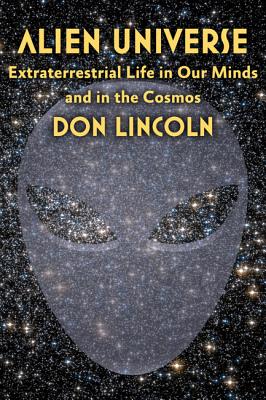
Alien Universe: Extraterrestrial Life in Our Minds and in the Cosmos
| AUTHOR | Lincoln, Don |
| PUBLISHER | Johns Hopkins University Press (11/08/2017) |
| PRODUCT TYPE | Paperback (Paperback) |
Are alien civilizations really possible?
If extraterrestrials exist, where are they? How likely is it that somewhere in the universe an Earth-like planet supports an advanced culture? Why do so many people claim to have encountered Aliens? In this gripping exploration, scientist Don Lincoln exposes and explains the truths about the belief in and the search for life on other planets.
In the first half of Alien Universe, Lincoln looks to Western civilization's collective image of Aliens, showing how our perceptions of extraterrestrials have evolved over time. The roots of this belief can be traced as far back as our earliest recognition of other planets in the universe--the idea of them supporting life was a natural progression of thinking that has fascinated us ever since. Our captivation with Aliens has, however, led to mixed results. The world was fooled in the nineteenth century during the Great Moon Hoax of 1835, and many people misunderstood Orson Welles's 1938 radio broadcast, The War of the Worlds, leading to significant anxiety among some listeners. Our continuing interest in Aliens is reflected in entertainment successes such as E.T., The X-Files, and Star Trek.
The second half of the book explores the scientific possibility of whether advanced Alien civilizations do exist. For many years, researchers have sought to answer Enrico Fermi's great paradox--if there are so many planets in the universe and there is a high probability that many of those can support life, then why have we not actually encountered any Aliens? Lincoln describes how modern science teaches us what is possible and what is not in our search for extraterrestrial civilizations.
Whether you are drawn to the psychological belief in Aliens, the history of our interest in life on other planets, or the scientific possibility of Alien existence, Alien Universe is sure to hold you spellbound.
If extraterrestrials exist, where are they? How likely is it that somewhere in the universe an Earth-like planet supports an advanced culture? Why do so many people claim to have encountered Aliens? In this gripping exploration, scientist Don Lincoln exposes and explains the truths about the belief in and the search for life on other planets.
In the first half of Alien Universe, Lincoln looks to Western civilization's collective image of Aliens, showing how our perceptions of extraterrestrials have evolved over time. The roots of this belief can be traced as far back as our earliest recognition of other planets in the universe--the idea of them supporting life was a natural progression of thinking that has fascinated us ever since. Our captivation with Aliens has, however, led to mixed results. The world was fooled in the nineteenth century during the Great Moon Hoax of 1835, and many people misunderstood Orson Welles's 1938 radio broadcast, The War of the Worlds, leading to significant anxiety among some listeners. Our continuing interest in Aliens is reflected in entertainment successes such as E.T., The X-Files, and Star Trek.
The second half of the book explores the scientific possibility of whether advanced Alien civilizations do exist. For many years, researchers have sought to answer Enrico Fermi's great paradox--if there are so many planets in the universe and there is a high probability that many of those can support life, then why have we not actually encountered any Aliens? Lincoln describes how modern science teaches us what is possible and what is not in our search for extraterrestrial civilizations.
Whether you are drawn to the psychological belief in Aliens, the history of our interest in life on other planets, or the scientific possibility of Alien existence, Alien Universe is sure to hold you spellbound.
"Rather than dismiss Alien life out of hand, he presents the historical and social reasons for the growth of our fascination with the possibility. After covering popular ideas, Lincoln then delves into what is scientifically possible, explaining the concepts beautifully and in layman's terms . . . This is a clear and clear-sighted look at Aliens by a man who would be delighted if one day they appeared."--Publishers Weekly
"I immediately warmed to this book. It's not only written in terms the average lay person can understand but it follows a well structured theme that has a start, middle, and an end. I like that because it maintains order in a subject that deals mainly with a mix of confusing ideologies, fact and scientifically based interpretations."--David Reneke's World of Space and Astronomy
"By combining the latest research with historical perception, Alien Universe successfully creates an outstanding inquiry highly recommended for any science-based collection looking for a blend of historical references and modern-day probes."--Midwest Book Review
"The book is a level-headed fusion of pop culture and the latest scientific advances in the field of astrobiology, discussing the requirements for life on Earth."--BBC Focus
"This book comes close to being the definitive guide to where we are in the search for extraterrestrials."--Cosmos
If extraterrestrials exist, where are they? How likely is it that somewhere in the universe an Earth-like planet supports an advanced culture? Why do so many people claim to have encountered Aliens? In this gripping exploration, scientist Don Lincoln exposes and explains the truths about the belief in and the search for life on other planets.
In the first half of Alien Universe, Lincoln looks to Western civilization's collective image of Aliens, showing how our perceptions of extraterrestrials have evolved over time. The roots of this belief can be traced as far back as our earliest recognition of other planets in the universe--the idea of them supporting life was a natural progression of thinking that has fascinated us ever since. Our captivation with Aliens has, however, led to mixed results. The world was fooled in the nineteenth century during the Great Moon Hoax of 1835, and many people misunderstood Orson Welles's 1938 radio broadcast, The War of the Worlds, leading to significant anxiety among some listeners. Our continuing interest in Aliens is reflected in entertainment successes such as E.T., The X-Files, and Star Trek.
The second half of the book explores the scientific possibility of whether advanced Alien civilizations do exist. For many years, researchers have sought to answer Enrico Fermi's great paradox--if there are so many planets in the universe and there is a high probability that many of those can support life, then why have we not actually encountered any Aliens? Lincoln describes how modern science teaches us what is possible and what is not in our search for extraterrestrial civilizations.
Whether you are drawn to the psychological belief in Aliens, the history of our interest in life on other planets, or the scientific possibility of Alien existence, Alien Universe is sure to hold you spellbound.
Rather than dismiss Alien life out of hand, he presents the historical and social reasons for the growth of our fascination with the possibility. After covering popular ideas, Lincoln then delves into what is scientifically possible, explaining the concepts beautifully and in layman's terms . . . This is a clear and clear-sighted look at Aliens by a man who would be delighted if one day they appeared.--Publishers Weekly
I immediately warmed to this book. It's not only written in terms the average lay person can understand but it follows a well structured theme that has a start, middle, and an end. I like that because it maintains order in a subject that deals mainly with a mix of confusing ideologies, fact and scientifically based interpretations.--David Reneke's World of Space and Astronomy
By combining the latest research with historical perception, Alien Universe successfully creates an outstanding inquiry highly recommended for any science-based collection looking for a blend of historical references and modern-day probes.--Midwest Book Review
The book is a level-headed fusion of pop culture and the latest scientific advances in the field of astrobiology, discussing the requirements for life on Earth.--BBC Focus
This book comes close to being the definitive guide to where we are in the search for extraterrestrials.--Cosmos
--Jocelyne DiRuggiero, Johns Hopkins University "Cosmos"Are alien civilizations really possible?
If extraterrestrials exist, where are they? How likely is it that somewhere in the universe an Earth-like planet supports an advanced culture? Why do so many people claim to have encountered Aliens? In this gripping exploration, scientist Don Lincoln exposes and explains the truths about the belief in and the search for life on other planets.
In the first half of Alien Universe, Lincoln looks to Western civilization's collective image of Aliens, showing how our perceptions of extraterrestrials have evolved over time. The roots of this belief can be traced as far back as our earliest recognition of other planets in the universe--the idea of them supporting life was a natural progression of thinking that has fascinated us ever since. Our captivation with Aliens has, however, led to mixed results. The world was fooled in the nineteenth century during the Great Moon Hoax of 1835, and many people misunderstood Orson Welles's 1938 radio broadcast, The War of the Worlds, leading to significant anxiety among some listeners. Our continuing interest in Aliens is reflected in entertainment successes such as E.T., The X-Files, and Star Trek.
The second half of the book explores the scientific possibility of whether advanced Alien civilizations do exist. For many years, researchers have sought to answer Enrico Fermi's great paradox--if there are so many planets in the universe and there is a high probability that many of those can support life, then why have we not actually encountered any Aliens? Lincoln describes how modern science teaches us what is possible and what is not in our search for extraterrestrial civilizations.
Whether you are drawn to the psychological belief in Aliens, the history of our interest in life on other planets, or the scientific possibility of Alien existence, Alien Universe is sure to hold you spellbound.