
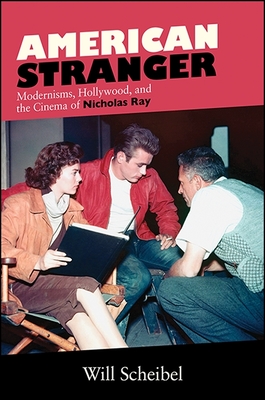
American Stranger: Modernisms, Hollywood, and the Cinema of Nicholas Ray
| AUTHOR | Scheibel, Will |
| PUBLISHER | State University of New York Press (01/02/2018) |
| PRODUCT TYPE | Paperback (Paperback) |
Reconstructs how Ray became a "rebel auteur" in cinema culture.
How does cinema culture imagine one of its favorite figures, the rebel? The reputation of the American director Nicholas Ray provides a particularly notable example. Most famous for Rebel Without a Cause, Ray has since been canonized as a "rebel auteur" and celebrated for seeking a personal vision and signature style under the industrial pressures of Classical Hollywood during its late studio period. In American Stranger, Will Scheibel reconstructs how Ray's reputation developed over time, analyzing the different historical practices of modernism that set new horizons for artistic rebellion in postwar cinema.
Drawing on biographical legends, interviews, film reviews, articles in both national newspapers and international film magazines, and star promotion and publicity, Scheibel examines the contexts in which Ray's reputation was constructed. These include the consolidation of director-based film criticism and the rise of film studies as an academic discipline; star performances and personifications of the rebel male in Ray's films; the counterculture in which Ray promoted himself as a teacher and worked as a political avant-gardist; and the art cinemas of Jean-Luc Godard, Wim Wenders, and Jim Jarmusch, each of whom were influenced by Ray. In addition to Rebel Without a Cause, Scheibel also analyzes such classic films as The Lusty Men and In a Lonely Place, as well as collaborative, less-examined films from his later career outside of Hollywood, We Can't Go Home Again and Lightning Over Water. Reconstructing the evolution of Ray's place in cinema culture, this intellectual history measures the standards for both rebellion and convention, for the vanguard and the establishment, that determine an artistic reputation.
Reconstructs how Ray became a "rebel auteur" in cinema culture.
How does cinema culture imagine one of its favorite figures, the rebel? The reputation of the American director Nicholas Ray provides a particularly notable example. Most famous for Rebel Without a Cause, Ray has since been canonized as a "rebel auteur" and celebrated for seeking a personal vision and signature style under the industrial pressures of Classical Hollywood during its late studio period. In American Stranger, Will Scheibel reconstructs how Ray's reputation developed over time, analyzing the different historical practices of modernism that set new horizons for artistic rebellion in postwar cinema.
Drawing on biographical legends, interviews, film reviews, articles in both national newspapers and international film magazines, and star promotion and publicity, Scheibel examines the contexts in which Ray's reputation was constructed. These include the consolidation of director-based film criticism and the rise of film studies as an academic discipline; star performances and personifications of the rebel male in Ray's films; the counterculture in which Ray promoted himself as a teacher and worked as a political avant-gardist; and the art cinemas of Jean-Luc Godard, Wim Wenders, and Jim Jarmusch, each of whom were influenced by Ray. In addition to Rebel Without a Cause, Scheibel also analyzes such classic films as The Lusty Men and In a Lonely Place, as well as collaborative, less-examined films from his later career outside of Hollywood, We Can't Go Home Again and Lightning Over Water. Reconstructing the evolution of Ray's place in cinema culture, this intellectual history measures the standards for both rebellion and convention, for the vanguard and the establishment, that determine an artistic reputation.