
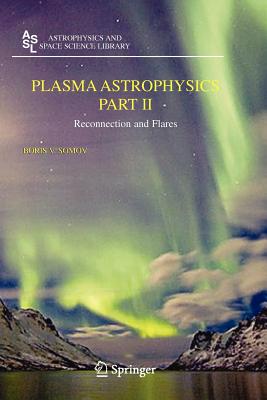
Plasma Astrophysics, Part II: Reconnection and Flares
| AUTHOR | Somov, Boris V. |
| PUBLISHER | Springer (12/16/2010) |
| PRODUCT TYPE | Paperback (Paperback) |
Description
Magnetic ?elds are easily generated in astrophysical plasma owing to its ?6 high conductivity. Magnetic ?elds, having strengths of order few 10 G, correlated on several kiloparsec scales are seen in spiral galaxies. Their origin could be due to ampli?cation of a small seed ?eld by a turbulent galactic dynamo. In several galaxies, like the famous M51, magnetic ?elds are well correlated (or anti-correlated) with the optical spiral arms. These are the weakest large-scale ?elds observed in cosmic space. The strongest magnets in space are presumably the so-called magnetars, the highly mag- 15 netized (with the strength of the ?eld of about 10 G) young neutron stars formed in the supernova explosions. The energy of magnetic ?elds is accumulated in astrophysical plasma, and the sudden release of this energy - an original electrodynamical 'burst' or'explosion'-takesplaceunderde?nitebutquitegeneralconditions(P- att, 1992; Sturrock, 1994; Kivelson and Russell, 1995; Rose, 1998; Priest and Forbes, 2000; Somov, 2000; Kundt, 2001). Such a '?are' in ast- physical plasma is accompanied by fast directed ejections (jets) of plasma, powerful ?ows of heat and hard electromagnetic radiation as well as by impulsive acceleration of charged particles to high energies.
Show More
Product Format
Product Details
ISBN-13:
9781441922458
ISBN-10:
1441922458
Binding:
Paperback or Softback (Trade Paperback (Us))
Content Language:
English
More Product Details
Page Count:
428
Carton Quantity:
18
Product Dimensions:
6.14 x 0.89 x 9.21 inches
Weight:
1.35 pound(s)
Country of Origin:
NL
Subject Information
BISAC Categories
Science | Physics - Astrophysics
Science | Space Science - Astronomy
Science | Physics - Atomic & Molecular
Dewey Decimal:
523.01
Descriptions, Reviews, Etc.
publisher marketing
Magnetic ?elds are easily generated in astrophysical plasma owing to its ?6 high conductivity. Magnetic ?elds, having strengths of order few 10 G, correlated on several kiloparsec scales are seen in spiral galaxies. Their origin could be due to ampli?cation of a small seed ?eld by a turbulent galactic dynamo. In several galaxies, like the famous M51, magnetic ?elds are well correlated (or anti-correlated) with the optical spiral arms. These are the weakest large-scale ?elds observed in cosmic space. The strongest magnets in space are presumably the so-called magnetars, the highly mag- 15 netized (with the strength of the ?eld of about 10 G) young neutron stars formed in the supernova explosions. The energy of magnetic ?elds is accumulated in astrophysical plasma, and the sudden release of this energy - an original electrodynamical 'burst' or'explosion'-takesplaceunderde?nitebutquitegeneralconditions(P- att, 1992; Sturrock, 1994; Kivelson and Russell, 1995; Rose, 1998; Priest and Forbes, 2000; Somov, 2000; Kundt, 2001). Such a '?are' in ast- physical plasma is accompanied by fast directed ejections (jets) of plasma, powerful ?ows of heat and hard electromagnetic radiation as well as by impulsive acceleration of charged particles to high energies.
Show More
List Price $209.00
Your Price
$206.91