
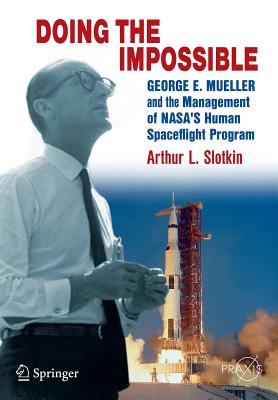
Doing the Impossible: George E. Mueller and the Management of Nasa's Human Spaceflight Program
| AUTHOR | Slotkin, Arthur L. |
| PUBLISHER | Springer (07/25/2012) |
| PRODUCT TYPE | Paperback (Paperback) |
Apollo was known for its engineering triumphs, but its success also came from a disciplined management style. This excellent account of one of the most important personalities in early American human spaceflight history describes for the first time how George E. Mueller, the system manager of the human spaceflight program of the 1960s, applied the SPO methodology and other special considerations such as "all-up"testing, resulting in the success of the Apollo Program. Wernher von Braun and others did not readily accept such testing or Mueller's approach to system management, but later acknowledged that without them NASA would not have landed astronauts on the Moon by 1969. While Apollo remained Mueller's priority, from his earliest days at the agency, he promoted a robust post-Apollo Program which resulted in Skylab, the Space Shuttle and the International Space Station. As a result of these efforts, Mueller earned the sobriquet: "the father of the space shuttle." Following his success at NASA, Mueller returned to industry. Although he did not play a leading role in human spaceflight again, in 2011 the National Air and Space Museum awarded him their lifetime achievement trophy for his contributions.
Following the contributions of George E. Mueller, in this unique book Arthur L. Slotkin answers such questions as: exactly how did the methods developed for use in the Air Force ballistic missile programs get modified and used in the Apollo Program? How did George E. Mueller, with the help of others, manage the Apollo Program? How did NASA centers, coming from federal agencies with cultures of their own, adapt to the new structured approach imposed from Washington? George E. Mueller is the ideal central character for this book. He was instrumental in the creation of Apollo extension systems leading to Apollo, the Shuttle, and today's ISS and thus was a pivotal figure in early American human spaceflight history.This excellent account of one of the most important personalities in early American human spaceflight history describes for the first time how George E. Mueller, the system manager of the human spaceflight program of the 1960s, applied the SPO methodology and other special considerations, resulting in the success of the Apollo Program. While Wernher von Braun and others did not really readily accept Mueller's approach to system management, they later acknowledged that without it NASA would not have landed astronauts on the Moon by 1969. While Apollo remained Mueller's top priority, from his earliest days at the agency he promoted a robust post-Apollo program, which culminated in Skylab, the Space Shuttle, and the International Space Station. As a result of these efforts, Mueller earned the sobriquet: "the father of the Space Shuttle."
Apollo was known for its engineering triumphs, but its success also came from a disciplined management style. This excellent account of one of the most important personalities in early American human spaceflight history describes for the first time how George E. Mueller, the system manager of the human spaceflight program of the 1960s, applied the SPO methodology and other special considerations such as "all-up"testing, resulting in the success of the Apollo Program. Wernher von Braun and others did not readily accept such testing or Mueller's approach to system management, but later acknowledged that without them NASA would not have landed astronauts on the Moon by 1969. While Apollo remained Mueller's priority, from his earliest days at the agency, he promoted a robust post-Apollo Program which resulted in Skylab, the Space Shuttle and the International Space Station. As a result of these efforts, Mueller earned the sobriquet: "the father of the space shuttle." Following his success at NASA, Mueller returned to industry. Although he did not play a leading role in human spaceflight again, in 2011 the National Air and Space Museum awarded him their lifetime achievement trophy for his contributions.
Following the contributions of George E. Mueller, in this unique book Arthur L. Slotkin answers such questions as: exactly how did the methods developed for use in the Air Force ballistic missile programs get modified and used in the Apollo Program? How did George E. Mueller, with the help of others, manage the Apollo Program? How did NASA centers, coming from federal agencies with cultures of their own, adapt to the new structured approach imposed from Washington? George E. Mueller is the ideal central character for this book. He was instrumental in the creation of Apollo extension systems leading to Apollo, the Shuttle, and today's ISS and thus was a pivotal figure in early American human spaceflight history.