
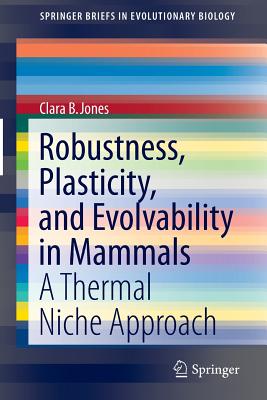
Robustness, Plasticity, and Evolvability in Mammals: A Thermal Niche Approach
| AUTHOR | Jones, Clara B. |
| PUBLISHER | Springer (06/06/2012) |
| PRODUCT TYPE | Paperback (Paperback) |
Description
Among the unresolved topics in evolutionary biology and behavioral ecology are the origins, mechanisms, evolution, and consequences of developmental and phenotypic diversity. In an attempt to address these challenges, plasticity has been investigated empirically and theoretically at all levels of biological organization--from biochemical to whole organism and beyond to the population, community, and ecosystem levels. Less commonly explored are constraints (e.g., ecological), costs (e.g., increased response error), perturbations (e.g., alterations in selection intensity), and stressors (e.g., resource limitation) influencing not only selective values of heritable phenotypic components but, also, decisions and choices (not necessarily conscious ones) available to individuals in populations. Treating extant mammals, the primary purpose of the proposed work is to provide new perspectives on common themes in the literature on robustness ("functional diversity"; differential resistance to "deconstraint" of conserved elements) and weak robustness (the potential to restrict plasticity and evolvability), plasticity (variation expressed throughout the lifetimes of individuals in a population setting "evolvability potential"), and evolvability (non-lethal phenotypic novelties induced by endogenous and/or exogenous stimuli). The proposed project will place particular emphasis upon the adaptive complex in relation to endogenous (e.g., genomes, neurophysiology) and exogenous (abiotic and biotic, including social environments) organismal features discussed as regulatory and environmental perturbations with the potential to induce, and, often, constrain variability and novelty of form and function
Show More
Product Format
Product Details
ISBN-13:
9781461438847
ISBN-10:
1461438845
Binding:
Paperback or Softback (Trade Paperback (Us))
Content Language:
English
More Product Details
Page Count:
108
Carton Quantity:
64
Product Dimensions:
6.10 x 0.70 x 9.10 inches
Weight:
0.40 pound(s)
Feature Codes:
Bibliography,
Index,
Maps,
Illustrated
Country of Origin:
NL
Subject Information
BISAC Categories
Science | Life Sciences - Ecology
Science | Life Sciences - Evolution
Science | Life Sciences - Developmental Biology
Dewey Decimal:
591.4
Library of Congress Control Number:
2012937848
Descriptions, Reviews, Etc.
publisher marketing
Among the unresolved topics in evolutionary biology and behavioral ecology are the origins, mechanisms, evolution, and consequences of developmental and phenotypic diversity. In an attempt to address these challenges, plasticity has been investigated empirically and theoretically at all levels of biological organization--from biochemical to whole organism and beyond to the population, community, and ecosystem levels. Less commonly explored are constraints (e.g., ecological), costs (e.g., increased response error), perturbations (e.g., alterations in selection intensity), and stressors (e.g., resource limitation) influencing not only selective values of heritable phenotypic components but, also, decisions and choices (not necessarily conscious ones) available to individuals in populations. Treating extant mammals, the primary purpose of the proposed work is to provide new perspectives on common themes in the literature on robustness ("functional diversity"; differential resistance to "deconstraint" of conserved elements) and weak robustness (the potential to restrict plasticity and evolvability), plasticity (variation expressed throughout the lifetimes of individuals in a population setting "evolvability potential"), and evolvability (non-lethal phenotypic novelties induced by endogenous and/or exogenous stimuli). The proposed project will place particular emphasis upon the adaptive complex in relation to endogenous (e.g., genomes, neurophysiology) and exogenous (abiotic and biotic, including social environments) organismal features discussed as regulatory and environmental perturbations with the potential to induce, and, often, constrain variability and novelty of form and function
Show More
Author:
Jones, Clara B.
Clara B. Jones, Ph.D. has studied spiders, fish, monkeys, and humans, including work in the field, in zoological gardens, and in the laboratory. Most of her research, beginning in 1973, has been conducted on the howling monkeys of Central America. Her publications primarily relate to sexual selection, reproductive competition, social organization, interindividual conflicts of interest, dispersal, and evolution in heterogeneous regimes. She has also contributed to the literature on primate conservation and population biology.
Show More
List Price $54.99
Your Price
$54.44