
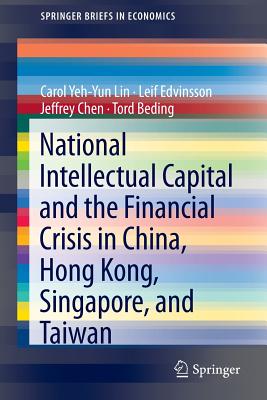
National Intellectual Capital and the Financial Crisis in China, Hong Kong, Singapore, and Taiwan
| AUTHOR | Chen, Jeffrey; Lin, Carol Yeh; Lin, Carol Yeh-Yun et al. |
| PUBLISHER | Springer (11/16/2012) |
| PRODUCT TYPE | Paperback (Paperback) |
In the first decade of the twenty-first century, the biggest event of worldwide proportion was the 2008 global financial crisis, which was caused primarily by ineffective governance, failed surveillance systems, and implementation flaws. While fiscal and monetary policies succeeded in pulling many countries out of a financial freefall, most economies have performed beneath pre-recession levels as governments continued to struggle with their finances.
Examining the financial crisis from the viewpoint of intangible assets provides a different perspective from traditional economic approaches. National Intellectual Capital (NIC), comprised mainly of human capital, market capital, process capital, renewal capital, and financial capital, is a valuable intangible asset and a key source of national competitive advantage in today's knowledge economy. The authors--pioneers in the field--present extensive data and a rigorous conceptual framework to analyze the connections between the global financial crisis and NIC development. Covering the period from 2005 to 2010 across 48 countries, the authors establish a positive correlation between NIC and GDP per capita and consider the impact of NIC investment for short-term recovery and long-term risk control and strategy formulation.
Each volume in a series of SpringerBriefs on NIC and the financial crisis provides in-depth coverage of the impact of thecrisis, the aftermath, future prospects, and policy implications for a regional cluster. This volume focuses on China, Hong Kong, Singapore, and Taiwan.
In the first decade of the twenty-first century, the biggest event of worldwide proportion was the 2008 global financial crisis, which was caused primarily by ineffective governance, failed surveillance systems, and implementation flaws. While fiscal and monetary policies succeeded in pulling many countries out of a financial freefall, most economies have performed beneath pre-recession levels as governments continued to struggle with their finances.
Examining the financial crisis from the viewpoint of intangible assets provides a different perspective from traditional economic approaches. National Intellectual Capital (NIC), comprised mainly of human capital, market capital, process capital, renewal capital, and financial capital, is a valuable intangible asset and a key source of national competitive advantage in today's knowledge economy. The authors--pioneers in the field--present extensive data and a rigorous conceptual framework to analyze the connections between the global financial crisis and NIC development. Covering the period from 2005 to 2010 across 48 countries, the authors establish a positive correlation between NIC and GDP per capita and consider the impact of NIC investment for short-term recovery and long-term risk control and strategy formulation.
Each volume in a series of SpringerBriefs on NIC and the financial crisis provides in-depth coverage of the impact of thecrisis, the aftermath, future prospects, and policy implications for a regional cluster. This volume focuses on China, Hong Kong, Singapore, and Taiwan.