
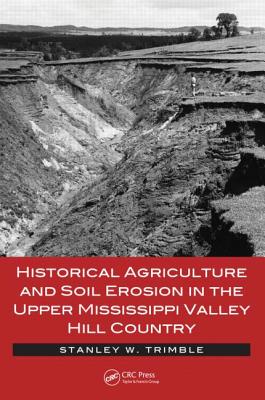
Historical Agriculture and Soil Erosion in the Upper Mississippi Valley Hill Country
| AUTHOR | Trimble, Stanley W. |
| PUBLISHER | CRC Press (11/21/2012) |
| PRODUCT TYPE | Hardcover (Hardcover) |
"This thought-provoking book demonstrates how processes of landscape transformation, usually illustrated only in simplified or idealized form, play out over time in real, complex landscapes. Trimble illustrates how a simple landscape disturbance, generated in this case by agriculture, can spread an astonishing variety of altered hydrologic and sedimentation processes throughout a drainage basin. The changes have spatial and temporal patterns forced on them by the distinctive topographic structure of drainage basins.
"Through painstaking field surveys, comparative photographic records, careful dating, a skillful eye for subtle landscape features, and a geographer's interdisciplinary understanding of landscape processes, the author leads the reader through the arc of an instructive and encouraging story. Farmers--whose unfamiliarity with new environmental conditions led initially to landscape destruction, impoverishment, and instability--eventually adapted their land use and settlement practices and, supported by government institutions, recovered and enriched the same working landscape.
"For the natural scientist, Historical Agriculture and Soil Erosion in the Upper Mississippi Valley Hill Country illustrates how an initially simple alteration of land cover can set off a train of unanticipated changes to runoff, erosion, and sedimentation processes that spread through a landscape over decades--impoverishing downstream landscapes and communities. Distinct zones of the landscape respond differently and in sequence. The effects take a surprisingly long time to spread through a landscape because sediment moves short distances during storms and can persist for decades or centuries in relatively stable forms where it resists further movement because of consolidation, plant reinforcement, and low gradients.
"For the social scientist, the book raises questions of whether and how people can be alerted early to their potential for environmental disturbance, but also for learning and adopting restorative practices. Trimble's commitment to all aspects of this problem should energize both groups."
--Professor Thomas Dunne, Bren School of Environmental Science and Management, UC Santa Barbara
"This thought-provoking book demonstrates how processes of landscape transformation, usually illustrated only in simplified or idealized form, play out over time in real, complex landscapes. Trimble illustrates how a simple landscape disturbance, generated in this case by agriculture, can spread an astonishing variety of altered hydrologic and sedimentation processes throughout a drainage basin. The changes have spatial and temporal patterns forced on them by the distinctive topographic structure of drainage basins.
"Through painstaking field surveys, comparative photographic records, careful dating, a skillful eye for subtle landscape features, and a geographer's interdisciplinary understanding of landscape processes, the author leads the reader through the arc of an instructive and encouraging story. Farmers--whose unfamiliarity with new environmental conditions led initially to landscape destruction, impoverishment, and instability--eventually adapted their land use and settlement practices and, supported by government institutions, recovered and enriched the same working landscape.
"For the natural scientist, Historical Agriculture and Soil Erosion in the Upper Mississippi Valley Hill Country illustrates how an initially simple alteration of land cover can set off a train of unanticipated changes to runoff, erosion, and sedimentation processes that spread through a landscape over decades--impoverishing downstream landscapes and communities. Distinct zones of the landscape respond differently and in sequence. The effects take a surprisingly long time to spread through a landscape because sediment moves short distances during storms and can persist for decades or centuries in relatively stable forms where it resists further movement because of consolidation, plant reinforcement, and low gradients.
"For the social scientist, the book raises questions of whether and how people can be alerted early to their potential for environmental disturbance, but also for learning and adopting restorative practices. Trimble's commitment to all aspects of this problem should energize both groups."
--Professor Thomas Dunne, Bren School of Environmental Science and Management, UC Santa Barbara