
ISBN 9781475254877 is currently unpriced. Please contact us for pricing.
Available options are listed below:
Available options are listed below:
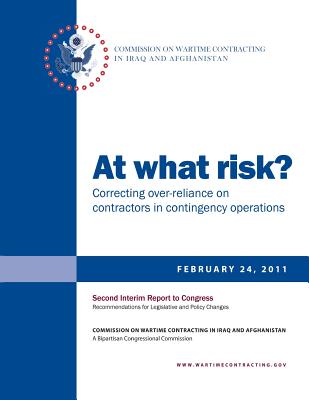
At what risk? Correcting over-reliance on contractors in contingency operations
| AUTHOR | Wartime Contracting, Us Commission on |
| PUBLISHER | Createspace Independent Publishing Platform (04/26/2012) |
| PRODUCT TYPE | Paperback (Paperback) |
Description
Congress established the Commission on Wartime Contracting to reduce the extensive amount of waste, fraud, and abuse in Iraq and Afghanistan and in future contingency operations. Contract waste, fraud, and abuse take many forms: - An ill-conceived project, no matter how well-managed, is wasteful if it does not fit the cultural, political, and economic mores of the society it is meant to serve, or if it cannot be supported and maintained. - Poor planning and oversight by the U.S. government, as well as poor performance on the part of contractors, have costly outcomes: time and money misspent are lost for other purposes. - Criminal behavior and blatant corruption sap dollars from what could otherwise be successful project outcomes and, more disturbingly, contribute to a climate in which huge amounts of waste are accepted as the norm. Although no estimate captures the full cost associated with this waste, fraud, and abuse, it clearly runs into the billions of dollars. Yet, for many years the government has abdicated its contracting responsibilities-too often using contractors as the default mechanism, driven by considerations other than whether they provide the best solution, and without consideration for the resources needed to manage them. That is how contractors have come to account for fully half the United States presence in contingency operations. Regrettably, our government has been slow to make the changes that could limit the dollars wasted. After extensive deliberation, the Commission has determined that only sweeping reforms can bring about the changes that must be made. We must expand responsibility and accountability for contracting outcomes. The business of contracting must be treated commensurately with its cost in taxpayer dollars and with its mission-critical role in contingency operations. We issue this second interim report, At what risk?, in the hope that the Congress and the Administration will adopt our recommendations.
Show More
Product Format
Product Details
ISBN-13:
9781475254877
ISBN-10:
1475254873
Binding:
Paperback or Softback (Trade Paperback (Us))
Content Language:
English
More Product Details
Page Count:
72
Carton Quantity:
45
Product Dimensions:
8.50 x 0.19 x 11.02 inches
Weight:
0.42 pound(s)
Country of Origin:
US
Subject Information
BISAC Categories
Business & Economics | Government & Business
Descriptions, Reviews, Etc.
publisher marketing
Congress established the Commission on Wartime Contracting to reduce the extensive amount of waste, fraud, and abuse in Iraq and Afghanistan and in future contingency operations. Contract waste, fraud, and abuse take many forms: - An ill-conceived project, no matter how well-managed, is wasteful if it does not fit the cultural, political, and economic mores of the society it is meant to serve, or if it cannot be supported and maintained. - Poor planning and oversight by the U.S. government, as well as poor performance on the part of contractors, have costly outcomes: time and money misspent are lost for other purposes. - Criminal behavior and blatant corruption sap dollars from what could otherwise be successful project outcomes and, more disturbingly, contribute to a climate in which huge amounts of waste are accepted as the norm. Although no estimate captures the full cost associated with this waste, fraud, and abuse, it clearly runs into the billions of dollars. Yet, for many years the government has abdicated its contracting responsibilities-too often using contractors as the default mechanism, driven by considerations other than whether they provide the best solution, and without consideration for the resources needed to manage them. That is how contractors have come to account for fully half the United States presence in contingency operations. Regrettably, our government has been slow to make the changes that could limit the dollars wasted. After extensive deliberation, the Commission has determined that only sweeping reforms can bring about the changes that must be made. We must expand responsibility and accountability for contracting outcomes. The business of contracting must be treated commensurately with its cost in taxpayer dollars and with its mission-critical role in contingency operations. We issue this second interim report, At what risk?, in the hope that the Congress and the Administration will adopt our recommendations.
Show More