
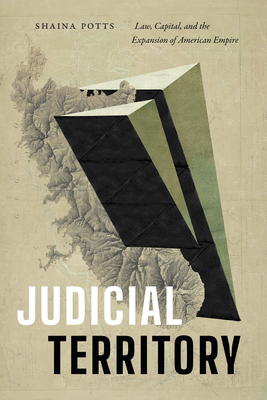
Judicial Territory: Law, Capital, and the Expansion of American Empire
| AUTHOR | Potts, Shaina |
| PUBLISHER | Duke University Press (09/13/2024) |
| PRODUCT TYPE | Hardcover (Hardcover) |
Description
In Judicial Territory, Shaina Potts reveals how the American empire has benefited from the post-World War II expansion of United States judicial authority over the economic decisions of postcolonial governments. Introducing the term "judicial territory" to refer to the increasingly transnational space over which US courts wield authority, Potts argues that law is an essential tool for US geopolitical and economic interests. Through close examination of cases involving private US companies, on the one hand, and foreign state-owned enterprises, nationalizations, and sovereign debt, on the other, she shows that technical changes relating to the treatment of foreign sovereigns in domestic US law allowed the United States to extend its purview over global financial and economic relations, including many economic decisions of foreign governments. Throughout, Potts argues, US law has not become divorced from territoriality but instead actively remapped it; it has not merely responded to globalization, but actively produced it--making the whole world part of US economic space in the process.
Show More
Product Format
Product Details
ISBN-13:
9781478026488
ISBN-10:
1478026480
Binding:
Hardback or Cased Book (Sewn)
Content Language:
English
More Product Details
Page Count:
304
Carton Quantity:
20
Product Dimensions:
5.90 x 1.00 x 9.00 inches
Weight:
1.55 pound(s)
Feature Codes:
Bibliography,
Index
Country of Origin:
US
Subject Information
BISAC Categories
Law | Legal History
Law | Globalization
Law | Human Geography
Dewey Decimal:
347.731
Library of Congress Control Number:
2023047394
Descriptions, Reviews, Etc.
publisher marketing
In Judicial Territory, Shaina Potts reveals how the American empire has benefited from the post-World War II expansion of United States judicial authority over the economic decisions of postcolonial governments. Introducing the term "judicial territory" to refer to the increasingly transnational space over which US courts wield authority, Potts argues that law is an essential tool for US geopolitical and economic interests. Through close examination of cases involving private US companies, on the one hand, and foreign state-owned enterprises, nationalizations, and sovereign debt, on the other, she shows that technical changes relating to the treatment of foreign sovereigns in domestic US law allowed the United States to extend its purview over global financial and economic relations, including many economic decisions of foreign governments. Throughout, Potts argues, US law has not become divorced from territoriality but instead actively remapped it; it has not merely responded to globalization, but actively produced it--making the whole world part of US economic space in the process.
Show More
List Price $107.95
Your Price
$106.87