
ISBN 9781478168300 is currently unpriced. Please contact us for pricing.
Available options are listed below:
Available options are listed below:
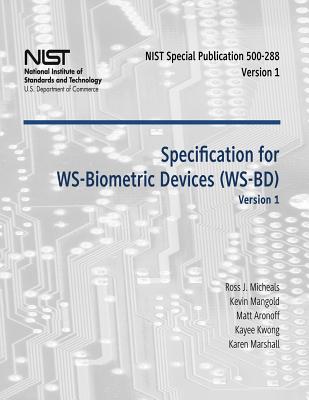
Specification for WS-Biometric Devices (WS-BD) Version 1: Recommendations of the National Institute of Standards and Technology (Special Publication 5
| AUTHOR | Kwong, Kayee; Aronoff, Matt; Micheals, Ross J. et al. |
| PUBLISHER | Createspace Independent Publishing Platform (06/30/2012) |
| PRODUCT TYPE | Paperback (Paperback) |
Description
The National Institute of Standards and Technology addresses biometric devices in their Special Publication 500-288, "Specifications for WS-Biometric Devices (WS-BD) Version 1". "The web services framework, has, in essence, begun to create a standard software 'communications bus' in support of service-oriented architecture. Applications and services can 'plug in' to the bus and begin communicating using standards tools. The emergence of this 'bus' has profound implications for identity exchange." Jamie Lewis, Burton Group, February 2005; Forward to Digital Identity by Phillip J. Windley. As noted by Jamie Lewis, the emergence of web services as a common communications bus has "profound implications." The next generation of biometric devices will not only need to be intelligent, secure, tamperproof, and spoof resistant, but first, they will need to be interoperable. These envisioned devices will require a communications protocol that is secure, globally connected, and free from requirements on operating systems, device drivers, form factors, and low-level communications protocols. WS-Biometric Devices is a protocol designed in the interest of furthering this goal, with a specific focus on the single process shared by all biometric systems-acquisition. Biometrics are playing an increasing role in security, access control, and identity management. Fingerprints are often used in conjunction with passwords for computer security. Many jobs require employees to provide biometrics; using WS-BD equipment could potentially reduce costs by facilitating interoperability in biometrics devices, NIST explained. The WS-BD protocol will simplify setting up and maintaining secure biometric systems to verify identity because such biometric systems will be easier to assemble with interoperable components compared to current biometrics systems that have proprietary device-specific drivers and cables, according to NIST.
Show More
Product Format
Product Details
ISBN-13:
9781478168300
ISBN-10:
1478168307
Binding:
Paperback or Softback (Trade Paperback (Us))
Content Language:
English
More Product Details
Page Count:
122
Carton Quantity:
32
Product Dimensions:
8.50 x 0.26 x 11.02 inches
Weight:
0.66 pound(s)
Country of Origin:
US
Subject Information
BISAC Categories
Computers | Information Technology
Descriptions, Reviews, Etc.
publisher marketing
The National Institute of Standards and Technology addresses biometric devices in their Special Publication 500-288, "Specifications for WS-Biometric Devices (WS-BD) Version 1". "The web services framework, has, in essence, begun to create a standard software 'communications bus' in support of service-oriented architecture. Applications and services can 'plug in' to the bus and begin communicating using standards tools. The emergence of this 'bus' has profound implications for identity exchange." Jamie Lewis, Burton Group, February 2005; Forward to Digital Identity by Phillip J. Windley. As noted by Jamie Lewis, the emergence of web services as a common communications bus has "profound implications." The next generation of biometric devices will not only need to be intelligent, secure, tamperproof, and spoof resistant, but first, they will need to be interoperable. These envisioned devices will require a communications protocol that is secure, globally connected, and free from requirements on operating systems, device drivers, form factors, and low-level communications protocols. WS-Biometric Devices is a protocol designed in the interest of furthering this goal, with a specific focus on the single process shared by all biometric systems-acquisition. Biometrics are playing an increasing role in security, access control, and identity management. Fingerprints are often used in conjunction with passwords for computer security. Many jobs require employees to provide biometrics; using WS-BD equipment could potentially reduce costs by facilitating interoperability in biometrics devices, NIST explained. The WS-BD protocol will simplify setting up and maintaining secure biometric systems to verify identity because such biometric systems will be easier to assemble with interoperable components compared to current biometrics systems that have proprietary device-specific drivers and cables, according to NIST.
Show More