
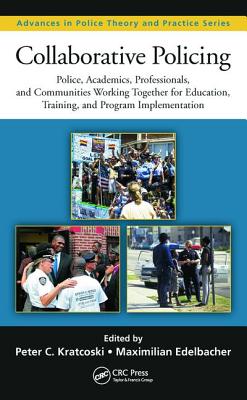
Collaborative Policing: Police, Academics, Professionals, and Communities Working Together for Education, Training, and Program Implementation
| PUBLISHER | Routledge (10/05/2015) |
| PRODUCT TYPE | Hardcover (Hardcover) |
"The chapters in this book reveal that police education, training, and practices are now closely tied to collaboration between police, academics, professional practitioners, and community agencies, and such collaboration is described and evaluated."
-Dilip K. Das, PhD, Founding President, International Police Executive Symposium (IPES) and founding editor-in-chief, Police Practice and Research: An International Journal, from the series editor's preface
"The chapters in this book present genuinely comparative, theoretically informed, and experience-based collaborative programs to appraise and analyze the specific practical, theoretical, and psychological challenges of working together and the creative means to overcome those challenges."
-Otwin Marenin, Department of Criminal Justice and Criminology, Washington State University, from the foreword
A collection of chapters authored by internationally known police leaders, academics, researchers, and professionals, Collaborative Policing focuses on the fact that the worlds of policing practice and research are moving closer. Using in-depth interviews with police and professionals who work with justice agencies as well as case studies demonstrating fruitful police-academic collaboration, it explores methods and programs for improving the quality of services provided by the police.
Many police executives, in conjunction with citizens and political leaders, now define the missions of their agencies on the basis of research findings, practical experience, and projections of what policing will involve in the future. This book shows you not only that collaboration can occur, but that it can also enhance police service, which in turn improves the quality of life for the communities they serve. Its descriptions of police-academic cooperation provide you with valuable guidelines for designing programs to develop a better police force and a stronger community.
"The chapters in this book reveal that police education, training, and practices are now closely tied to collaboration between police, academics, professional practitioners, and community agencies, and such collaboration is described and evaluated."
-Dilip K. Das, PhD, Founding President, International Police Executive Symposium (IPES) and founding editor-in-chief, Police Practice and Research: An International Journal, from the series editor's preface
"The chapters in this book present genuinely comparative, theoretically informed, and experience-based collaborative programs to appraise and analyze the specific practical, theoretical, and psychological challenges of working together and the creative means to overcome those challenges."
-Otwin Marenin, Department of Criminal Justice and Criminology, Washington State University, from the foreword
A collection of chapters authored by internationally known police leaders, academics, researchers, and professionals, Collaborative Policing focuses on the fact that the worlds of policing practice and research are moving closer. Using in-depth interviews with police and professionals who work with justice agencies as well as case studies demonstrating fruitful police-academic collaboration, it explores methods and programs for improving the quality of services provided by the police.
Many police executives, in conjunction with citizens and political leaders, now define the missions of their agencies on the basis of research findings, practical experience, and projections of what policing will involve in the future. This book shows you not only that collaboration can occur, but that it can also enhance police service, which in turn improves the quality of life for the communities they serve. Its descriptions of police-academic cooperation provide you with valuable guidelines for designing programs to develop a better police force and a stronger community.