
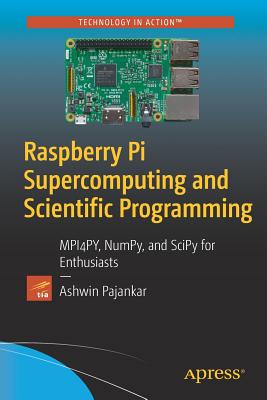
Raspberry Pi Supercomputing and Scientific Programming: MPI4PY, NumPy, and SciPy for Enthusiasts
| AUTHOR | Pajankar, Ashwin |
| PUBLISHER | Apress (05/25/2017) |
| PRODUCT TYPE | Paperback (Paperback) |
Description
Build an inexpensive cluster of multiple Raspberry Pi computers and install all the required libraries to write parallel and scientific programs in Python 3. This book covers setting up your Raspberry Pis, installing the necessary software, and making a cluster of multiple Pis.
Once the cluster is built, its power has to be exploited by means of programs to run on it. So, Raspberry Pi Supercomputing and Scientific Programming teaches you to code the cluster with the MPI4PY library of Python 3. Along the way, you will learn the concepts of the Message Passing Interface (MPI) standards and will explore the fundamentals of parallel programming on your inexpensive cluster. This will make this book a great starting point for supercomputing enthusiasts who want to get started with parallel programming.
The book finishes with details of symbolic mathematics and scientific and numerical programming in Python, using SymPi, SciPy, NumPy, and Matplotlib. You'll see how to process signals and images, carry out calculations using linear algebra, and visualize your results, all using Python code. With the power of a Raspberry Pi supercomputer at your fingertips, data-intensive scientific programming becomes a reality at home.
What You Will Learn
Who This Book Is For
Python 3 developers who seek the knowledge of parallel programming, Raspberry Pi enthusiasts, researchers, and the scientific Python community.
Once the cluster is built, its power has to be exploited by means of programs to run on it. So, Raspberry Pi Supercomputing and Scientific Programming teaches you to code the cluster with the MPI4PY library of Python 3. Along the way, you will learn the concepts of the Message Passing Interface (MPI) standards and will explore the fundamentals of parallel programming on your inexpensive cluster. This will make this book a great starting point for supercomputing enthusiasts who want to get started with parallel programming.
The book finishes with details of symbolic mathematics and scientific and numerical programming in Python, using SymPi, SciPy, NumPy, and Matplotlib. You'll see how to process signals and images, carry out calculations using linear algebra, and visualize your results, all using Python code. With the power of a Raspberry Pi supercomputer at your fingertips, data-intensive scientific programming becomes a reality at home.
What You Will Learn
- Discover the essentials of supercomputing
- Build a low-cost cluster of Raspberry Pis at home
- Harness the power of parallel programming and the Message Passing Interface (MPI)
- Use your Raspberry Pi for symbolic, numerical, and scientific programming
Who This Book Is For
Python 3 developers who seek the knowledge of parallel programming, Raspberry Pi enthusiasts, researchers, and the scientific Python community.
Show More
Product Format
Product Details
ISBN-13:
9781484228777
ISBN-10:
1484228774
Binding:
Paperback or Softback (Trade Paperback (Us))
Content Language:
English
More Product Details
Page Count:
171
Carton Quantity:
40
Product Dimensions:
6.14 x 0.42 x 9.21 inches
Weight:
0.62 pound(s)
Feature Codes:
Index,
Illustrated
Country of Origin:
NL
Subject Information
BISAC Categories
Computers | Hardware - General
Computers | Languages - Python
Computers | Computer Science
Dewey Decimal:
004
Library of Congress Control Number:
2017943339
Descriptions, Reviews, Etc.
jacket back
Build an inexpensive cluster of multiple Raspberry Pi computers and install all the required libraries to write parallel and scientific programs in Python 3. This book covers setting up your Raspberry Pis, installing the necessary software, and making a cluster of multiple Pis.
Once the cluster is built, its power has to be exploited by means of programs to run on it. So, Raspberry Pi Supercomputing and Scientific Programming teaches you to code the cluster with the MPI4PY library of Python 3. Along the way, you will learn the concepts of the Message Passing Interface (MPI) standards and will explore the fundamentals of parallel programming on your inexpensive cluster. This will make this book a great starting point for supercomputing enthusiasts who want to get started with parallel programming. The book finishes with details of symbolic mathematics and scientific and numerical programming inPython, using SymPi, SciPy, NumPy, and Matplotlib. You'll see how to process signals and images, carry out calculations using algebra, and visualize your results, all using Python code. With the power of a Raspberry Pi supercomputer at your fingertips, data-intensive scientific programming becomes a reality at home.
You will:
Once the cluster is built, its power has to be exploited by means of programs to run on it. So, Raspberry Pi Supercomputing and Scientific Programming teaches you to code the cluster with the MPI4PY library of Python 3. Along the way, you will learn the concepts of the Message Passing Interface (MPI) standards and will explore the fundamentals of parallel programming on your inexpensive cluster. This will make this book a great starting point for supercomputing enthusiasts who want to get started with parallel programming. The book finishes with details of symbolic mathematics and scientific and numerical programming inPython, using SymPi, SciPy, NumPy, and Matplotlib. You'll see how to process signals and images, carry out calculations using algebra, and visualize your results, all using Python code. With the power of a Raspberry Pi supercomputer at your fingertips, data-intensive scientific programming becomes a reality at home.
You will:
- Discover the essentials of supercomputing
- Build a low-cost cluster of Raspberry Pis at home
- Harness the power of parallel programming and the Message Passing Interface (MPI)
- Use your supercomputer for symbolic, numerical, and scientific programming
Show More
publisher marketing
Build an inexpensive cluster of multiple Raspberry Pi computers and install all the required libraries to write parallel and scientific programs in Python 3. This book covers setting up your Raspberry Pis, installing the necessary software, and making a cluster of multiple Pis.
Once the cluster is built, its power has to be exploited by means of programs to run on it. So, Raspberry Pi Supercomputing and Scientific Programming teaches you to code the cluster with the MPI4PY library of Python 3. Along the way, you will learn the concepts of the Message Passing Interface (MPI) standards and will explore the fundamentals of parallel programming on your inexpensive cluster. This will make this book a great starting point for supercomputing enthusiasts who want to get started with parallel programming.
The book finishes with details of symbolic mathematics and scientific and numerical programming in Python, using SymPi, SciPy, NumPy, and Matplotlib. You'll see how to process signals and images, carry out calculations using linear algebra, and visualize your results, all using Python code. With the power of a Raspberry Pi supercomputer at your fingertips, data-intensive scientific programming becomes a reality at home.
What You Will Learn
Who This Book Is For
Python 3 developers who seek the knowledge of parallel programming, Raspberry Pi enthusiasts, researchers, and the scientific Python community.
Once the cluster is built, its power has to be exploited by means of programs to run on it. So, Raspberry Pi Supercomputing and Scientific Programming teaches you to code the cluster with the MPI4PY library of Python 3. Along the way, you will learn the concepts of the Message Passing Interface (MPI) standards and will explore the fundamentals of parallel programming on your inexpensive cluster. This will make this book a great starting point for supercomputing enthusiasts who want to get started with parallel programming.
The book finishes with details of symbolic mathematics and scientific and numerical programming in Python, using SymPi, SciPy, NumPy, and Matplotlib. You'll see how to process signals and images, carry out calculations using linear algebra, and visualize your results, all using Python code. With the power of a Raspberry Pi supercomputer at your fingertips, data-intensive scientific programming becomes a reality at home.
What You Will Learn
- Discover the essentials of supercomputing
- Build a low-cost cluster of Raspberry Pis at home
- Harness the power of parallel programming and the Message Passing Interface (MPI)
- Use your Raspberry Pi for symbolic, numerical, and scientific programming
Who This Book Is For
Python 3 developers who seek the knowledge of parallel programming, Raspberry Pi enthusiasts, researchers, and the scientific Python community.
Show More
List Price $64.99
Your Price
$64.34