
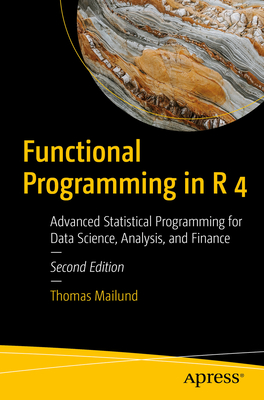
Functional Programming in R 4: Advanced Statistical Programming for Data Science, Analysis, and Finance
| AUTHOR | Mailund, Thomas |
| PUBLISHER | Apress (06/09/2023) |
| PRODUCT TYPE | Paperback (Paperback) |
Description
Master functions and discover how to write functional programs in R. In this book, updated for R 4, you'll learn to make your functions pure by avoiding side effects, write functions that manipulate other functions, and construct complex functions using simpler functions as building blocks.
In Functional Programming in R 4, you'll see how to replace loops, which can have side-effects, with recursive functions that can more easily avoid them. In addition, the book covers why you shouldn't use recursion when loops are more efficient and how you can get the best of both worlds.
Functional programming is a style of programming, like object-oriented programming, but one that focuses on data transformations and calculations rather than objects and state. Where in object-oriented programming you model your programs by describing which states an object can be in and how methods will reveal or modify that state, in functional programming you model programs by describing how functions translate input data to output data. Functions themselves are considered to be data you can manipulate and much of the strength of functional programming comes from manipulating functions; that is, building more complex functions by combining simpler functions.
What You'll Learn
Those with at least some experience with programming in R.
In Functional Programming in R 4, you'll see how to replace loops, which can have side-effects, with recursive functions that can more easily avoid them. In addition, the book covers why you shouldn't use recursion when loops are more efficient and how you can get the best of both worlds.
Functional programming is a style of programming, like object-oriented programming, but one that focuses on data transformations and calculations rather than objects and state. Where in object-oriented programming you model your programs by describing which states an object can be in and how methods will reveal or modify that state, in functional programming you model programs by describing how functions translate input data to output data. Functions themselves are considered to be data you can manipulate and much of the strength of functional programming comes from manipulating functions; that is, building more complex functions by combining simpler functions.
What You'll Learn
- Write functions in R 4, including infix operators and replacement functions
- Create higher order functions
- Pass functions to other functions and start using functions as data you can manipulate
- Use Filer, Map and Reduce functions to express the intent behind code clearly and safely
- Build new functions from existing functions without necessarily writing any new functions, using point-free programming
- Create functions that carry data along with them
Those with at least some experience with programming in R.
Show More
Product Format
Product Details
ISBN-13:
9781484294864
ISBN-10:
1484294866
Binding:
Paperback or Softback (Trade Paperback (Us))
Content Language:
English
Edition Number:
0002
More Product Details
Page Count:
158
Carton Quantity:
46
Product Dimensions:
6.14 x 0.37 x 9.21 inches
Weight:
0.55 pound(s)
Feature Codes:
Illustrated
Country of Origin:
NL
Subject Information
BISAC Categories
Computers | Languages - General
Computers | Programming - Compilers
Computers | Software Development & Engineering - General
Descriptions, Reviews, Etc.
jacket back
Master functions and discover how to write functional programs in R. In this book, updated for R 4, you'll learn to make your functions pure by avoiding side effects, write functions that manipulate other functions, and construct complex functions using simpler functions as building blocks.
In Functional Programming in R 4, you'll see how to replace loops, which can have side-effects, with recursive functions that can more easily avoid them. In addition, the book covers why you shouldn't use recursion when loops are more efficient and how you can get the best of both worlds.
Functional programming is a style of programming, like object-oriented programming, but one that focuses on data transformations and calculations rather than objects and state. Where in object-oriented programming you model your programs by describing which states an object can be in and how methods will reveal or modify that state, in functional programming you model programs by describing how functions translate input data to output data. Functions themselves are considered to be data you can manipulate and much of the strength of functional programming comes from manipulating functions; that is, building more complex functions by combining simpler functions.
You will:
In Functional Programming in R 4, you'll see how to replace loops, which can have side-effects, with recursive functions that can more easily avoid them. In addition, the book covers why you shouldn't use recursion when loops are more efficient and how you can get the best of both worlds.
Functional programming is a style of programming, like object-oriented programming, but one that focuses on data transformations and calculations rather than objects and state. Where in object-oriented programming you model your programs by describing which states an object can be in and how methods will reveal or modify that state, in functional programming you model programs by describing how functions translate input data to output data. Functions themselves are considered to be data you can manipulate and much of the strength of functional programming comes from manipulating functions; that is, building more complex functions by combining simpler functions.
You will:
- Write functions in R 4, including infix operators and replacement functions
- Create higher order functions
- Pass functions to other functions and start using functions as data you can manipulate
- Use Filer, Map and Reduce functions to express the intent behind code clearly and safely
- Build new functions from existing functions without necessarily writing any new functions, using point-free programming
- Create functions that carry data along with them
Show More
publisher marketing
Master functions and discover how to write functional programs in R. In this book, updated for R 4, you'll learn to make your functions pure by avoiding side effects, write functions that manipulate other functions, and construct complex functions using simpler functions as building blocks.
In Functional Programming in R 4, you'll see how to replace loops, which can have side-effects, with recursive functions that can more easily avoid them. In addition, the book covers why you shouldn't use recursion when loops are more efficient and how you can get the best of both worlds.
Functional programming is a style of programming, like object-oriented programming, but one that focuses on data transformations and calculations rather than objects and state. Where in object-oriented programming you model your programs by describing which states an object can be in and how methods will reveal or modify that state, in functional programming you model programs by describing how functions translate input data to output data. Functions themselves are considered to be data you can manipulate and much of the strength of functional programming comes from manipulating functions; that is, building more complex functions by combining simpler functions.
What You'll Learn
Those with at least some experience with programming in R.
In Functional Programming in R 4, you'll see how to replace loops, which can have side-effects, with recursive functions that can more easily avoid them. In addition, the book covers why you shouldn't use recursion when loops are more efficient and how you can get the best of both worlds.
Functional programming is a style of programming, like object-oriented programming, but one that focuses on data transformations and calculations rather than objects and state. Where in object-oriented programming you model your programs by describing which states an object can be in and how methods will reveal or modify that state, in functional programming you model programs by describing how functions translate input data to output data. Functions themselves are considered to be data you can manipulate and much of the strength of functional programming comes from manipulating functions; that is, building more complex functions by combining simpler functions.
What You'll Learn
- Write functions in R 4, including infix operators and replacement functions
- Create higher order functions
- Pass functions to other functions and start using functions as data you can manipulate
- Use Filer, Map and Reduce functions to express the intent behind code clearly and safely
- Build new functions from existing functions without necessarily writing any new functions, using point-free programming
- Create functions that carry data along with them
Those with at least some experience with programming in R.
Show More
List Price $54.99
Your Price
$54.44