
ISBN 9781499298253 is currently unpriced. Please contact us for pricing.
Available options are listed below:
Available options are listed below:
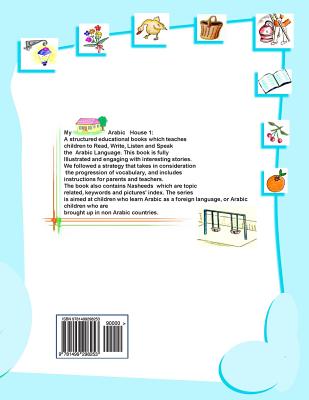
My Arabic House 2: Rayanutullugha
| AUTHOR | Dabboussi, Fatima; Dabboussi, Mrs Fatima |
| PUBLISHER | Createspace Independent Publishing Platform (07/04/2014) |
| PRODUCT TYPE | Paperback (Paperback) |
Description
My Arabic house is a series of books that have been written with the sole aim of teaching Arabic language to children between the ages of 5 to 7 years. Rayanatullugha is the first book of this series. I have drawn upon my own personal experience in teaching Arabic Language to children of this particular age group during the production of these books. For me choosing the correct curriculum for this particular age group proved to be difficult as I found that an Arabic curriculum designed for native speakers of Arabic did not particularly suit children living in a non-Arabic country. I found that this was due to the vast differences in culture and the educational environment. Therefore it was deemed essential to design a syllabus which took into account all the difficulties and addressed them. This publication aims to: - Teach the Arabic letters, both short and long vowels. This can be done in either one academic year, during which the number of lessons reflects the number of academic weeks in weekend schools, or in two to three years when the Arabic is taught as a supplementary subject wherein children need time to consolidate vocabulary and enhance their reading and writing. - Take into account individual differences among children and teach them in a manner so that each child will benefit and learn to the best of their ability. Each child should be able to distinguish between short and long vowels and read simple words correctly. - Connect the child with his current surroundings through easy and interesting stories so he can express himself in Arabic confidently. - Subconsciously instil into the child the moral guidance that the stories reflect. This is achieved through focussing on the lessons learnt from the stories. - Enable the child to use grammatical structures correctly and gradually through the paragraph " answer me ". - Develop the child's vocabulary and enhance their ability to think and reflect .The key words and phrases in texts keep the work at a challenging level and words are repeated in other texts for the child to absorb completely. - Provide gradual practice in writing skills, where the child starts to fill or color the outlined letter, and then writes on the grey area outlining the letter/word to be learnt following the direction of the arrows until reaching the stage where they can write it independently. A diagram is provided in the book, that the child can work on in their own time with support from home, this will greatly increase skill levels. -Train the child to spell words from an early stage, as it is proven that spelling helps speed the reading process and enhances writing skills. - Teach the child in a manner that is educational as well as fun, this method of teaching promotes love for Arabic in a child's young age. This will then self-motivate the child to learn more as he gets older.
Show More
Product Format
Product Details
ISBN-13:
9781499298253
ISBN-10:
1499298250
Binding:
Paperback or Softback (Trade Paperback (Us))
Content Language:
Arabic
More Product Details
Page Count:
80
Carton Quantity:
40
Product Dimensions:
8.50 x 0.21 x 11.00 inches
Weight:
0.61 pound(s)
Country of Origin:
US
Subject Information
BISAC Categories
Education | Curricula
Descriptions, Reviews, Etc.
publisher marketing
My Arabic house is a series of books that have been written with the sole aim of teaching Arabic language to children between the ages of 5 to 7 years. Rayanatullugha is the first book of this series. I have drawn upon my own personal experience in teaching Arabic Language to children of this particular age group during the production of these books. For me choosing the correct curriculum for this particular age group proved to be difficult as I found that an Arabic curriculum designed for native speakers of Arabic did not particularly suit children living in a non-Arabic country. I found that this was due to the vast differences in culture and the educational environment. Therefore it was deemed essential to design a syllabus which took into account all the difficulties and addressed them. This publication aims to: - Teach the Arabic letters, both short and long vowels. This can be done in either one academic year, during which the number of lessons reflects the number of academic weeks in weekend schools, or in two to three years when the Arabic is taught as a supplementary subject wherein children need time to consolidate vocabulary and enhance their reading and writing. - Take into account individual differences among children and teach them in a manner so that each child will benefit and learn to the best of their ability. Each child should be able to distinguish between short and long vowels and read simple words correctly. - Connect the child with his current surroundings through easy and interesting stories so he can express himself in Arabic confidently. - Subconsciously instil into the child the moral guidance that the stories reflect. This is achieved through focussing on the lessons learnt from the stories. - Enable the child to use grammatical structures correctly and gradually through the paragraph " answer me ". - Develop the child's vocabulary and enhance their ability to think and reflect .The key words and phrases in texts keep the work at a challenging level and words are repeated in other texts for the child to absorb completely. - Provide gradual practice in writing skills, where the child starts to fill or color the outlined letter, and then writes on the grey area outlining the letter/word to be learnt following the direction of the arrows until reaching the stage where they can write it independently. A diagram is provided in the book, that the child can work on in their own time with support from home, this will greatly increase skill levels. -Train the child to spell words from an early stage, as it is proven that spelling helps speed the reading process and enhances writing skills. - Teach the child in a manner that is educational as well as fun, this method of teaching promotes love for Arabic in a child's young age. This will then self-motivate the child to learn more as he gets older.
Show More