
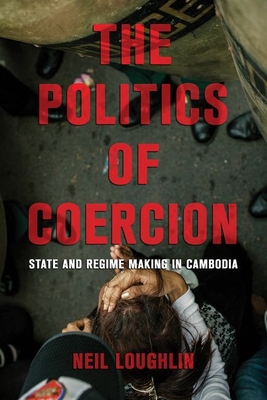
The Politics of Coercion: State and Regime Making in Cambodia
| AUTHOR | Loughlin, Neil |
| PUBLISHER | Southeast Asia Program Publications (09/15/2024) |
| PRODUCT TYPE | Hardcover (Hardcover) |
In The Politics of Coercion, Neil Loughlin explains the persistence of Cambodia's authoritarian regime for more than four decades. It provides a historically grounded investigation of the country's ruling coalition: political elites, many drawn from within the state's coercive apparatus, who, in coordination with state-dependent tycoons, have come to control Cambodia's politics and its economy. Loughlin presents new empirical data foregrounding the coercive underpinnings of the modern Cambodian state and its party, the Cambodian People's Party (CPP).
The focus on coercion reflects the regime's conflict and postconflict evolution and extractive political economy as the ruling coalition failed to channel popular interests through its political institutions, thus resorting either to low-intensity forms of coercion such as intimidation and surveillance or to high-intensity coercion such as violent crackdowns and extrajudicial killings.
Through a critical reevaluation of the regime's origins and evolution in its relationship with citizens, The Politics of Coercion reconceptualizes the CPP to emphasize the obstacles--structural, institutional, and distributional--to building a mass-based clientelist or developmentally legitimate authoritarian party.
In The Politics of Coercion, Neil Loughlin explains the persistence of Cambodia's authoritarian regime for more than four decades. It provides a historically grounded investigation of the country's ruling coalition: political elites, many drawn from within the state's coercive apparatus, who, in coordination with state-dependent tycoons, have come to control Cambodia's politics and its economy. Loughlin presents new empirical data foregrounding the coercive underpinnings of the modern Cambodian state and its party, the Cambodian People's Party (CPP).
The focus on coercion reflects the regime's conflict and postconflict evolution and extractive political economy as the ruling coalition failed to channel popular interests through its political institutions, thus resorting either to low-intensity forms of coercion such as intimidation and surveillance or to high-intensity coercion such as violent crackdowns and extrajudicial killings.
Through a critical reevaluation of the regime's origins and evolution in its relationship with citizens, The Politics of Coercion reconceptualizes the CPP to emphasize the obstacles--structural, institutional, and distributional--to building a mass-based clientelist or developmentally legitimate authoritarian party.