
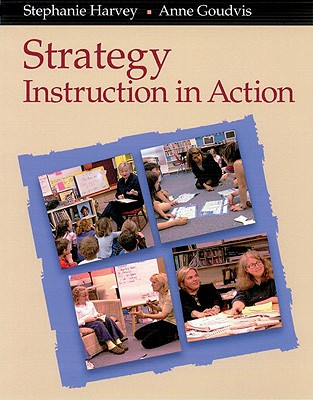
Strategy Instruction in Action [With Study Guide]
| AUTHOR | Goudvis, Anne; Harvey, Stephanie |
| PUBLISHER | Stenhouse Publishers (01/01/2006) |
| PRODUCT TYPE | Video (DVD-Video) |
As Stephanie Harvey and Anne Goudvis demonstrate in their popular book, Strategies That Work: Teaching Comprehension to Enhance Understanding, reading comprehension is about much more than answering literal questions at the end of a passage, story, or chapter.
In this four-part video series, Stephanie and Anne invite you to join them in the classrooms of Leslie Blauman, Mary Buerger, and Debbie Miller, three teachers with whom they have worked for many years. All teach reading comprehension in the context of reading workshop, modeling their thinking and giving students ample time to practice so they learn what proficient readers do to make sense of the text. To enhance their students' understanding, Debbie, Mary, and Leslie demonstrate several comprehension strategies, including asking questions, determining importance, and inferring. They use a variety of fiction and nonfiction for strategy instruction, including picture books, magazine articles, and young adult novels. In each program, the teachers lead a mini-lesson, confer and share with the kids, and have a conversation with Stephanie and Anne about the comprehension instruction in their classrooms.
Program 1: Creating a Culture of Thinking
Before we can teach our students to meaningfully comprehend what they read, we must create a classroom culture that promotes and values the reader's thinking. Through segments from Debbie's, Mary's, and Leslie's classrooms we see the conditions and practices that develop engaged readers. These three teachers build in time for their students to read books they choose and to talk, write, and respond to their reading. When readers begin to recognize that their thinking matters, reading changes. Creating a Culture of Thinking is a powerful staff development tool that guides educators to discuss the conditions that lead to a literate environment. This program provides the foundation needed to get the most out of the following three parts, and it encourages you to try these practices in your own classroom.
Program 2: Modeling Questioning in a Reading Workshop
Students in Debbie Miller's primary classroom are beginning to discover the power of their own thinking. In this program Debbie guides her students through a reading workshop. She models her own questions about a picture book and confers with individuals, pairs, and small groups of students as they begin to use the questioning strategy to enhance their understanding of text. Finally, the children share their thinking and responses with their classmates. As Debbie, Stephanie, and Anne debrief and discuss their observations of the reading workshop, Debbie elaborates on her teaching practices that encourage these first graders to become engaged, thoughtful, and independent young readers.
Program 3: Reading and Understanding Nonfiction
In this program intermediate teacher Mary Buerger shows her students a process for reading nonfiction and encourages them to read for information and respond with their own thoughts and questions. Mary uses an article from a children's magazine to demonstrate how to ask questions and determine the importance in text with a Facts/Questions/Response form. We observe the students reasoning through the text, reading in pairs, and then sharing their thinking about the article. When students have an opportunity to merge their thinking and share their ideas, their engagement soars. In the final segment, Mary, Anne, and Stephanie talk about how students learn and remember information when reading nonfiction and reflect on the kids' enthusiasm for the genre.
Program 4: Using Strategies to Enhance Book Club Discussions
Nothing enhances our understanding of literature more than talking about it. Book clubs and the discussions they generate encourage Leslie Blauman's intermediate studentss to delve deeper into literature. Knowledge and use of comprehension strategies, such as making connections and drawing inferences, enhance students' understanding of characters, themes, and the authentic questions that arise as they read and discuss young adult novels. Working with three different book clubs, Leslie helps one group get started as they build their background knowledge before beginning to read the book. She supports another group as they move their discussion from the literal to the inferential level, and she subtly guides a third group who are well into a book and moving toward independence. In the discussion with Stephanie and Anne that follows, Leslie describes the planning and thinking that underlie her unique approach to supporting students as they talk about books.
As Stephanie Harvey and Anne Goudvis demonstrate in their popular book, Strategies That Work: Teaching Comprehension to Enhance Understanding, reading comprehension is about much more than answering literal questions at the end of a passage, story, or chapter.
In this four-part video series, Stephanie and Anne invite you to join them in the classrooms of Leslie Blauman, Mary Buerger, and Debbie Miller, three teachers with whom they have worked for many years. All teach reading comprehension in the context of reading workshop, modeling their thinking and giving students ample time to practice so they learn what proficient readers do to make sense of the text. To enhance their students' understanding, Debbie, Mary, and Leslie demonstrate several comprehension strategies, including asking questions, determining importance, and inferring. They use a variety of fiction and nonfiction for strategy instruction, including picture books, magazine articles, and young adult novels. In each program, the teachers lead a mini-lesson, confer and share with the kids, and have a conversation with Stephanie and Anne about the comprehension instruction in their classrooms.
Program 1: Creating a Culture of Thinking
Before we can teach our students to meaningfully comprehend what they read, we must create a classroom culture that promotes and values the reader's thinking. Through segments from Debbie's, Mary's, and Leslie's classrooms we see the conditions and practices that develop engaged readers. These three teachers build in time for their students to read books they choose and to talk, write, and respond to their reading. When readers begin to recognize that their thinking matters, reading changes. Creating a Culture of Thinking is a powerful staff development tool that guides educators to discuss the conditions that lead to a literate environment. This program provides the foundation needed to get the most out of the following three parts, and it encourages you to try these practices in your own classroom.
Program 2: Modeling Questioning in a Reading Workshop
Students in Debbie Miller's primary classroom are beginning to discover the power of their own thinking. In this program Debbie guides her students through a reading workshop. She models her own questions about a picture book and confers with individuals, pairs, and small groups of students as they begin to use the questioning strategy to enhance their understanding of text. Finally, the children share their thinking and responses with their classmates. As Debbie, Stephanie, and Anne debrief and discuss their observations of the reading workshop, Debbie elaborates on her teaching practices that encourage these first graders to become engaged, thoughtful, and independent young readers.
Program 3: Reading and Understanding Nonfiction
In this program intermediate teacher Mary Buerger shows her students a process for reading nonfiction and encourages them to read for information and respond with their own thoughts and questions. Mary uses an article from a children's magazine to demonstrate how to ask questions and determine the importance in text with a Facts/Questions/Response form. We observe the students reasoning through the text, reading in pairs, and then sharing their thinking about the article. When students have an opportunity to merge their thinking and share their ideas, their engagement soars. In the final segment, Mary, Anne, and Stephanie talk about how students learn and remember information when reading nonfiction and reflect on the kids' enthusiasm for the genre.
Program 4: Using Strategies to Enhance Book Club Discussions
Nothing enhances our understanding of literature more than talking about it. Book clubs and the discussions they generate encourage Leslie Blauman's intermediate studentss to delve deeper into literature. Knowledge and use of comprehension strategies, such as making connections and drawing inferences, enhance students' understanding of characters, themes, and the authentic questions that arise as they read and discuss young adult novels. Working with three different book clubs, Leslie helps one group get started as they build their background knowledge before beginning to read the book. She supports another group as they move their discussion from the literal to the inferential level, and she subtly guides a third group who are well into a book and moving toward independence. In the discussion with Stephanie and Anne that follows, Leslie describes the planning and thinking that underlie her unique approach to supporting students as they talk about books.