
Available options are listed below:
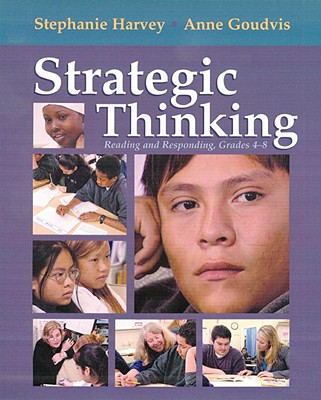
Strategic Thinking: Reading and Responding, Grades 4-8 [With Viewing Guide] (Out of print)
| AUTHOR | Goudvis, Anne; Harvey, Stephanie |
| PUBLISHER | Stenhouse Publishers (01/01/2006) |
| PRODUCT TYPE | Video (DVD-Video) |
Nothing matters more than kids' thinking. As teachers, we want to honor kids' thinking and teach them to become critical, thoughtful, independent readers. To help them turn thinking into meaning and to understand what they read, students need an arsenal of strategies to navigate and synthesize text. And they need to know when, where, and how, to use these strategies.
Strategic Thinking builds on the comprehension instruction in the book, Strategies That Work, and the videotape series Strategy Instruction In Action. In this four-part video series, Stephanie Harvey and Anne Goudvis spend a week with Jessica Lawrence and her middle school language arts students. They focus on teaching the comprehension strategies of inferring in fiction and determining importance in nonfiction. These two strategies are essential to comprehension for intermediate and middle-grade students
On each program, Steph, Anne, and Jessica plan instruction, lead mini-lessons, confer and share with the kids, and reflect on their teaching and the students' learning. Throughout the lesson sequences, students grapple with information, themes, issues and ideas as they read literature and content-related text. As the kids read and respond orally and in writing, they merge their thinking with the text, adding to their knowledge and discovering the power of their own thinking.
Inferring Themes in Fiction: Parts One and Two
On these two programs, Steph uses fiction to explore the strategy of inferential thinking. She launches the three-day lesson with an interactive read aloud of Eve Bunting's picture-book, Gleam and Glow. Steph models the inner conversation she has with herself as she reads the book to the class. The students respond to the book as she teaches them how to use evidence in the text to infer the themes and bigger ideas. After discussing and writing about the themes in Gleam and Glow, the kids practice inferring themes in their independent reading.
Determining Importance in Nonfiction: Parts One and Two
In these two programs, Anne and Jessica show students how to determine important information as they read nonfiction. Anne and Jessica read through a text on the Civil War, modeling their thinking and taking notes with a Facts/Questions/Response form. Students respond on the FQR form, learning how to merge their thinking with the information. This strategy helps kids think about information rather than merely memorizing it, making them more likely to identify what is important and understand it. Throughout the lesson, students work in pairs and small groups to think through the information together. This strategy helps students come to a deeper understanding of text that is packed with information and ideas and supports them to become strategic readers across the curriculum.
Nothing matters more than kids' thinking. As teachers, we want to honor kids' thinking and teach them to become critical, thoughtful, independent readers. To help them turn thinking into meaning and to understand what they read, students need an arsenal of strategies to navigate and synthesize text. And they need to know when, where, and how, to use these strategies.
Strategic Thinking builds on the comprehension instruction in the book, Strategies That Work, and the videotape series Strategy Instruction In Action. In this four-part video series, Stephanie Harvey and Anne Goudvis spend a week with Jessica Lawrence and her middle school language arts students. They focus on teaching the comprehension strategies of inferring in fiction and determining importance in nonfiction. These two strategies are essential to comprehension for intermediate and middle-grade students
On each program, Steph, Anne, and Jessica plan instruction, lead mini-lessons, confer and share with the kids, and reflect on their teaching and the students' learning. Throughout the lesson sequences, students grapple with information, themes, issues and ideas as they read literature and content-related text. As the kids read and respond orally and in writing, they merge their thinking with the text, adding to their knowledge and discovering the power of their own thinking.
Inferring Themes in Fiction: Parts One and Two
On these two programs, Steph uses fiction to explore the strategy of inferential thinking. She launches the three-day lesson with an interactive read aloud of Eve Bunting's picture-book, Gleam and Glow. Steph models the inner conversation she has with herself as she reads the book to the class. The students respond to the book as she teaches them how to use evidence in the text to infer the themes and bigger ideas. After discussing and writing about the themes in Gleam and Glow, the kids practice inferring themes in their independent reading.
Determining Importance in Nonfiction: Parts One and Two
In these two programs, Anne and Jessica show students how to determine important information as they read nonfiction. Anne and Jessica read through a text on the Civil War, modeling their thinking and taking notes with a Facts/Questions/Response form. Students respond on the FQR form, learning how to merge their thinking with the information. This strategy helps kids think about information rather than merely memorizing it, making them more likely to identify what is important and understand it. Throughout the lesson, students work in pairs and small groups to think through the information together. This strategy helps students come to a deeper understanding of text that is packed with information and ideas and supports them to become strategic readers across the curriculum.