
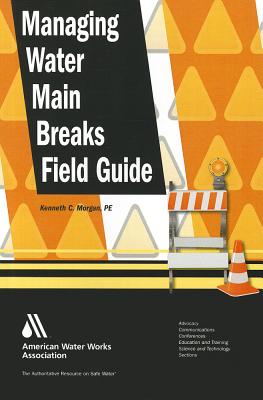
Managing Water Main Breaks Field Guide
| AUTHOR | Kenneth C. Morgan, P. E.; Morgan, Kenneth C.; Morgan, Ken et al. |
| PUBLISHER | American Water Works Association (01/01/2012) |
| PRODUCT TYPE | Paperback (Paperback) |
Description
Although every water utility knows how to repair water main breaks, some utilities are betterat managing main breaks to minimize both disruptions to the public and lost consumer confidence in the utility. _x000d_
How can a water utility "manage" something as unknowable as when and where water main breaks will happen?Canthe negative impacts of main breaks be mitigated? _x000d_
Preparation is vitalManaging Water Main Breaks Field Guide will help water utilities to better prepare for pipeline breaks.Utilitiesshould be proactive, rather than reactive. Becoming proactive will reduce the number of main breaks, as well as the negative impacts to the community. _x000d_
This concise book will help you prepare by telling you -kinds of breaks and their causes-where main breaks are most likely to occur-how to respond quickly or in a timely manner-how to identify and locate leaks and breaks-how to maintain safety at repair sites-how to mitigate impacts on the utility, on customers, and on other utilities-how to make repairs efficiently and expertly-when to replace a pipe rather than repair it-how to notify all those affected and keep them informed during repairs-how to record main-break information_x000d_
MoreManaging Water Main Breaks Field Guide includes excerpts from related AWWA books, manuals of practice, and periodicals. Theseprovide additional useful information about corrosion, water pressure, leak detection, repair costs, and other related topics. Numerous photosillustrate types, causes, and impacts of main breaks. Each chapter concludes with a "Questions to Consider," section - a series of questions to help the reader to evaluate specific processes, issues, or programs. These questions will help utilities provide best-in-class service.
How can a water utility "manage" something as unknowable as when and where water main breaks will happen?Canthe negative impacts of main breaks be mitigated? _x000d_
Preparation is vitalManaging Water Main Breaks Field Guide will help water utilities to better prepare for pipeline breaks.Utilitiesshould be proactive, rather than reactive. Becoming proactive will reduce the number of main breaks, as well as the negative impacts to the community. _x000d_
This concise book will help you prepare by telling you -kinds of breaks and their causes-where main breaks are most likely to occur-how to respond quickly or in a timely manner-how to identify and locate leaks and breaks-how to maintain safety at repair sites-how to mitigate impacts on the utility, on customers, and on other utilities-how to make repairs efficiently and expertly-when to replace a pipe rather than repair it-how to notify all those affected and keep them informed during repairs-how to record main-break information_x000d_
MoreManaging Water Main Breaks Field Guide includes excerpts from related AWWA books, manuals of practice, and periodicals. Theseprovide additional useful information about corrosion, water pressure, leak detection, repair costs, and other related topics. Numerous photosillustrate types, causes, and impacts of main breaks. Each chapter concludes with a "Questions to Consider," section - a series of questions to help the reader to evaluate specific processes, issues, or programs. These questions will help utilities provide best-in-class service.
Show More
Product Format
Product Details
ISBN-13:
9781583218600
ISBN-10:
1583218602
Binding:
Paperback or Softback (Trade Paperback (Us))
Content Language:
English
More Product Details
Page Count:
115
Carton Quantity:
80
Product Dimensions:
5.90 x 0.20 x 8.90 inches
Weight:
0.40 pound(s)
Feature Codes:
Bibliography,
Index,
Table of Contents,
Illustrated
Country of Origin:
US
Subject Information
BISAC Categories
Technology & Engineering | Industrial Health & Safety
Technology & Engineering | Environmental - Water Supply
Dewey Decimal:
628.15
Library of Congress Control Number:
2012011228
Descriptions, Reviews, Etc.
publisher marketing
Although every water utility knows how to repair water main breaks, some utilities are betterat managing main breaks to minimize both disruptions to the public and lost consumer confidence in the utility. _x000d_
How can a water utility "manage" something as unknowable as when and where water main breaks will happen?Canthe negative impacts of main breaks be mitigated? _x000d_
Preparation is vitalManaging Water Main Breaks Field Guide will help water utilities to better prepare for pipeline breaks.Utilitiesshould be proactive, rather than reactive. Becoming proactive will reduce the number of main breaks, as well as the negative impacts to the community. _x000d_
This concise book will help you prepare by telling you -kinds of breaks and their causes-where main breaks are most likely to occur-how to respond quickly or in a timely manner-how to identify and locate leaks and breaks-how to maintain safety at repair sites-how to mitigate impacts on the utility, on customers, and on other utilities-how to make repairs efficiently and expertly-when to replace a pipe rather than repair it-how to notify all those affected and keep them informed during repairs-how to record main-break information_x000d_
MoreManaging Water Main Breaks Field Guide includes excerpts from related AWWA books, manuals of practice, and periodicals. Theseprovide additional useful information about corrosion, water pressure, leak detection, repair costs, and other related topics. Numerous photosillustrate types, causes, and impacts of main breaks. Each chapter concludes with a "Questions to Consider," section - a series of questions to help the reader to evaluate specific processes, issues, or programs. These questions will help utilities provide best-in-class service.
How can a water utility "manage" something as unknowable as when and where water main breaks will happen?Canthe negative impacts of main breaks be mitigated? _x000d_
Preparation is vitalManaging Water Main Breaks Field Guide will help water utilities to better prepare for pipeline breaks.Utilitiesshould be proactive, rather than reactive. Becoming proactive will reduce the number of main breaks, as well as the negative impacts to the community. _x000d_
This concise book will help you prepare by telling you -kinds of breaks and their causes-where main breaks are most likely to occur-how to respond quickly or in a timely manner-how to identify and locate leaks and breaks-how to maintain safety at repair sites-how to mitigate impacts on the utility, on customers, and on other utilities-how to make repairs efficiently and expertly-when to replace a pipe rather than repair it-how to notify all those affected and keep them informed during repairs-how to record main-break information_x000d_
MoreManaging Water Main Breaks Field Guide includes excerpts from related AWWA books, manuals of practice, and periodicals. Theseprovide additional useful information about corrosion, water pressure, leak detection, repair costs, and other related topics. Numerous photosillustrate types, causes, and impacts of main breaks. Each chapter concludes with a "Questions to Consider," section - a series of questions to help the reader to evaluate specific processes, issues, or programs. These questions will help utilities provide best-in-class service.
Show More
List Price $97.00
Your Price
$96.03