
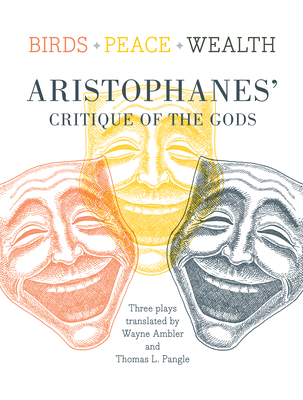
Birds/Peace/Wealth: Aristophanes' Critique of the Gods
| AUTHOR | Ambler, Wayne; Pangle, Thomas L.; Aristophanes |
| PUBLISHER | Paul Dry Books (02/12/2013) |
| PRODUCT TYPE | Paperback (Paperback) |
In these three raucous comedies, mortals outwit and even replace Zeus and other Olympian deities of the Greek Pantheon. As Aristophanes provokes laughter at the foibles of gods and men, he arouses wonder at our human need for the divine.
"The three comic heroes in the plays included here raise the questions of whether there are gods, who they might be, how powerful they are, and how they might be changed or eliminated. Although the precise form of such questions changes from age to age, these are questions that are inseparable from political life; and they certainly are powerfully present in our own day...great theorists and architects of the modern liberal state designed its contours partly with an eye on the goal of diminishing the role of religion in the public square. Not unlike our three comic heroes, they wanted to reduce dependence on "Zeus" and his priests. In his place, and like our three heroes, they sought peace, wealth, and human rulers liberated from exaggerated piety. And nowadays the so-called New Atheists are pressing the case that it is high time for a final defeat and elimination of the powers of darkness that, in their view, have cost us so much blood and treasure...Aristophanes was not a modern liberal; still less would he agree with the New Atheists' advocacy of universal public atheism. He does, however, put dissatisfaction with the gods at the center of the three plays included here, does bestow victories on the human critics of those gods, and does invite us to think with him about the justice of their causes, the tactics behind their victories, and the limits of their successes."--From the Introduction
Aristophanes was a prolific and much acclaimed comic playwright of ancient Athens. Eleven of his forty plays survive virtually complete. Aristophanes has been said to recreate the life of ancient Athens more convincingly than any other author.
Thomas Lee Pangle holds the Joe R. Long Chair in Democratic Studies at the University of Texas.
Wayne Ambler is associate professor in the Herbst Program of Humanities for Engineers at the University of Colorado.
In these three raucous comedies, mortals outwit and even replace Zeus and other Olympian deities of the Greek Pantheon. As Aristophanes provokes laughter at the foibles of gods and men, he arouses wonder at our human need for the divine.
"The three comic heroes in the plays included here raise the questions of whether there are gods, who they might be, how powerful they are, and how they might be changed or eliminated. Although the precise form of such questions changes from age to age, these are questions that are inseparable from political life; and they certainly are powerfully present in our own day...great theorists and architects of the modern liberal state designed its contours partly with an eye on the goal of diminishing the role of religion in the public square. Not unlike our three comic heroes, they wanted to reduce dependence on "Zeus" and his priests. In his place, and like our three heroes, they sought peace, wealth, and human rulers liberated from exaggerated piety. And nowadays the so-called New Atheists are pressing the case that it is high time for a final defeat and elimination of the powers of darkness that, in their view, have cost us so much blood and treasure...Aristophanes was not a modern liberal; still less would he agree with the New Atheists' advocacy of universal public atheism. He does, however, put dissatisfaction with the gods at the center of the three plays included here, does bestow victories on the human critics of those gods, and does invite us to think with him about the justice of their causes, the tactics behind their victories, and the limits of their successes."--From the Introduction
Aristophanes was a prolific and much acclaimed comic playwright of ancient Athens. Eleven of his forty plays survive virtually complete. Aristophanes has been said to recreate the life of ancient Athens more convincingly than any other author.
Thomas Lee Pangle holds the Joe R. Long Chair in Democratic Studies at the University of Texas.
Wayne Ambler is associate professor in the Herbst Program of Humanities for Engineers at the University of Colorado.