
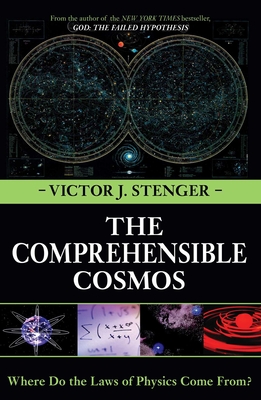
The Comprehensible Cosmos: Where Do the Laws of Physics Come From?
| AUTHOR | Stenger, Victor J. |
| PUBLISHER | Prometheus Books (11/01/2006) |
| PRODUCT TYPE | Hardcover (Hardcover) |
Description
For those fascinated by how physics explains the universe and affects philosophy, this in-depth presentation of the cosmos, complete with an appendix of mathematical formulas, makes accessible to lay readers findings normally available only to professional scientists. In a series of remarkable developments in the 20th century and continuing into the 21st, elementary particle physicists, astronomers, and cosmologists have removed much of the mystery that surrounds our understanding of the physical universe. We now have mathematical models that are consistent with all observational data, including measurements of incredible precision, and we have a good understanding of why those models take the form they do. But the question arises: Where do the "laws" revealed by the mathematical models come from? Some conjecture that they represent a set of restraints on the behavior of matter that are built into the structure of the universe, either by God or some other ubiquitous governing principle. In this challenging, stimulating discussion of physics and its implications, the author disputes this notion. Instead, he argues that physical laws are simply restrictions on the ways physicists may draw the models they use to represent the behavior of matter if they wish to do so objectively. Since mathematical descriptions of data must be independent of any specific point of view, that is, they must possess "point-of-view invariance" (maximum objectivity), they naturally conform to certain fundamental laws that insure that objectivity, such as the great conservation principles of energy and momentum. The laws of physics, however, are not simply an arbitrary set of rules since the observed data beautifully demonstrate their accuracy.
Show More
Product Format
Product Details
ISBN-13:
9781591024248
ISBN-10:
1591024242
Binding:
Hardback or Cased Book (Sewn)
Content Language:
English
More Product Details
Page Count:
340
Carton Quantity:
1
Product Dimensions:
5.35 x 0.93 x 8.56 inches
Weight:
1.04 pound(s)
Feature Codes:
Bibliography,
Index,
Dust Cover,
Table of Contents,
Illustrated
Country of Origin:
US
Subject Information
BISAC Categories
Science | Physics - General
Science | Space Science - Cosmology
Dewey Decimal:
530.01
Library of Congress Control Number:
2006009274
Descriptions, Reviews, Etc.
publisher marketing
For those fascinated by how physics explains the universe and affects philosophy, this in-depth presentation of the cosmos, complete with an appendix of mathematical formulas, makes accessible to lay readers findings normally available only to professional scientists. In a series of remarkable developments in the 20th century and continuing into the 21st, elementary particle physicists, astronomers, and cosmologists have removed much of the mystery that surrounds our understanding of the physical universe. We now have mathematical models that are consistent with all observational data, including measurements of incredible precision, and we have a good understanding of why those models take the form they do. But the question arises: Where do the "laws" revealed by the mathematical models come from? Some conjecture that they represent a set of restraints on the behavior of matter that are built into the structure of the universe, either by God or some other ubiquitous governing principle. In this challenging, stimulating discussion of physics and its implications, the author disputes this notion. Instead, he argues that physical laws are simply restrictions on the ways physicists may draw the models they use to represent the behavior of matter if they wish to do so objectively. Since mathematical descriptions of data must be independent of any specific point of view, that is, they must possess "point-of-view invariance" (maximum objectivity), they naturally conform to certain fundamental laws that insure that objectivity, such as the great conservation principles of energy and momentum. The laws of physics, however, are not simply an arbitrary set of rules since the observed data beautifully demonstrate their accuracy.
Show More
Author:
Stenger, Victor J.
Stenger is professor of physics and astronomy at the University of Hawaii.
Show More
List Price $28.99
Your Price
$28.70