
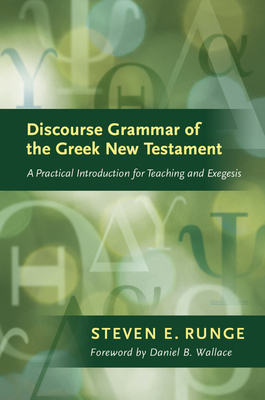
Discourse Grammar of the Greek New Testament: A Practical Introduction for Teaching and Exegesis
| AUTHOR | Wallace, Daniel B.; Wallace, Daniel B., PH.D.; Runge, Steven E. |
| PUBLISHER | Hendrickson Academic (01/01/2011) |
| PRODUCT TYPE | Hardcover (Hardcover) |
Description
In Discourse Grammar of the Greek New Testament, Steve Runge, scholar in residence at Logos Bible Software, explores New Testament Greek grammatical conventions by focusing on the communication tasks they accomplish through discourse analysis. His focus on discourse analysis emphasizes the ways in which words are used in texts and contexts, and has less to do with the elements of speech and focuses, instead, on how humans cognitively process language. In doing so, Runge is consciously building on the ground breaking work of James Barr entitled Semantics of Biblical Language which focused on lexical linguistics (an element of speech) rather than grammatical linguistics. Runge, in effect, picks up from where Barr left off and attempts to show the exegetical significance of discourse grammar for students of the New Testament. Runge's project is dynamic and multi-layered. One might even call it a "cross-linguistic" and "function-based" approach to discourse analysis that treat aspects of the language often examined in isolation, or only with lip-service. The result, according to Daniel Wallace, is that Runge "has made discourse analysis accessible, systematic, comprehensive, and meaningful to students of the New Testament". As such, Runge's Discourse Grammar of the Greek New Testament offers direct treatment of linguistic phenomena often truncated or all together mishandled by traditional grammars. Runge provides ample examples from the New Testament to illustrate his points, and does so with accompanying commentary. Everywhere he demonstrates that "if there is more than one way of accomplishing a discourse task, there is likely a meaning associated with each choice" (148). In some ways Runge's book seems like it may be a substitute for traditional grammars. It is not. It is, rather, a grammar that augments specific aspects of the language that traditional grammars often do not have, or choose not to have, room to highlight the importance of discourse analysis for sound exegesis.
Show More
Product Format
Product Details
ISBN-13:
9781598565836
ISBN-10:
1598565834
Binding:
Hardback or Cased Book (Unsewn / Adhesive Bound)
Content Language:
English
More Product Details
Page Count:
442
Carton Quantity:
18
Product Dimensions:
6.00 x 1.20 x 9.00 inches
Weight:
1.80 pound(s)
Feature Codes:
Bibliography,
Table of Contents,
Illustrated
Country of Origin:
US
Subject Information
BISAC Categories
Religion | Biblical Reference - Language Study
Religion | Biblical Studies - Exegesis & Hermeneutics
Grade Level:
College Senior
and up
Dewey Decimal:
487.4
Library of Congress Control Number:
2010041842
Descriptions, Reviews, Etc.
publisher marketing
In Discourse Grammar of the Greek New Testament, Steve Runge, scholar in residence at Logos Bible Software, explores New Testament Greek grammatical conventions by focusing on the communication tasks they accomplish through discourse analysis. His focus on discourse analysis emphasizes the ways in which words are used in texts and contexts, and has less to do with the elements of speech and focuses, instead, on how humans cognitively process language. In doing so, Runge is consciously building on the ground breaking work of James Barr entitled Semantics of Biblical Language which focused on lexical linguistics (an element of speech) rather than grammatical linguistics. Runge, in effect, picks up from where Barr left off and attempts to show the exegetical significance of discourse grammar for students of the New Testament. Runge's project is dynamic and multi-layered. One might even call it a "cross-linguistic" and "function-based" approach to discourse analysis that treat aspects of the language often examined in isolation, or only with lip-service. The result, according to Daniel Wallace, is that Runge "has made discourse analysis accessible, systematic, comprehensive, and meaningful to students of the New Testament". As such, Runge's Discourse Grammar of the Greek New Testament offers direct treatment of linguistic phenomena often truncated or all together mishandled by traditional grammars. Runge provides ample examples from the New Testament to illustrate his points, and does so with accompanying commentary. Everywhere he demonstrates that "if there is more than one way of accomplishing a discourse task, there is likely a meaning associated with each choice" (148). In some ways Runge's book seems like it may be a substitute for traditional grammars. It is not. It is, rather, a grammar that augments specific aspects of the language that traditional grammars often do not have, or choose not to have, room to highlight the importance of discourse analysis for sound exegesis.
Show More
Author:
Runge, Steven E.
Steve Runge has a Master of Theological Studies degree in Biblical Languages from Trinity Western Seminary in Langley, B.C., Canada, a BA in Speech Communication from Western Washington University, and a Doctor of Literature degree in Biblical Languages from the University of Stellenbosch in South Africa, which was supervised by Christo Van der Merwe. In preparation for his doctoral research, Steve completed several years of study in the linguistic fields of pragmatics and discourse grammar. He has served as an adjunct faculty member at Northwest Baptist Theological College, Trinity Western University, and Associated Canadian Theological Schools (ACTS) while completing his education. He is also very active in the church. He and his wife were married in 1990. They have two daughters, and live in Bellingham, Washington. Steve presently serves as a Scholar-in-Residence at Logos Bible Software, and where, along with Discourse Grammar of the Greek New Testament: A Practical Introduction for Teaching and Exegesis, he has developed the Lexham Discourse Greek New Testament and the Lexham High Definition New Testament.
Show More
Foreword by:
Wallace, Daniel B., PH.D.
Dr. Daniel B. Wallace (B.A., Biola University, 1975; Th.M., Dallas Theological Seminary, 1979; Ph.D., 1995), su libro didactico de gramatica griega intermedia es usado en dos tercios de las escuelas que ensenan esta materia en la nacion. Es editor principal del Nuevo Testamento en NET Bible, coeditor de NET-Nestle Greek-English diglot y fundador del centro para el estudio de los manuscritos del Nuevo Testamento.
Show More
List Price $49.95
Your Price
$49.45