
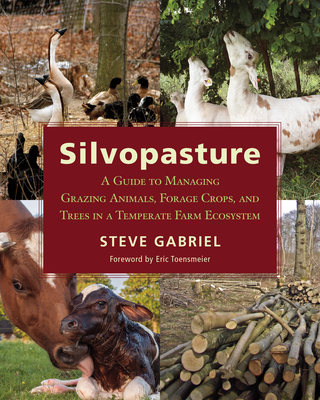
Silvopasture: A Guide to Managing Grazing Animals, Forage Crops, and Trees in a Temperate Farm Ecosystem
| AUTHOR | Gabriel, Steve; Toensmeier, Eric |
| PUBLISHER | Chelsea Green Publishing Company (06/01/2018) |
| PRODUCT TYPE | Paperback (Paperback) |
Description
A system for regenerating land, storing carbon, and creating climate resilience The concept of silvopasture challenges our notions of both modern agriculture and land use. For centuries, European settlers of North America have engaged in practices that separate the field from the forest, and even the food from the animal. Silvopasture systems integrate trees, animals, and forages in a whole-system approach that offers a number of benefits to the farmer and the environment. Such a system not only offers the promise of ecological regeneration of the land, but also an economical livelihood and even the ability to farm extensively while buffering the effects of a changing climate: increased rainfall, longer droughts, and more intense storm events. Silvopasture, however, involves more than just allowing animals into the woodlot. It is intentional, steeped in careful observation skills and flexible to the dynamics of such a complex ecology. It requires a farmer who understands grassland ecology, forestry, and animal husbandry. The farmer needn't be an expert in all of these disciplines, but familiar enough with them to make decisions on a wide variety of time scales. A silvopasture system will inevitably look different from year to year, and careful design coupled with creativity and visioning for the future are all part of the equation. In this book, farmer Steve Gabriel offers examples of diverse current systems that include:
All of these examples share common goals, components, and philosophies. The systems may take several years to establish, but the long-term benefits include healthier animals and soils, greater yields, and the capacity to sequester atmospheric carbon better than forests or grasslands alone. For all these reasons and more, Silvopasture offers farmers an innovative and ecological alternative to conventional grazing practice.
- A black locust plantation for fence posts coupled with summer grazing pastures for cattle in central New York;
- Oxen and pigs used to clear forested land in New Hampshire to create space for new market gardens and orchards;
- Turkeys used for controlling pests and fertilization on a cider orchard and asparagus farm in New York; and
- Sheep that graze the understory of hybrid chestnut and hickory trees at a nut nursery in Minnesota.
All of these examples share common goals, components, and philosophies. The systems may take several years to establish, but the long-term benefits include healthier animals and soils, greater yields, and the capacity to sequester atmospheric carbon better than forests or grasslands alone. For all these reasons and more, Silvopasture offers farmers an innovative and ecological alternative to conventional grazing practice.
Show More
Product Format
Product Details
ISBN-13:
9781603587310
ISBN-10:
1603587314
Binding:
Paperback or Softback (Trade Paperback (Us))
Content Language:
English
More Product Details
Page Count:
320
Carton Quantity:
16
Product Dimensions:
7.90 x 0.60 x 9.90 inches
Weight:
1.90 pound(s)
Feature Codes:
Bibliography,
Index,
Price on Product,
Maps,
Illustrated
Country of Origin:
US
Subject Information
BISAC Categories
Technology & Engineering | Agriculture - Sustainable Agriculture
Technology & Engineering | Agriculture - Forestry
Technology & Engineering | Agriculture - Animal Husbandry
Dewey Decimal:
333.761
Library of Congress Control Number:
2018000802
Descriptions, Reviews, Etc.
publisher marketing
A system for regenerating land, storing carbon, and creating climate resilience The concept of silvopasture challenges our notions of both modern agriculture and land use. For centuries, European settlers of North America have engaged in practices that separate the field from the forest, and even the food from the animal. Silvopasture systems integrate trees, animals, and forages in a whole-system approach that offers a number of benefits to the farmer and the environment. Such a system not only offers the promise of ecological regeneration of the land, but also an economical livelihood and even the ability to farm extensively while buffering the effects of a changing climate: increased rainfall, longer droughts, and more intense storm events. Silvopasture, however, involves more than just allowing animals into the woodlot. It is intentional, steeped in careful observation skills and flexible to the dynamics of such a complex ecology. It requires a farmer who understands grassland ecology, forestry, and animal husbandry. The farmer needn't be an expert in all of these disciplines, but familiar enough with them to make decisions on a wide variety of time scales. A silvopasture system will inevitably look different from year to year, and careful design coupled with creativity and visioning for the future are all part of the equation. In this book, farmer Steve Gabriel offers examples of diverse current systems that include:
All of these examples share common goals, components, and philosophies. The systems may take several years to establish, but the long-term benefits include healthier animals and soils, greater yields, and the capacity to sequester atmospheric carbon better than forests or grasslands alone. For all these reasons and more, Silvopasture offers farmers an innovative and ecological alternative to conventional grazing practice.
- A black locust plantation for fence posts coupled with summer grazing pastures for cattle in central New York;
- Oxen and pigs used to clear forested land in New Hampshire to create space for new market gardens and orchards;
- Turkeys used for controlling pests and fertilization on a cider orchard and asparagus farm in New York; and
- Sheep that graze the understory of hybrid chestnut and hickory trees at a nut nursery in Minnesota.
All of these examples share common goals, components, and philosophies. The systems may take several years to establish, but the long-term benefits include healthier animals and soils, greater yields, and the capacity to sequester atmospheric carbon better than forests or grasslands alone. For all these reasons and more, Silvopasture offers farmers an innovative and ecological alternative to conventional grazing practice.
Show More
Author:
Gabriel, Steve
In addition to Steve s role at Cornell as an extension program aide, he is also the program director of the Finger Lakes Permaculture Institute and owner of a farm that explores agroforestry practices. He has a blog (www.agroforestrysolutions.com) and has worked as a writer for several newspapers.
Show More
Foreword by:
Toensmeier, Eric
Eric Toensmeier is the award-winning author of Paradise Lot and Perennial Vegetables, and the co-author of Edible Forest Gardens. Eric is an appointed lecturer at Yale University, a Senior Fellow with Project Drawdown, and an international trainer. He presents in English and Spanish throughout the United States, Canada, Mexico, Guatemala, and the Caribbean. Eric has studied useful perennial plants and their roles in agroforestry systems for over two decades, and cultivates about 300 species in his urban garden. His writing can be viewed online at perennialsolutions.org.
Show More
List Price $39.95
Your Price
$39.55