
Available options are listed below:
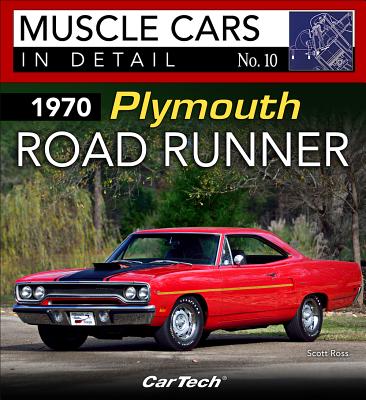
1970 Plym Road Runner: MC Id #10 - Op: Muscle Cars in Detail No. 10 (Out of print)
| AUTHOR | Ross, Scott |
| PUBLISHER | Cartech (01/09/2018) |
| PRODUCT TYPE | Paperback (Paperback) |
Bring the 1970 Plymouth Road Runner and its defining characteristics into focus, including the 440 Six Pack and 426 Hemi powerplants, cartoon graphics, beep-beep horn, and more.
The stripped-down Road Runner exemplified the essence of a purpose-built muscle car: brute power and stunning acceleration. A new aggressive grille and Air Grabber hood provided an audacious yet tasteful performance statement. By 1969, the muscle car war among Ford, General Motors, and Chrysler had reached a fevered pitch. Plymouth's Road Runner, Mopar's intermediate entry, led the charge. For 1970, the Road Runner had its strongest year yet as it housed the best street V-8s Chrysler had to offer.
Underneath the skin, the Road Runner lived up to its persona. The 335-hp 383 was one of the fastest 383s Chrysler built because it was fitted with the 440 camshaft, heads, and manifolds for even more performance. The 440 Six Pack car generated 390 hp and gained a reputation as a stout street performer. And at the top, the conservatively rated 425-hp 426 Hemi set the standard for performance.
The Road Runner was lighter than the Cuda and somewhat overbuilt as it was one of the toughest muscle cars. To transfer all this power to the ground, the Road Runner was equipped with the A-833 4-speed or TorqueFlite 727 automatic. With a torsion-bar suspension and heavy-duty rear end, the Road Runner handled well. However, these are just a few of the highlights of the complete story from author Scott Ross.
Each volume in the In Detail Series provides an introduction and historical overview, an explanation of the design and concepts involved in creating the car, a look at marketing and promotion, an in-depth study of all hardware and available options, as well as an examination of where the car is on the market today. Also included are paint and option codes, VIN and build tag decoders, as well as production numbers.
Author Scott Ross retraces the history of the Road Runner and brings the 1970 model year into full focus. The stripped-down Road Runner exemplified the essence of a purpose-built muscle car: brute power and stunning acceleration. A new aggressive grille and Air Grabber hood provided an audacious yet tasteful performance statement.
Underneath the skin, the Road Runner lived up to its persona. The 335-hp 383 was one of the fastest 383s Chrysler built because it was fitted with the 440 camshaft, heads, and manifolds for even more performance. The 440 "Six Pack" car generated 390 hp and gained a reputation as a stout street performer. At the top, the conservatively rated 425-hp 426 Hemi set the standard for performance.
Each volume in the In Detail Series provides an introduction and historical overview, an explanation of the design and concepts involved in creating the car, a look at marketing and promotion, an in-depth study of all hardware and available options, as well as an examination of where the car is on the market today. Also included are paint and option codes, VIN and build tag decoders, as well as production numbers.
Bring the 1970 Plymouth Road Runner and its defining characteristics into focus, including the 440 Six Pack and 426 Hemi powerplants, cartoon graphics, beep-beep horn, and more.
The stripped-down Road Runner exemplified the essence of a purpose-built muscle car: brute power and stunning acceleration. A new aggressive grille and Air Grabber hood provided an audacious yet tasteful performance statement. By 1969, the muscle car war among Ford, General Motors, and Chrysler had reached a fevered pitch. Plymouth's Road Runner, Mopar's intermediate entry, led the charge. For 1970, the Road Runner had its strongest year yet as it housed the best street V-8s Chrysler had to offer.
Underneath the skin, the Road Runner lived up to its persona. The 335-hp 383 was one of the fastest 383s Chrysler built because it was fitted with the 440 camshaft, heads, and manifolds for even more performance. The 440 Six Pack car generated 390 hp and gained a reputation as a stout street performer. And at the top, the conservatively rated 425-hp 426 Hemi set the standard for performance.
The Road Runner was lighter than the Cuda and somewhat overbuilt as it was one of the toughest muscle cars. To transfer all this power to the ground, the Road Runner was equipped with the A-833 4-speed or TorqueFlite 727 automatic. With a torsion-bar suspension and heavy-duty rear end, the Road Runner handled well. However, these are just a few of the highlights of the complete story from author Scott Ross.
Each volume in the In Detail Series provides an introduction and historical overview, an explanation of the design and concepts involved in creating the car, a look at marketing and promotion, an in-depth study of all hardware and available options, as well as an examination of where the car is on the market today. Also included are paint and option codes, VIN and build tag decoders, as well as production numbers.