
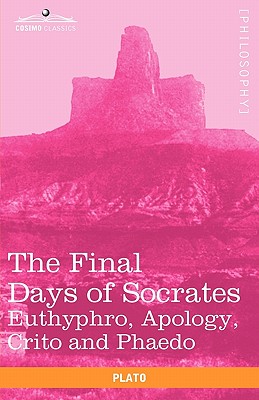
The Final Days of Socrates: Euthyphro, Apology, Crito and Phaedo
| AUTHOR | Plato; Jowett, Benjamin |
| PUBLISHER | Cosimo Classics (03/01/2011) |
| PRODUCT TYPE | Paperback (Paperback) |
Description
The Final Days of Socrates is a book of four dialogues by Plato-Euthyphro, Apology, Crito, and Phaedo-centering, as most of Plato's dialogues do, around Socrates. These four dialogues cover the time leading up to Socrates' trial and through his death and depiction of the afterlife. Euthyphro concerns Socrates and Euthyphro, a known so-called religious expert, as they try to determine a definition for piety. Apology is Plato's version of Socrates' speech as he defends himself against the criminal charges of corrupting the youth and not believing in the same deities as the state. The Crito is a dialogue between Socrates and a friend about justice, injustice, and the reaction to injustice. Finally Phaedo, one of Plato's most famous Socratic dialogues, depicts the death of Socrates and his argument for the existence of an afterlife. All four works are also included in the Cosimo omnibus editions of The Works of Plato. One of the greatest Western philosophers who ever lived, PLATO (c. 428-347 B.C.) was a student of Socrates and teacher of Aristotle. Plato was greatly influenced by Socrates' teachings, often using him as a character in scripts and plays (Socratic dialogues), which he used to demonstrate philosophical ideas. Plato's dialogues were and still are used to teach a wide range of subjects, including politics, mathematics, rhetoric, logic, and, naturally, philosophy.
Show More
Product Format
Product Details
ISBN-13:
9781616403690
ISBN-10:
1616403691
Binding:
Paperback or Softback (Trade Paperback (Us))
Content Language:
English
More Product Details
Page Count:
138
Carton Quantity:
58
Product Dimensions:
5.50 x 0.32 x 8.50 inches
Weight:
0.40 pound(s)
Country of Origin:
US
Subject Information
BISAC Categories
Philosophy | General
Descriptions, Reviews, Etc.
publisher marketing
The Final Days of Socrates is a book of four dialogues by Plato-Euthyphro, Apology, Crito, and Phaedo-centering, as most of Plato's dialogues do, around Socrates. These four dialogues cover the time leading up to Socrates' trial and through his death and depiction of the afterlife. Euthyphro concerns Socrates and Euthyphro, a known so-called religious expert, as they try to determine a definition for piety. Apology is Plato's version of Socrates' speech as he defends himself against the criminal charges of corrupting the youth and not believing in the same deities as the state. The Crito is a dialogue between Socrates and a friend about justice, injustice, and the reaction to injustice. Finally Phaedo, one of Plato's most famous Socratic dialogues, depicts the death of Socrates and his argument for the existence of an afterlife. All four works are also included in the Cosimo omnibus editions of The Works of Plato. One of the greatest Western philosophers who ever lived, PLATO (c. 428-347 B.C.) was a student of Socrates and teacher of Aristotle. Plato was greatly influenced by Socrates' teachings, often using him as a character in scripts and plays (Socratic dialogues), which he used to demonstrate philosophical ideas. Plato's dialogues were and still are used to teach a wide range of subjects, including politics, mathematics, rhetoric, logic, and, naturally, philosophy.
Show More
Author:
Plato
Catalin Partenie is co-editor of Plato's Complete Works in Romanian (2001-2005).
Show More
Your Price
$15.43