
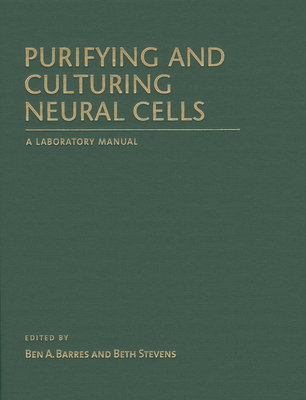
Purifying and Culturing Neural Cells: A Laboratory Manual
| AUTHOR | Stevens, Beth; Barres, Ben A.; Barres, Ben A. et al. |
| PUBLISHER | Cold Spring Harbor Laboratory Press (11/30/2013) |
| PRODUCT TYPE | Hardcover (Hardcover) |
Description
Composed of countless neurons, glia, and vascular cells, the nervous system innervates all parts of the body to function as a vast communication network. This complexity makes it challenging to examine neural properties at the cellular and molecular levels. Cell culture systems for specific neural cell types are thus essential for studies of their development and function.
This laboratory manual provides step-by-step protocols for isolating specific cell populations from rodent tissues and culturing them under conditions that closely resemble those in vivo. The contributors describe in detail how to dissect the brain, spinal cord, and other tissues; how to separate cells using mechanical and enzymatic tissue-dissociation strategies; the use of immunopanning and fluorescence-activated cell sorting (FACS) to enrich the target cell population; and the culture conditions that optimize cell viability and growth. Retinal ganglion cells, motor neurons, dorsal root ganglion cells, astrocytes, oligodendrocytes, and Schwann cells are covered, as are vascular cells such as pericytes and endothelial cells. Myelinating cocultures of neurons and oligodendrocytes are also described.
The manual includes detailed recipes for media and reagents, tips for avoiding common pitfalls, and advice for designing new immunopanning protocols using tissues from other sources. Many of the protocols are accompanied by freely accessible online movies that demonstrate critical steps of the procedures. This is an essential laboratory companion for all neurobiologists, from the graduate student level upward.
This laboratory manual provides step-by-step protocols for isolating specific cell populations from rodent tissues and culturing them under conditions that closely resemble those in vivo. The contributors describe in detail how to dissect the brain, spinal cord, and other tissues; how to separate cells using mechanical and enzymatic tissue-dissociation strategies; the use of immunopanning and fluorescence-activated cell sorting (FACS) to enrich the target cell population; and the culture conditions that optimize cell viability and growth. Retinal ganglion cells, motor neurons, dorsal root ganglion cells, astrocytes, oligodendrocytes, and Schwann cells are covered, as are vascular cells such as pericytes and endothelial cells. Myelinating cocultures of neurons and oligodendrocytes are also described.
The manual includes detailed recipes for media and reagents, tips for avoiding common pitfalls, and advice for designing new immunopanning protocols using tissues from other sources. Many of the protocols are accompanied by freely accessible online movies that demonstrate critical steps of the procedures. This is an essential laboratory companion for all neurobiologists, from the graduate student level upward.
Show More
Product Format
Product Details
ISBN-13:
9781621820116
ISBN-10:
1621820114
Binding:
Hardback or Cased Book (Sewn)
Content Language:
English
More Product Details
Page Count:
205
Carton Quantity:
1
Product Dimensions:
8.50 x 0.70 x 11.00 inches
Weight:
2.05 pound(s)
Feature Codes:
Bibliography,
Index,
Dust Cover,
Table of Contents,
Textbook,
Illustrated
Country of Origin:
US
Subject Information
BISAC Categories
Science | Life Sciences - Biochemistry
Science | Life Sciences - Cell Biology
Science | Life Sciences - Human Anatomy & Physiology
Dewey Decimal:
571.638
Library of Congress Control Number:
2013021663
Descriptions, Reviews, Etc.
publisher marketing
Composed of countless neurons, glia, and vascular cells, the nervous system innervates all parts of the body to function as a vast communication network. This complexity makes it challenging to examine neural properties at the cellular and molecular levels. Cell culture systems for specific neural cell types are thus essential for studies of their development and function.
This laboratory manual provides step-by-step protocols for isolating specific cell populations from rodent tissues and culturing them under conditions that closely resemble those in vivo. The contributors describe in detail how to dissect the brain, spinal cord, and other tissues; how to separate cells using mechanical and enzymatic tissue-dissociation strategies; the use of immunopanning and fluorescence-activated cell sorting (FACS) to enrich the target cell population; and the culture conditions that optimize cell viability and growth. Retinal ganglion cells, motor neurons, dorsal root ganglion cells, astrocytes, oligodendrocytes, and Schwann cells are covered, as are vascular cells such as pericytes and endothelial cells. Myelinating cocultures of neurons and oligodendrocytes are also described.
The manual includes detailed recipes for media and reagents, tips for avoiding common pitfalls, and advice for designing new immunopanning protocols using tissues from other sources. Many of the protocols are accompanied by freely accessible online movies that demonstrate critical steps of the procedures. This is an essential laboratory companion for all neurobiologists, from the graduate student level upward.
This laboratory manual provides step-by-step protocols for isolating specific cell populations from rodent tissues and culturing them under conditions that closely resemble those in vivo. The contributors describe in detail how to dissect the brain, spinal cord, and other tissues; how to separate cells using mechanical and enzymatic tissue-dissociation strategies; the use of immunopanning and fluorescence-activated cell sorting (FACS) to enrich the target cell population; and the culture conditions that optimize cell viability and growth. Retinal ganglion cells, motor neurons, dorsal root ganglion cells, astrocytes, oligodendrocytes, and Schwann cells are covered, as are vascular cells such as pericytes and endothelial cells. Myelinating cocultures of neurons and oligodendrocytes are also described.
The manual includes detailed recipes for media and reagents, tips for avoiding common pitfalls, and advice for designing new immunopanning protocols using tissues from other sources. Many of the protocols are accompanied by freely accessible online movies that demonstrate critical steps of the procedures. This is an essential laboratory companion for all neurobiologists, from the graduate student level upward.
Show More
Editor:
Stevens, Beth
Beth Stevens is a teacher who loves to make learning easy for struggling students who don t have the skills they need to succeed. She has been a specific learning disabilities teacher at the primary level for more than 20 years. Beth is a fifth-generation Floridian and comes from a long line of teachers. Terri Heidger and Beth Stevens are The Apron Ladies and co-authors of Become a Good Reader: Six Simple Steps and Ready-to-Go Comprehension: Easy Activities for All Readers.
Show More
List Price $135.00
Your Price
$133.65