
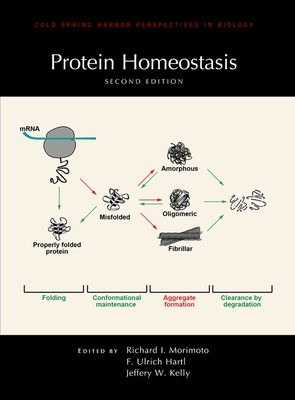
Protein Homeostasis, Second Edition
| AUTHOR | Hartl, Franz-Ulrich; Kelly, Jeffery W.; Hartl, Franz-Ulrich et al. |
| PUBLISHER | Cold Spring Harbor Laboratory Press (06/30/2019) |
| PRODUCT TYPE | Hardcover (Hardcover) |
Description
The entire life cycle of a protein-from synthesis and folding to transport and degradation-is carefully controlled by the proteostasis network. This network, consisting of many interconnected pathways and processes, manages protein homeostasis by dynamically responding to the needs of the cell. Stress and aging can challenge the proteostasis network, resulting in the aggregation of misfolded proteins-a feature of numerous neurodegenerative conditions. Written and edited by experts in the field, this collection from Cold Spring Harbor Perspectives in Biology provides a comprehensive update on how the proteostasis network functions in healthy cells and the diseases that result when protein quality control goes awry. The contributors examine the relevant biochemical attributes of proteins (e.g., solubility), the functions of normal protein aggregates (e.g., biofilm formation in bacteria), and the various heat shock proteins, chaperones, translocation machineries, proteasomes, signaling factors, and transcriptional programs involved in proteostasis. The roles of specific subcellular structures-the endoplasmic reticulum, mitochondria, ribosomes, lysosomes, and cytoplasm-in protein quality control are covered, as is the regulation of proteostasis at the organismal level (e.g., via neuronal activity). Discussions of the responses by cells when errors in protein quality control occur, the medical disorders that can result (e.g., Alzheimer disease), and pharmacologic approaches to ameliorate protein conformational disorders are also included. This book is therefore an essential reference for biochemists, cell biologists, and all biomedical scientists wishing to understand the pathological consequences of and potential therapies for proteostasis deficiencies in common human diseases.
Show More
Product Format
Product Details
ISBN-13:
9781621822967
ISBN-10:
1621822966
Binding:
Hardback or Cased Book (Sewn)
Content Language:
English
Edition Number:
0002
More Product Details
Page Count:
562
Carton Quantity:
8
Product Dimensions:
7.30 x 1.30 x 10.30 inches
Weight:
3.00 pound(s)
Feature Codes:
Bibliography,
Index,
Dust Cover,
Illustrated
Country of Origin:
US
Subject Information
BISAC Categories
Science | Life Sciences - Biochemistry
Science | Life Sciences - Cell Biology
Science | Biochemistry
Dewey Decimal:
572.6
Library of Congress Control Number:
2018061087
Descriptions, Reviews, Etc.
publisher marketing
The entire life cycle of a protein-from synthesis and folding to transport and degradation-is carefully controlled by the proteostasis network. This network, consisting of many interconnected pathways and processes, manages protein homeostasis by dynamically responding to the needs of the cell. Stress and aging can challenge the proteostasis network, resulting in the aggregation of misfolded proteins-a feature of numerous neurodegenerative conditions. Written and edited by experts in the field, this collection from Cold Spring Harbor Perspectives in Biology provides a comprehensive update on how the proteostasis network functions in healthy cells and the diseases that result when protein quality control goes awry. The contributors examine the relevant biochemical attributes of proteins (e.g., solubility), the functions of normal protein aggregates (e.g., biofilm formation in bacteria), and the various heat shock proteins, chaperones, translocation machineries, proteasomes, signaling factors, and transcriptional programs involved in proteostasis. The roles of specific subcellular structures-the endoplasmic reticulum, mitochondria, ribosomes, lysosomes, and cytoplasm-in protein quality control are covered, as is the regulation of proteostasis at the organismal level (e.g., via neuronal activity). Discussions of the responses by cells when errors in protein quality control occur, the medical disorders that can result (e.g., Alzheimer disease), and pharmacologic approaches to ameliorate protein conformational disorders are also included. This book is therefore an essential reference for biochemists, cell biologists, and all biomedical scientists wishing to understand the pathological consequences of and potential therapies for proteostasis deficiencies in common human diseases.
Show More
List Price $33.75
Your Price
$33.41