
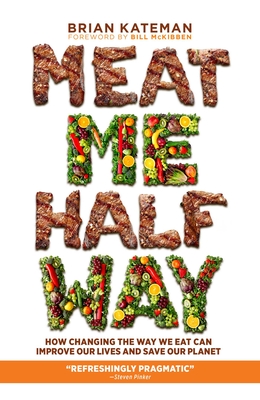
Meat Me Halfway: How Changing the Way We Eat Can Improve Our Lives and Save Our Planet
| AUTHOR | Kateman, Brian; McKibben, Bill |
| PUBLISHER | Prometheus Books (04/22/2022) |
| PRODUCT TYPE | Hardcover (Hardcover) |
Description
We know that eating animals is bad for the planet and bad for our health, and yet we do it anyway. Ask anyone in the plant-based movement and the solution seems obvious: Stop eating meat. But, for many people, that stark solution is neither appealing nor practical. In Meat Me Halfway, author and founder of the reducetarian movement Brian Kateman puts forth a realistic and balanced goal: mindfully reduce your meat consumption. It might seem strange for a leader of the plant-based movement to say, but meat is here to stay. The question is not how to ween society off meat but how to make meat more healthy, more humane, and more sustainable. In this book, Kateman answers the question that has plagued vegans for years: why are we so resistant to changing the way we eat, and what can we do about it? Exploring our historical relationship with meat, from the domestication of animals to the early industrialization of meatpacking, to the advent of the one-stop grocery store, the science of taste, and the laws that impact our access to food, Meat Me Halfway reveals how humans have evolved as meat eaters. Featuring interviews with pioneers in the science of meat alternatives, investigations into new types of farming designed to lessen environmental impact, and innovations in ethical and sustainable agriculture, this down-to-earth book shows that we all can change the way we create and consume food.
Show More
Product Format
Product Details
ISBN-13:
9781633887916
ISBN-10:
163388791X
Binding:
Hardback or Cased Book (Sewn)
Content Language:
English
More Product Details
Page Count:
248
Carton Quantity:
36
Product Dimensions:
6.32 x 0.83 x 9.30 inches
Weight:
1.18 pound(s)
Feature Codes:
Bibliography,
Price on Product,
Illustrated
Country of Origin:
US
Subject Information
BISAC Categories
Science | Environmental Science (see also Chemistry - Environmental)
Science | Philosophy & Social Aspects
Science | Diet & Nutrition - General
Dewey Decimal:
641.36
Library of Congress Control Number:
2021042411
Descriptions, Reviews, Etc.
publisher marketing
We know that eating animals is bad for the planet and bad for our health, and yet we do it anyway. Ask anyone in the plant-based movement and the solution seems obvious: Stop eating meat. But, for many people, that stark solution is neither appealing nor practical. In Meat Me Halfway, author and founder of the reducetarian movement Brian Kateman puts forth a realistic and balanced goal: mindfully reduce your meat consumption. It might seem strange for a leader of the plant-based movement to say, but meat is here to stay. The question is not how to ween society off meat but how to make meat more healthy, more humane, and more sustainable. In this book, Kateman answers the question that has plagued vegans for years: why are we so resistant to changing the way we eat, and what can we do about it? Exploring our historical relationship with meat, from the domestication of animals to the early industrialization of meatpacking, to the advent of the one-stop grocery store, the science of taste, and the laws that impact our access to food, Meat Me Halfway reveals how humans have evolved as meat eaters. Featuring interviews with pioneers in the science of meat alternatives, investigations into new types of farming designed to lessen environmental impact, and innovations in ethical and sustainable agriculture, this down-to-earth book shows that we all can change the way we create and consume food.
Show More
Foreword by:
McKibben, Bill
Bill McKibben is an author and environmentalist. His 1989 book The End of Nature is regarded as the first book for a general audience about climate change, and has appeared in 24 languages. He is founder of 350.org, the first planet-wide, grassroots climate change movement. The Schumann Distinguished Scholar in Environmental Studies at Middlebury College and a fellow of the American Academy of Arts and Sciences, he was the 2013 winner of the Gandhi Prize and the Thomas Merton Prize, and holds honorary degrees from 18 colleges and universities; Foreign Policy named him to their inaugural list of the world's 100 most important global thinkers, and the Boston Globe said he was "probably America's most important environmentalist." A former staff writer for the New Yorker, he writes frequently a wide variety of publications around the world, including the New York Review of Books, National Geographic, and Rolling Stone. He lives in the mountains above Lake Champlain with his wife, the writer Sue Halpern.
Show More
List Price $26.95
Your Price
$26.68