
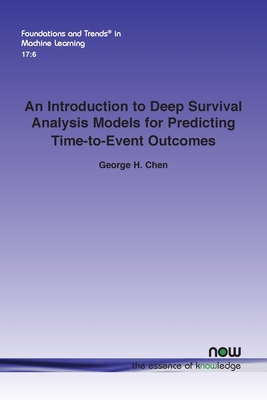
An Introduction to Deep Survival Analysis Models for Predicting Time-To-Event Outcomes
| AUTHOR | Chen, George H. |
| PUBLISHER | Now Publishers (01/02/2025) |
| PRODUCT TYPE | Paperback (Paperback) |
Description
The earliest research into time-to-event outcomes can be dated back to the 17th century. Here the initial focus was predicting time until death, hence the term survival analysis. Applications of time-to-event outcomes are to be found in many walks of life, such as insurance, medicine, and even calculating when will a customer end their subscription. Recently, the machine learning community has made significant methodological advances in survival analysis that take advantage of the representation learning ability of deep neural networks. At this point, there is a proliferation of deep survival analysis models. In this monograph, the author provides a self-contained modern introduction to survival analysis. The focus is on predicting time-to-event outcomes at the individual data point level with the help of neural networks. They provide the reader with a working understanding of precisely what the basic time-to-event prediction problem is, how it differs from standard regression and classification, and how key "design patterns" have been used time after time to derive new time-to-event prediction models. The author also details two extensions of the basic time-to-event prediction setup, namely the competing risks setting and the dynamic setting. The monograph concludes with a discussion of a variety of topics such as fairness, causal reasoning, interpretability, and statistical guarantees. This timely monograph provides researchers and students with a succinct introduction to the use of time-to-event outcomes in modern artificial intelligence driven systems.
Show More
Product Format
Product Details
ISBN-13:
9781638284543
ISBN-10:
1638284547
Binding:
Paperback or Softback (Trade Paperback (Us))
Content Language:
English
More Product Details
Page Count:
192
Carton Quantity:
40
Product Dimensions:
6.14 x 0.41 x 9.21 inches
Weight:
0.61 pound(s)
Country of Origin:
US
Subject Information
BISAC Categories
Computers | Machine Theory
Computers | Data Science - Machine Learning
Descriptions, Reviews, Etc.
publisher marketing
The earliest research into time-to-event outcomes can be dated back to the 17th century. Here the initial focus was predicting time until death, hence the term survival analysis. Applications of time-to-event outcomes are to be found in many walks of life, such as insurance, medicine, and even calculating when will a customer end their subscription. Recently, the machine learning community has made significant methodological advances in survival analysis that take advantage of the representation learning ability of deep neural networks. At this point, there is a proliferation of deep survival analysis models. In this monograph, the author provides a self-contained modern introduction to survival analysis. The focus is on predicting time-to-event outcomes at the individual data point level with the help of neural networks. They provide the reader with a working understanding of precisely what the basic time-to-event prediction problem is, how it differs from standard regression and classification, and how key "design patterns" have been used time after time to derive new time-to-event prediction models. The author also details two extensions of the basic time-to-event prediction setup, namely the competing risks setting and the dynamic setting. The monograph concludes with a discussion of a variety of topics such as fairness, causal reasoning, interpretability, and statistical guarantees. This timely monograph provides researchers and students with a succinct introduction to the use of time-to-event outcomes in modern artificial intelligence driven systems.
Show More
List Price $99.00
Your Price
$98.01