
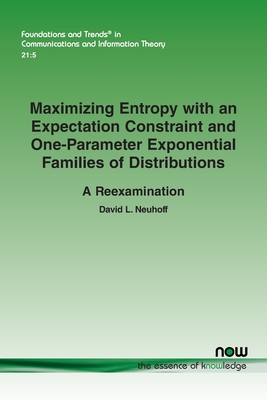
Maximizing Entropy with an Expectation Constraint and One-Parameter Exponential Families of Distributions: A Reexamination
| AUTHOR | Neuhoff, David L. |
| PUBLISHER | Now Publishers (12/09/2024) |
| PRODUCT TYPE | Paperback (Paperback) |
Description
The usual answer to the question "What probability distribution maximizes entropy or differential entropy of a random variable X subject to the constraint that the expected value of a real-valued function g applied to X has a specified value ?" is an exponential distribution (probability mass or probability density function), with g(x) in the exponent multiplied by a parameter ?, and with the parameter chosen so the exponential distribution causes the expected value of g(X) to equal . The latter is called moment matching. While it is well-known that, when there are multiple expected value constraints, there are functions and expected value specifications for which moment matching is not possible, it is not well-known that this can happen when there is a single expected value constraint and a single parameter. This motivates the present monograph, whose goal is to reexamine the question posed above, and to derive its answer in an accessible, self-contained and complete fashion. It also derives the maximum entropy/differential entropy when there is a constraint on the support of the probability distributions, when there is only a bound on expected value and when there is a variance constraint. Properties of the resulting maximum entropy/differential entropy as a function of are derived, such as its convexity and its monotonicities. Example functions are presented, including many for which moment matching is possible for all relevant values of , and some for which it is not. Indeed, there can be only subtle differences between the two kinds of functions. As one-parameter exponential probability distributions play a dominant role, one section provides a self-contained discussion and derivation of their properties, such as the finiteness and continuity of the exponential normalizing constant (sometimes called the partition function) as ? varies, the finiteness, continuity, monotonicity and limits of the expected value of g(X) under the exponential distribution as ? varies, and similar issues for entropy and differential entropy. Most of these are needed in deriving the maximum entropy/differential entropy or the properties of the resulting function of . Aside from addressing the question posed initially, this monograph can be viewed as a warmup for discussions of maximizing entropy/differential entropy with multiple expected value constraints and of multiparameter exponential families. It also provides a small taste of information geometry.
Show More
Product Format
Product Details
ISBN-13:
9781638284802
ISBN-10:
1638284806
Binding:
Paperback or Softback (Trade Paperback (Us))
Content Language:
English
More Product Details
Page Count:
272
Carton Quantity:
28
Product Dimensions:
6.14 x 0.57 x 9.21 inches
Weight:
0.85 pound(s)
Country of Origin:
US
Subject Information
BISAC Categories
Computers | Information Theory
Computers | Computer Science
Descriptions, Reviews, Etc.
publisher marketing
The usual answer to the question "What probability distribution maximizes entropy or differential entropy of a random variable X subject to the constraint that the expected value of a real-valued function g applied to X has a specified value ?" is an exponential distribution (probability mass or probability density function), with g(x) in the exponent multiplied by a parameter ?, and with the parameter chosen so the exponential distribution causes the expected value of g(X) to equal . The latter is called moment matching. While it is well-known that, when there are multiple expected value constraints, there are functions and expected value specifications for which moment matching is not possible, it is not well-known that this can happen when there is a single expected value constraint and a single parameter. This motivates the present monograph, whose goal is to reexamine the question posed above, and to derive its answer in an accessible, self-contained and complete fashion. It also derives the maximum entropy/differential entropy when there is a constraint on the support of the probability distributions, when there is only a bound on expected value and when there is a variance constraint. Properties of the resulting maximum entropy/differential entropy as a function of are derived, such as its convexity and its monotonicities. Example functions are presented, including many for which moment matching is possible for all relevant values of , and some for which it is not. Indeed, there can be only subtle differences between the two kinds of functions. As one-parameter exponential probability distributions play a dominant role, one section provides a self-contained discussion and derivation of their properties, such as the finiteness and continuity of the exponential normalizing constant (sometimes called the partition function) as ? varies, the finiteness, continuity, monotonicity and limits of the expected value of g(X) under the exponential distribution as ? varies, and similar issues for entropy and differential entropy. Most of these are needed in deriving the maximum entropy/differential entropy or the properties of the resulting function of . Aside from addressing the question posed initially, this monograph can be viewed as a warmup for discussions of maximizing entropy/differential entropy with multiple expected value constraints and of multiparameter exponential families. It also provides a small taste of information geometry.
Show More
List Price $99.00
Your Price
$98.01